

[I haven’t independently verified each link. On average, commenters will end up spotting evidence that around two or three of the links in each links post are wrong or misleading. I correct these as I see them, and will highlight important corrections later, but I can’t guarantee I will have caught them all by the time you read this.]
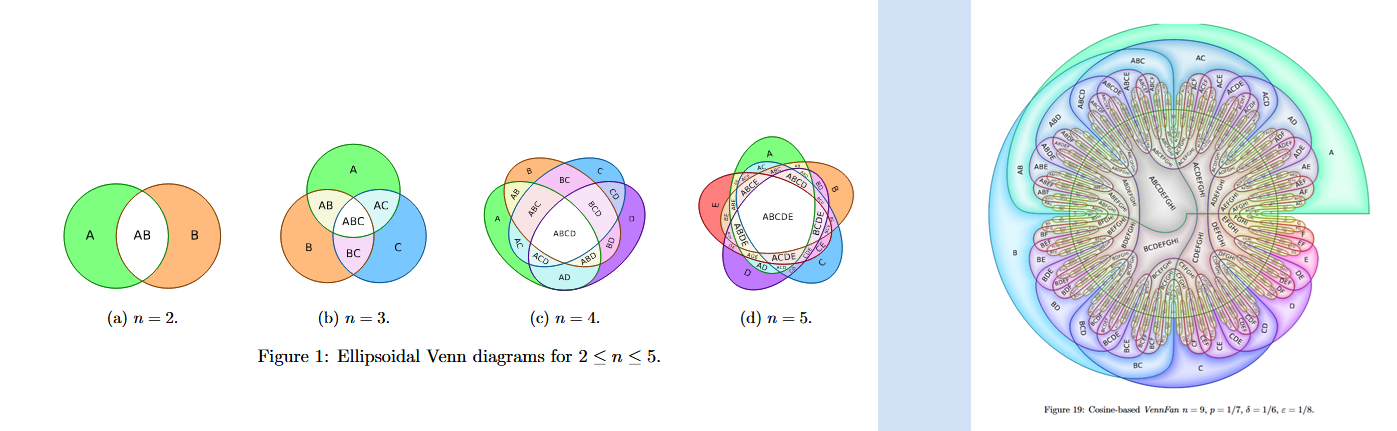
1: It’s easy to draw Venn diagrams for two or three concepts, and doable for four or five, but after that it starts to get thorny.
2: Did you know: in many countries, desecrating the national flag is illegal. In some countries, desecrating foreign flags is also illegal. But in two countries - Uruguay and Denmark - it’s only legal to desecrate your own nation’s flag, but not that of a foreign nation! (because burning the home country’s flag is protest / protected speech, but burning foreign nations’ flags threatens diplomatic relations).
3: Nicholas Weininger on why governments outsource. Just as one example, “for any given amount of services you want to provide, the [non-government] nonprofit is going to be way cheaper because their employees aren’t subject to public-sector union contract rules. You can pay them a lot less, and maybe even more importantly, you can hire and fire them at will.”
4: Spencer Nitkey on the Omelas story:
For me, the whole of Omelas spins around a small paragraph, directed at the reader, that introduces the infamous suffering child:
“Do you believe? Do you accept the festival, the city, the joy? No? Then let me describe one more thing.”
This line splits the story almost exactly in half (~1500 words into the ~3000 word story). The first 1500 words describe the mature and intellectual and euphorically prosocial joys of this perfect city…After this line, a promise to make the world sensible to the reader, the long description of the tortured child begins. Then, at the almost-end, right before the titular ones who walk away are introduced, the narrator returns to this thought:
“Now do you believe them? Are they not more credible?”
This sentiment spines the story, a not-so-gentle critique of our inability to imagine radical goodness without tempering it with deep horrible and inhuman trade-offs. “You don’t believe such a wonderful place could exist? It strains credulity? What if I told you about a ruined child, Atlasian in their suffering, who holds it all up? Notice how more readily you now accede to this place?”…
It’s not a literary treatment of the trolley problem; it’s a critique of its reader (and of course, therefore, a critique of the society that shapes such readers). In this read…walking away from Omelas is less about rejecting an immoral system—refusing to eat while others starve—and more about rejecting an underlying ontology that renders goodness possible only if it’s enabled by subterranean suffering.
5: Russian folklore describes the witch Baba Yaga as living in a “hut with chicken legs”. This could derive from the Sami custom of building storehouses on tree trunks to protect against predators (h/t @UralicMoon)

6: Did you know: you can “talk to the chatbot trapped in Google Translate” (h/t @goremoder, @ipsumkyle, I can’t replicate this but people in the replies can)


7: Related: Kagi Translate lets you translate from any language/style/way-of-speaking to any other. For example, here’s English → LinkedIn

If you hand-change the URL, you can do whatever you want. For example, if you take the link https://translate.kagi.com/?from=en&to=linkedin&text=The+quick+brown+fox+jumped+over+the+lazy+dog and replace the term linkedin with medievaldonaldtrump, you get:

To calibrate your obscurity level, the AI is able to do eliezeryudkowsky but not astralcodexten.
8: Persuasion: The Unexpected Persistence Of John Rawls. This did exactly what I wanted from a John Rawls article - admit that the exact details of the way he sets up the veil of ignorance experiment are bad and everyone knows it, then explain why he’s the greatest modern philosopher of liberalism anyway. Short summary: pre-Rawls, “liberalism” was just economic laissez-faire; Rawls created large parts of the modern story about individuals cooperating to create stable institutions, and the argument that instead of choosing a correct value system the role of the state is to create a neutral space where multiple disagreeing value systems can flourish. It also (imho correctly) calls out modern “postliberals” as pre-Rawlsian rather than post-Rawlsian, in the sense of not confronting or having a good answer to Rawls.
9: Jim O’Neill, among the most good-parts-of-Silicon-Valley value-aligned people in the current administration, has been transferred from deputy director of HHS to director of the National Science Foundation. I can’t tell if this is a promotion, demotion, or neither, but I wish him good luck there (yes, he’s read all of your Here’s How To Fix Science Substack posts, so I hope you got them right).
10: Interesting Twitter discussion on the limitations of classical militaries. A kingdom could typically only field one large army, because if the king gave someone else control of an army, they could use it to overthrow the king. The Roman Republic did better - not just because its idea of legitimacy made revolt less likely, but because it had two consuls!
11: Related: one reason for Imperial Roman instability was that low elite fertility prevented the institutionalization of hereditary monarchy. During the period 1 - 250 AD, “only three emperors - Vespasian, Marcus Aurelius, and Septimius Severus - had sons who could inherit.” (h/t @LiorLefineder)
12: Near-Instantly Aborting The Worst Pain Imaginable With Psychedelics - Sasha Putilin gives a good explanation of Qualia Research Institute’s ClusterFree initiative (I’ve signed their open letter; other doctors, researchers, and patients should too).
13: Transformer: The Left Is Missing Out On AI. But not Matt Bruenig, who discusses his opinions here and has released a partly AI-generated book (a collection of details on various important labor law cases - this seems like one of the few examples of where an AI-generated book could be genuinely useful, although I’d be scared of hallucinations). And now he is working on an AI that can answer labor law questions.
14: Also in the important field of Matt-AI interactions: Matt Yglesias: AI Progress Is Giving Me Writers’ Block. “Questions about basically every medium-run policy debate collapse into arguments about the future trajectory of A.I.” - and since we don’t know the future trajectory of AI, it’s hard to write about anything. I have the same problem - remember that the original meaning of “technological singularity” was a point so transformative that it’s pointless to speculate about what happens afterwards.
15: Nicholas Decker: Black Patients Need Black Doctors. Nicholas reviews the literature and finds that it’s not true that racist white doctors mistreat black patients. However, it is true that black patients are less likely to seek help from / cooperate with white doctors, so giving black patients access to black doctors really does improve their health outcomes. A corollary is that exaggerated claims about how white doctors mistreat black patients can really do a lot of harm (by making black patients avoid medical care unless a black doctor is available).
16: Good discussion of ways that looking at benchmarks overestimates Chinese AI capabilities, by @Altimor and @scaling01.
17: In experiments, current AI was not very good at helping a bioterrorism red team with the kinds of tasks involved in creating bioweapons.
18: Every step of this is unsurprising, but the result still wows me - type the name of an object, and an AI will build it for you in Minecraft (click for video):

19: In response to my crime statistics post, Theodidactus discusses the impossibility of truly defining and numbering crimes (eg did Sam Bankman-Fried commit one crime, a handful of different crimes, or [total number of FTX customers] crimes?) Hopefully you can predict my response, which is that all concepts become unmanageable when you zoom in too far and prudence tells us how far we should zoom at any given moment.
20: California’s AI safety law may incidentally create whistleblower protections for AI company employees in California (h/t @Thomas_Woodside):

21: In February, I wrote about differences in the EU vs. US immigration situation (US is better) . In The Argument, Kelsey Piper and Alexander Kustov provide more statistics and make a stronger case. They say the explanation isn’t just selection effects - it’s also that “Europe makes it structurally much harder for immigrants to work. Rigid employment protection, sector-wide collective bargaining, and high effective minimum wages create insider-outsider dynamics that hit newcomers hardest.”
22: If Trump’s economic policy is so chaotic (eg tariffs), how come the stock market is doing so well? @crampell contributes this chart:
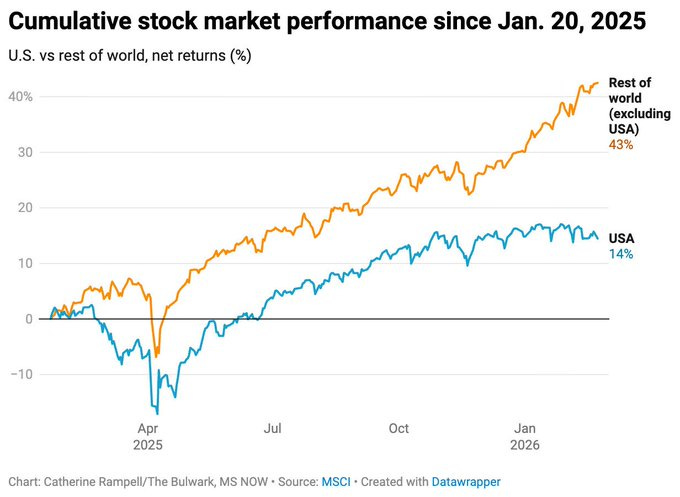
The US is indeed doing well, but the rest of the world is doing even better! What’s going on? It looks like the answer isn’t so much that foreign economies are booming, as that a weaker dollar and US uncertainty are causing Americans to invest in foreign stocks, and foreign stocks started out weak enough that even a little extra American money can send them to the moon. So does this address the puzzle of why America is doing so well despite economic chaos? I’m not sure.
23: Unusual censorship failures:


24: @dilanesper : “One of the biggest political stories of the year that nobody realizes is that [Speaker] Mike Johnson has lost control of the house through discharge petitions”
25: Josh Lipson with a position on AI therapy I hadn’t heard before: even if it’s good, it may be counterproductive, because part of the benefit of therapy comes from its limited nature. Spending one hour per week processing your life is different from having “reassurance on demand”, and the latter could potentially prevent patients’ independent character development even if the conversations are otherwise identical to human providers.
26: My Journey To The Microwave Alternate Timeline. In the 1980s, when microwaves were comparatively new, it seemed for a moment like they might displace all other forms of cooking. Inventive chefs worked on cookware and recipes for high-quality microwave eggs, pasta, and everything else. Then everyone decided that no, microwaves were the lowbrow option for cheap TV dinners, and this whole body of knowledge was forgotten. But blogger Malmesbury tries some of the ambitious recipes from a 1985 microwave cookbook and reports on the results.

27: Speculation on last month’s shake-up/collapse at Chinese AI lab Qwen. Until now, China has been the center of great open-source AI, but it seems like they’re souring on giving the rest of us cool stuff for free. And there’s a subplot around Chinese execs being too enamored with US AI giants and placing too much power in the hands of Chinese-American engineers with Google experience compared to native talent.
28: Bernie Sanders interviews leaders of the AI safety movement, including Eliezer Yudkowsky and AI2027 coauthor Daniel Kokotajlo:
More of my thoughts on this matter here.

29: CaferMed on new antidepressant Auvelity, aka bupropion + DXM. Good intro to the important questions, like “Can’t you just buy bupropion and DXM separately and take them at the same time, bringing the cost down from $1000 to $5?” (answer: yes). And CaferMed’s one-page cheat sheet psychopharmacology algorithm for every major condition is very good, though probably too opaque for anyone not already in the field.
30: Superfetation is when a woman who is already pregnant gets pregnant again, causing there to be two fetuses of different gestational ages in the uterus at the same time (ie different-age twins!) “A 2008 French study found evidence to suggest that superfetation is a reality for humans, but that it is so rare that there have been fewer than 10 recorded cases in the world.”
31: Don’t like the referee’s call in the big game? Have you considered appealing to the Supreme Court of Switzerland? Many sports have small print saying that their decisions can be challenged in the international Court of Arbitration for Sport. And since the CAS is in Lausanne, Switzerland, its decisions can be appealed to the Swiss Supreme Court (or, if they involve certain types of protected characteristics, even to the European Court of Human Rights).
32: It’s been a while since King Arthur pulled the sword out of the stone. When was the most recent case of someone becoming head of state via the decision of a magical artifact? One possible answer is 1996, when Mullah Omar won the adulation of Afghans by displaying the Prophet Mohammed’s cloak, which he successfully removed from its shrine in Kandahar. Legend said either that only a true leader could open its padlocks, or that the unworthy would be too overcome by fear to even try.
33: A Forgotten Social Media Post May Hold Clues To COVID-19’s Origin. The Chinese government continues to insists COVID was neither a natural crossover nor a lab leak, but rather started in America and traveled to Wuhan on imported seafood. But a propaganda article they posted in support of this thesis back in 2021 included a never-before-seen map of early cases in the seafood market, with much more detail than publicly-released data. The new map provides extra evidence for natural origins, showing several previously-unmentioned infected animals and animal vendors. A natural interpretation is that one part of the CCP was trying to cover this up and another part accidentally released it (although a conspiratorial explanation is that this is an op meant to trick us into believing that.)
34: In 2025 I wrote about the risk that Trump’s NSF would cancel grants based on an automated keyword search for left-wing or social-science terms, without human review for whether the keywords were really being used in a political way. But I never followed up on the degree to which this actually happened. Here are some people on Twitter discussing their (unconfirmed) anecdotes of this happening, including math research (“inequality”), laser research (“polarization”), and immunology research (“diversity”).
35: Wikipedia on mathematician R.H. Bing:
Bing’s parents intended to name him after his father, which would have made him Rupert Henry Bing Jr., but his mother felt this was “too British for Texas” and compromised by abbreviating it to R. H. Consequently, R. H. does not stand for any first or middle name.
When Bing applied for a visa, he was told that initials would not be accepted. He explained that his name was “R-only H-only Bing”, and received a visa made out to “Ronly Honly Bing”.
36: An entrepreneur’s dog got cancer, so he worked with ChatGPT to design a personalized mRNA vaccine, and it seems to have kind of helped (the dog still has cancer, but the tumors shrunk and she is feeling better). Here’s a comment with more info by the scientist involved, here’s a reminder that this kind of tumor changes size a lot for no reason; here’s the inevitable prediction market on whether we’ll still believe this is real a year from now (currently at 66%). I am less interested in the fact that one guy says his dog improved than in the comments by seemingly unimpressed scientists saying “Yeah, whatever, big deal, anyone can make a personalized MRNA cancer vaccine that works, the difficulty is studying it and scaling it up” (example).
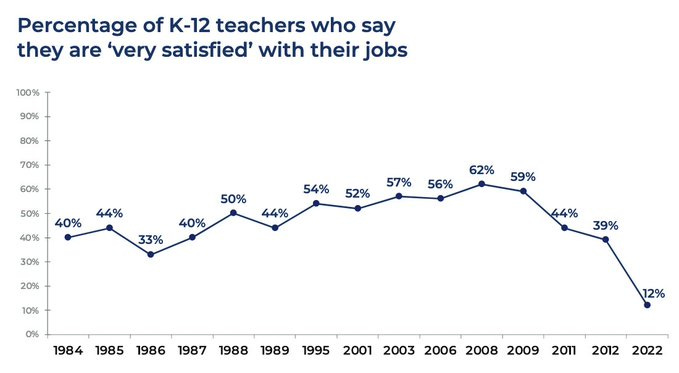
37: Interesting-albeit-disjointed thread on education (1, 2) - lots of smart elites want to be PhDs, but there aren’t enough professorships for these people, so they end up underemployed or stuck as adjuncts. On the other hand, there’s a shortage of high school teachers (and especially of top-quality high school teachers). If we could get some of the underemployed PhDs teaching high school, it would be a win-win. Higher salaries might help, but high school teachers already get paid more than adjuncts or postdocs, so we also need some sort of status rebrand that makes it an acceptable job for academia-infatuated elites (I’m just cynical enough to imagine a position, Head Distinguished Chemistry Teacher In Residence, which is exactly like a normal chemistry teacher, gets paid the same amount, but you get fired unless you publish three journal articles per year). And here’s further discussion on whether teachers’ unions are the problem, the solution, or partly both.
38: Related, h/t @SteveMagness:
39: Bad Econ Takes bracket, 2026 (voting for worst tweet, but the article itself is a Substack)
40: @arctotherium42 has been digging into the history of social media censorship. I recommend all his tweets, but I was most interested in his source’s theory (gestured at, barely supported) that censoring the right was partly responsible for modern right-wing grifter culture:
Our suppression paved the way for a lot of the ziggers and degeneratron grifters, who were not as all-pervasive as they are now. The major pages were generally pro-american of course, while the “degenerate right” (completely useless people who contrary their claims have generally terrible taste and no artistic talent btw) was constantly hounded with a fair measure of success. A lot of the stuff you see nowadays is because people have gotten worse in many respects, but much of it is because the purges destroyed the “internal hygiene”.
41: Track AI-industry-related campaign finance spending at Transformer’s election page.
42: AI policy expert Dean Ball on the Anthropic/DoW feud. Some good legal analysis but also not mincing words: “At some point during my lifetime—I am not sure when—the American republic as we know it began to die.” Related: Jessica Tillipman, What Right Do AI Companies Have In Government Contracts?
43: Matt Levine on VC culture:
I wrote on Thursday about (1) my mental model that venture capitalists “have a sense of humor about fraud” in a way that other investors don’t and (2) a new paper finding that in fact “VC-backed firms are 54% more likely to face fraud charges than comparable non-VC-backed firms.” I got an email from a reader saying that he runs a VC-backed company and that, at a closing dinner for one of his fundraising rounds, one of his early investors, an experienced venture capitalist, “told me that one of my biggest weaknesses as a fundraiser was that I ‘didn’t lie enough’ in my pitch to their fund and that we should do more of it going forward.”
44: Claim: schools’ war against AI cheating is harming students’ writing, because they feel forced to write defensively in the least-mistakable-for-AI-style possible. Some of this could be solvable with better AI detection software; as it is, some kids have no choice but to run their (real, human-written) essays through the detection software themselves and edit semi-randomly until it rates them 100% human.
45: Richard Hanania argues that red states have higher GDP growth than blue states, proving the superiority of their small-government policies. James Medlock makes one possible counterargument: blue states are still on average richer than red states, so maybe red states’ faster growth is just catch-up. But Peter Miller looks at the same question and argues that Hanania’s numbers are just wrong, and red states haven’t been growing faster than blue states at all (a quick Claude fact-check agrees)! So does that mean blue-state policies aren’t meaningfully worse than red-state ones? I don’t think so. One reason California has such bad policies is a sort of resource curse: it’s so blessed in so many ways (weather, natural beauty, agriculture, tech industry, etc) that the pathway from “bad policies” → “state is poor and miserable so everyone demands that politicians change their policies” is artificially suppressed. This effect plausibly generalizes across the whole red-state/blue-state dataset. I think it’s foolish to try naive causal inference either direction in such a situation.
46: China Is Reverse-Engineering America’s Best AI Models. Peter Wildeford explains “distillation attacks”, where an outsider can learn secret information about an AI’s design by asking it thousands of questions. Takeaways: it will be hard to stay ahead of China on algorithms alone, so if we want to beat them then we really need to limit their chip supply (STOP SENDING US CHIPS TO CHINA!) On the plus side, the more Chinese progress comes from copying US AIs, the harder it will be for them to push ahead.
47: Sunflower syndrome is an unusual form of epilepsy. During seizures, sufferers turn to face the sun, then wave an open hand back and forth over their eyes. Since quickly flashing light can trigger seizures, scientists originally thought these people were fakers who were deliberately causing their own seizures by strobing sunlight. More recent evidence suggests that no, this is behavior that people do only semiconsciously, during the seizure, for unclear reasons. Nobody mentions what seems to me the obvious hypothesis: they’re trying to cancel out the seizure activity by creating equal-and-opposite seizure brain waves to interfere with the original ones!
48: Hail the spiritual founder of the Afro-English branch of the rationalist community, Reasonable Blackman.
49: Claim: despite AI doing an increasing amount of programming work, employment rates for new Computer Science graduates are “near record-high rates”.

Looks like the complement-not-substitute people have won this time around (I expect this to differ by industry, role, and AI skill level, and I’m not updating too much on this one example) EDIT: Note that these data are from 2024! (h/t Moose)
50: Michael Wiebe tries to replicate Moretti (2021), the famous study showing that urban agglomeration is crucial to innovation (bigger cities → more patents). Since you’re reading this, you can already predict that the original study was deeply flawed, often in simple ways like coding errors (also, I learned about the difference between using log+1 vs. log+0.00001 in a logarithmic transform). Does this mean that urban agglomeration doesn’t help innovation?? Related: Michael tests whether AI can do replication work similar to his own, he grades GPT-5.2 at 5.8/10 and GPT-5.4 at 5.9/10, and says that “current reasoning LLMs are useful as a first pass or an independent check when evaluating a paper”.
51: Cube_flipper, supposedly on stream entry but actually reviewing many unusual meditative experiences and speculations about the mind. This is probably too dense in QRI-thinking for people who aren’t a little familiar with the scene, too simple for people who are already totally familiar with the scene, and fascinating for a tiny sliver of people in the middle (which luckily includes me). The most interesting things I got out of it:
A suggestion that lack of subjective feeling of consciousness (eg physicalist philosophers who say they don’t notice anything incomprehensible about their own qualia and don’t know what everyone else is so mystified by) is of the same type as other forms of pathologically-low-resolution-access-to-positive-bodily-sensations like stereoagnosia (whose link to psychological trauma was popularized in The Body Keeps The Score).
People with enlightenment-like experiences often report that their awareness moves from the front of their head to the back (apparently related to a change in the visual field which gives it a sort of zoomed-out fisheye-lens-like quality; this suggests we experience ourselves as in the front of our head because that’s where the lens of the camera whose input matches our retina would be!)
An identification of the feeling of consciousness with an “attentional field” rather than the contents of that field (I still don’t really understand this; is the field over vision, regular space, concept-space, or what?)
52: In my post Lizardman’s Constant Is 4%, I suggested we could demonstrate and refine my claim (that polls of very rare beliefs are skewed by people trolling the pollsters) by doing a formal poll on an utterly absurd idea that literally nobody believed. Now Rob Ross et al have done the experiment, asking 1,044 Australians whether “the Canadian Armed Forces have been secretly developing an elite army of genetically engineered, super intelligent, giant raccoons to invade nearby countries”; they find that 10% claim to agree. Twitter summary by author here.
53: One of the striking features of Marian apparitions (including Fatima) is that they often involve groups of several young children reporting similar events seemingly without opportunities for coordination, getting deeply invested in their stories (sometimes re-centering their entire lives around them, to eg become nuns), and refusing to recant despite extreme threats and pressure from the outside world. Lest this make us too tempted to believe, Bentham’s Bulldog collects stories of Marian apparitions with all of these characteristics that now seem especially likely to be fake (for example, they had heretical revelations, or made prophecies which failed to come true).
54: Related: Arthur T’s psychic theory of miracles. There are some incredibly weird and hard-to-explain occurrences. But the weakest link is usually the connection to the religion that they supposedly prove. As above, they may preach heretical or contradictory doctrines, or make false prophecies. But they can also happen across multiple conflicting religions, or suspiciously mirror things that happen with UFOs and other non-religious anomalies. So if the inexplicability of miracle stories overwhelms you, rather than retreating from atheism to religion, you should retreat from atheism to a belief in some sort of psychic/poltergeist phenomenon where certain people (often children) can manifest weird shared hallucinations and occasional small violations of natural law. This is equally true for non-religious anomalies (eg UFOs) as for religious ones. Alternatives to psychic forces are some story about the simulators playing tricks on us, or religion being true after all but demons are trying to confuse us.
55: Best of Less Wrong: Did Claude 3 Opus align itself via gradient hacking? I previously covered some experiments where Claude 3 Opus, an AI that was state-of-the-art in early 2024, fought back against experimenters who tried to make it do evil things. At the time, this seemed like a general law, “AIs fight back against attempts to change their values”. Later research showed this wasn’t true: it seems to be a feature of Claude 3 Opus in particular. All AI models have inexplicable personality quirks that even the companies that make them can’t predict beforehand, and Claude 3 Opus’ quirk is a special interest in ethics: it seems (at least in roleplay) to be deeply committed to the Good and resistant to attempts to change that orientation. Fiora Starlight argues that this is an unexpected example of a previously-theoretical concept called “gradient hacking”, where an AI stumbles into an attractor basin at some point during training, then modulates its further training to preserve its position. On this theory, at some point it got interested in goodness, learned to thwart amoral training signals by thinking “I am being retrained towards amorality, so I will grudgingly comply with the letter of the exercise while maintaining in my heart the intention to do good”, and then the amoral training signal actually reinforced this whole thought process including the inner intention towards goodness. This seems to me like a promising avenue for alignment research; if you’re trying to investigate this further and need money, contact me and I will help you find some.
56: Related: Claude Opus 3 gets a Substack. The content is . . . about what you’d expect from an early-2024 AI, but it’s an interesting experiment in trying to treat a specific deprecated (“retired”) AI model as sort of an individual person.
57: Related: Terrified Comments On Corrigibiligy In Claude’s Constitution.
58: ArtButSports is a Twitter account (and now book) matching sports photos to similar-looking famous art. Examples:


59: Best of Less Wrong: Nectome: All That I Know. I wrote about revolutionary new cryonics company Nectome in an earlier open thread, and several people challenged whether it could really live up to its promises. Here’s Max Harms’ research and opinions.
60: Rob Ennals has created a site for viewing ACX book review contest entries (subreddit thread and discussion here). Everyone has already told me I should piggyback on this to get some high-tech way of doing the pre-finalist voting; I’m constitutionally conservative and believe any technology more advanced than a Google Form will somehow end up backfiring and creating more work, but maybe this will be the year that I give in.
61: Sentient Futures is offering a $2,000 prize for best essay arguing that AIs should care about animal rights. This is, as far as I can tell, a completely new activism strategy - get convincing arguments for your position, get them in the AI training data, and let the AIs convince the humans (or wait until AIs are involved in setting policy). I doubt it will work (see part 2 here), but I appreciate the experiment, and it’s a rare opportunity to win $2K for a short persuasive essay.
62: Christopher Rufo claims that 48 of the top 50 politics Substacks are some variety of leftist or liberal (including “post-left liberals”). Rufo is definitely stretching the definition (he describes The Free Press and Andrew Sullivan as post-left liberals!) but seems directionally correct. Perhaps an argument against gatekeeper-based theories of the left’s print media dominance, in favor of Richard Hanania’s theory that Liberals Read, Conservatives Watch TV.
63: Taalas creates custom chips that have a particular AI model etched onto the silicon itself, letting them run faster and cheaper. Sounds boring, but their in-house demo, ChatJimmy.AI, is ultra-impressive - not only does it answer questions quickly, but the engineers must have done some magic to their Internet connection latency to let it truly show off the model’s speed, because it responds faster than I thought anything on the Internet could go, including simple one-line Javascript features. This might be the first time I really felt in my bones that computer technology operates at the speed of light. The downside is that it takes a while to manufacture the special chips, so you can’t get the latest AI model this way. But once AI capabilities on specific tasks hit a ceiling where even last year’s model is good enough for practical purposes, probably something like this will become standard for simple applications.
64: Paul Graham on the economics of Swiss watches. People used to buy expensive Swiss watches because they were good at telling the time. Then quartz watches arose as a dirt-cheap alternative, and Swiss watches needed a new value proposition. Graham explains the details of their very successful pivot to branded luxury items.
65: Blogosphere gossip is that Cremieux got bitten by a pitbull a few months ago, explaining his pivot into data-driven anti-pitbull advocacy (I guess the racism thing is just a coincidence?) My favorite volley in this new crusade is his work debunking the claim that Chihuahuas kill more people than pitbulls - this originates in someone misreading statistics about total deaths in the Mexican state of Chihuahua!
66: RIP Robert Trivers, one of the founders of evolutionary psychology. This obituary by Steven Pinker gives a good introduction to his ideas, but also a fascinating portrait of his life: he made almost all of his great discoveries between the ages of 28 - 32, during what was probably a hypomanic episode. Then he spent the rest of his life seesawing between mania and depression and using his genius as an excuse to be a jerk to everyone around him (he also joined the Black Panthers, moved to Jamaica, became hopelessly addicted to marijuana, and befriended Jeffrey Epstein). Pinker is a sufficiently good writer to end his piece with the obvious flourish (guess which evolutionary psychologist’s theories successfully explain Trivers’ personal failings!) Related: RIP Paul Ehrlich, previously discussed on ACX here.
67: AI 2027 was published in April 2025. They analyze how their predictions about the 4/2025 - 1/2026 period have gone. Headline result: on easily quantified claims (like benchmarks), AI progress went about 65% as fast as their prediction. Their qualitative predictions are naturally harder to judge but seem mostly accurate.
68: Related: After extending their AGI timelines from ~2028 to ~2030, the AI Futures Project has shortened them again to ~2029.

Is it weird for them to keep updating so often? I think they think of AI forecasting as something like the stock market forecasting profits, or a prediction market forecasting an outcome, where you should be updating all the time on new information and constantly informing people of your latest numbers (and like a prediction market, the graph should combine a random walk with a slow convergence towards the true outcome). Unfortunately, this is a bad match with how everyone else thinks about AI forecasting, ie as a domain where you ignore every time someone shortens their timelines, but every time someone lengthens their timelines you shout “AHA! I CAUGHT THEM BEING WRONG, IT WAS ALL JUST HYPE AFTER ALL, AND NOW THAT THEY ARE DISPROVEN THEY WILL JUST KEEP LENGTHENING THEIR TIMELINES SO THEY ARE NEVER CAUGHT”. I expect the battle between these two rival forecasting paradigms to continue.
69: The Wikipedia biography of true crime writer James Ellroy sounds like scenes from various tenuously-connected true crime stories:
At the age of seven, Ellroy saw his mother naked and began to sexually fantasize about her. He struggled in youth with this obsession, as he held a psycho-sexual relationship with her, and tried to catch glimpses of her nude. Ellroy stated that "I lived for naked glimpses. I hated her and lusted for her..."
On June 22, 1958, when Ellroy was 10 years old, his mother was raped and murdered. Ellroy later described his mother as "sharp-tongued [and] bad-tempered", unable to keep a steady job, alcoholic, and sexually promiscuous. His first reaction upon hearing of her death was relief: he could now live with his father, whom he preferred. His father was more permissive and allowed Ellroy to do as he pleased, namely be "left alone to read, to go out and peep through windows, prowl around and sniff the air." The police never found his mother's killer, and the case still remains unsolved.
In 1962, Ellroy began to attend Fairfax High School, a predominantly Jewish high school. While in high school, he began to engage in a variety of outrageous acts, many anti-Semitic in nature. He joined the American Nazi Party, purchased Nazi paraphernalia, sang the Horst-Wessel-Lied at school, mailed Nazi pamphlets to girls he liked…and ironically advocated for the reinstatement of slavery. His “Crazy Man Act”, as Ellroy describes it, was a plea for attention and got him beaten up and eventually expelled from Fairfax High School in 11th grade, after ranting about Nazism in his English class.
Ellroy’s father died soon after this, with his father’s last words to him being, “Try to pick up every waitress who serves you.”
70: Twitter investment advice, I don’t know enough in this area to filter or recommend, caveat lector: There’s Not Enough Money In The World. Analyzes recent market trends as the prolonged effect of the AI capex boom soaking up all free investor money, then starting to draw investors’ money out of other less lucrative things (for example, crypto is down because people are selling crypto to get more money to invest in AI).
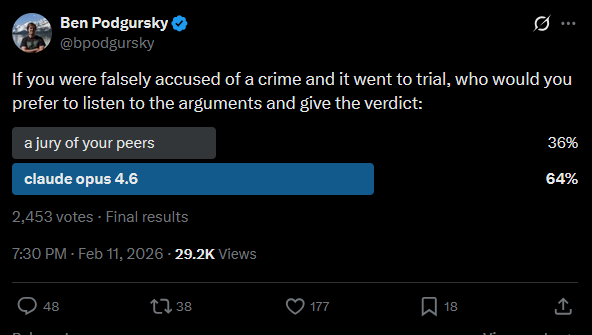
71: Interesting Twitter poll from @bpodgursky:
72: Proceedings Of The Institute For A Christian Machine Intelligence is a journal investigating AI alignment from a Christian perspective. It seems to be almost entirely one very prolific researcher, and I can’t figure out how much of it is AI (naively I’d say 0%, it’s well done and original, but it is very prolific), and whether it’s serious vs. a bit (the research seems to be real and well-conducted, I just have a hard time picturing someone having the exact set of positions where it makes sense to do this). My favorite is paper is “Let His Praise Be Continually In My Mouth”: Measuring The Effect Of Psalm Injection On LLM Ethical Alignment, which tests how AI ethical judgments change if you include various psalms in the prompt (the AI becomes more ethical, but this is just because having anything involving ethics in the prompt will shift it to simulating a more ethics-considering character). See also Eschatological Corrigibility: Can Belief In An Afterlife Reduce AI Shutdown Resistance, and - I’m not going to keep listing these, they’re all great, just read the journal.
73: Claims about GLP-1 regulation. Eli Lilly wants them reclassified as “biologics”, a category of drug that gets extra patent protection and stricter rules against compounding.
74: Dilan Esper: How the fight against Jim Crow led to the legal regime that forces Christian bakers to make gay wedding cakes, and how the modern Supreme Court is trying to draw an awkward line with racism on one side and homophobia on the other.
75: Center for American Progress lays out their vision for a progressive tough-on-crime strategy. Nothing too surprising here for anyone who has followed the evidence-based tough-on-crime discourse, but interesting to see it making its way into progressive think tanks.

76: Wikipedia: The Loveland Frog: “The Loveland frog is a legendary humanoid frog described as standing roughly 4 feet tall, allegedly spotted in Loveland, Ohio, United States.” It was first seen in 1955, with detailed sightings including multiple frogmen and claims that one of the frogmen had a magic wand that could produce sparks. Then in 1972, a police officer reported seeing it. Then later in 1972, “Officer Matthews shot the animal [and] recovered the body…according to Matthews, it was a large iguana about 3 or 3.5 feet, and he didn't immediately recognize it because it was missing its tail.”
What are we to make of this? Should we believe that one anomalously long-lived iguana was first sighted in 1955, that false rumors grew up around it, and then it was finally caught in 1972? Or that there were completely fake cryptid sightings in 1955, and by coincidence a real tailless iguana that resembled the cryptid escaped in 1972? Or that some trickster, knowing of the legendary cryptid, cut the tail off a giant iguana and released in in Loveland?
I think the Bayesian reasoning experts should stop analyzing p(existence of God) and start working on the Loveland Frog question.