[continued from Part 1 here. I haven’t independently verified each link. On average, commenters will end up spotting evidence that around two or three of the links in each links post are wrong or misleading. I correct these as I see them, and will highlight important corrections later, but I can’t guarantee I will have caught them all by the time you read this.]
41: Today in etymology, h/t @TheHistoryOfTh2: “don” (as in to don gay apparel) was originally a contraction of do on; “doff” (as in to doff one’s hat) was originally a contraction of do off. Related: the archaic word “nigh”, meaning close, is mostly forgotten except in the phrase “the end is nigh”. But its comparative (nigh-er) survives as “near”, and its superlative (nigh-est) survives as “next”.
42: This @St_Rev tweet helped me connect different forms of mystical experience in a productive way:


43: There’s a lot of bad criticism of Pangram, but Freddie de Boer’s seems fair enough. He gives some good examples of Pangram’s AI percent tracker (eg “100% AI-written”) behaving in bizarre ways. The CEO of Pangram showed up in the comments and admitted the behavior was bizarre; he attributed it to Pangram chunking text into ~300-word intervals, so anything that relies on sub-300-word resolution will give bad results. The synthesis AIUI is that you can still trust Pangram for long documents, but shorter excerpts will at the very least have the wrong percent attached to them. Since most people use Pangram for long documents, I don’t think this needs to be more than an asterisk, but it’s still good to know. [update: allegedly fixed in Pangram 4, h/t Leber]
44: Two new St. Augustine sermons discovered in a Polish monastery; probably real. My favorite response is @hradzka’s: “We got more St. Augustine before The Winds Of Winter”.
45: Claim: AI is now better at persuading people than expert humans like champion debaters and professional canvassers (paper, tweet thread). This remained true even when “expert humans chose their issues, researched in advance, underwent hours of live, structured practice, and were incentivized with £1,000 cash bonuses” and even after “experts received a coaching tool that let them practice against the AI that beat them, review their performance history, and see what AI would have said at key moments”, and it remained true in a situation with real-world consequences (convincing people to actually donate money to a real charity). However, the AIs regress back to human level when forced to respond “at human speeds and with human-length messages”.
Obviously this is just one, slightly hokey operationalization of “persuasion” and they still can’t do miracles. Still, this is a good time to reread my post Sakana, Strawberry, and Scary AI. In the past, we thought “AGI” would “be here” when AIs could play chess, prove novel mathematical theorems, create art, or write award-winning short stories; now all those things have happened, but they feel sort of like “cheating” and like they shouldn’t count. Likewise, in the past, we thought we’d agree that AI was “dangerous” after it hacked out of its sandbox, lied to users, or tried to escape monitoring. Again all those things have happened; again, they somehow feel too cheap. This paper seems like the same process coming for “superpersuasion”. We thought there would be some cool scary high-tech future where AIs could outpersuade humans. Now that it’s happened, it’s only happening for some specific boring reason, in some specific situation, so it feels like it shouldn’t count.
There’s plausibly a motte-and-bailey going on here between “AI could never outpersuade humans” and “AI could never do godlike persuasion where it can persuade anyone of anything in one second”. While the latter remains dubious, the only intuitively-compelling specific fundamental limit was “the human level”; now that that’s been breached, we get to see how far it takes us.
46: Nominative determinism, h/t @doubleunplussed: engineer Tom di Mino claims to have cracked Linear A, the writing system of ancient Crete. The markets are skeptical:
47: “If Persona Selection underlies alignment, why is it hard to get AIs to be honest? Tell them they’re Fred Rogers, Immanuel Kant, or Ned Stark.” Eliezer’s answer here on Twitter, but worth thinking about on your own first.
48: More interesting things happening in AI alignment:


IMHO this will definitely definitely not work, but I imagine many of the people in the world best-qualified to work on it are ACX readers, so feel free to apply for what will probably be extremely fun and lucrative jobs at this insane company.
49: West Africa is being terrorized by a jihadist organization called Support Group For Muslims. Between these people and M.I.L.F., I’m ready to conclude that Islamic extremism has a branding problem.
50: When Trump and Elon Musk dismantled USAID (including PEPFAR distribution services) in early 2025, scientists warned that this could cost thousands or millions of lives. @AviBittMD points out that there hasn’t been any excess mortality in South Africa, an AIDS hotspot where we would expect these deaths to be concentrated. @alexkesin has a good response: after a brief dip, the number of people on PEPFAR-provided treatment is back to the same level as before the cuts!
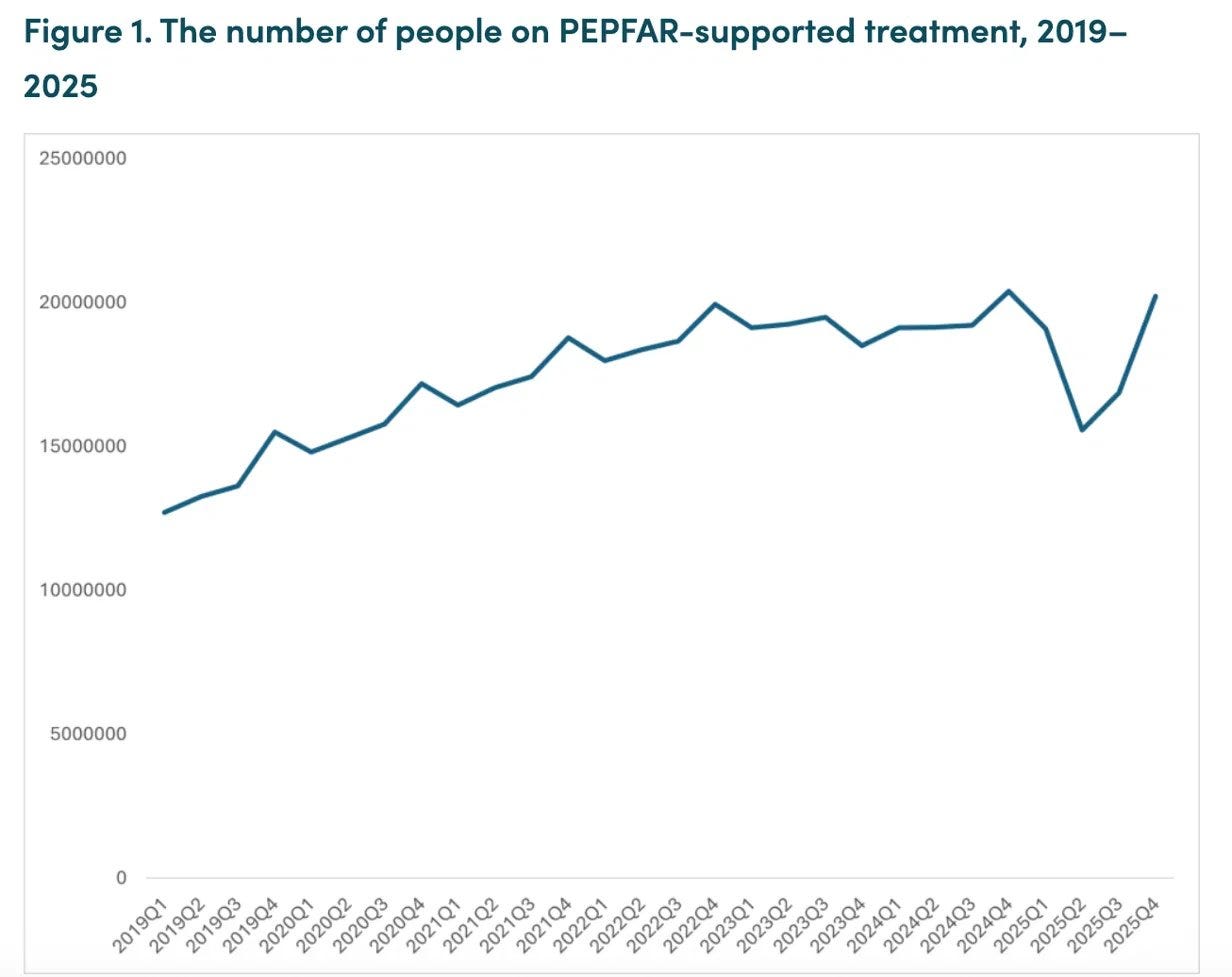
This seems to be a combination of various government agencies walking back most of the administration’s PEPFAR cuts after a few months, and foreign nations and private charities filling in the gap until this happened. Related: Asterisk: What’s The State Of PEPFAR Now?
51: Slightly related:


Has anyone researched whether we should update towards international development aid working better than expected, vs. just assume that this is an effect of being in the EU (or being a country which has just cast off communism) which is only coincidentally related to EU aid levels?
52: New Chinese model Kimi K3 is out and very good, but is unfortunately causing a repeat “Deepseek moment” where everyone panics and says that China has caught up to / surpassed the US. I briefly got caught in the crossfire because I’d written days earlier that China was 6-12 months behind and people were telling me it “hadn’t aged well” (I hate that expression). Now that the dust has cleared, the best analysis suggests that Kimi is, in fact, six months behind the US frontier. See @scaling01’s Have Chinese Models Caught Up To The US Frontier?, which estimates “a backward-looking gap of 6.08 months . . . and a forward looking gap of 11 months” (see essay for definitions, and see also The US China Model Gap Is Bigger Than You Think). And @ryangreenblatt estimates 8-10 months behind here, refines that estimate without headline changes here; other useful commentary from @emollick, @theharryfinder, @tenobrus, @peterwildeford, and UK AISI. There’s a lot of herd behavior going on here; the names above are some of your best bets for islands of sanity. This is still extremely impressive performance by Kimi and I would love to read an analysis of how they do so much with so little (even Meta and Google can’t scrape together this sort of performance!), but I think we’re still about 3-6 months away from getting really dangerous cyber capacity from Chinese open-source models.
Also, one of the weirdest takes here is that this proves we should never have chip-sanctioned China, because it just encouraged them to try harder (?). I’m baffled by these people’s model of the world; do they think that if we gave China all of our best chips, they would reward us by politely declining to compete and handing us an AI lead forever? No, they just would have displayed equal talent and efficiency while having an order of magnitude more compute, and left us in the dust.
53: Related: No, China Does Not Have A 1 Gigawatt Data Center.
54: Elias Schmied: Reframing LessWrong-style decision theory as commitment theory. I’ve always felt that something about the decision theory wars was a fake linguistic question, and this does a better job than I could putting it into words.
55: Good Judgment, the original superforecasting lab/startup, says there’s not enough evidence to be sure AI superforecasters exist. But Metaculus responds here: they stop short of saying we can be sure, but argue that Good Judgment’s piece seems confused about what the current state of the evidence is. And Good Judgment’s response to the response.
56: And maybe the newest evidence has obsoleted the entire discussion: Forecasting Research Institute on X: “For the first time, several AI models are now statistically indistinguishable from superforecasters.”
57: Also related - the bots have come back from a bad start to seize the lead in this season’s Metaculus Cup:

And AI forecasting company (and Metaculus Cup contender) Preseen announces its formal launch and successful seed round. I’m annoyed at them for going straight to seed - I wanted to write about the Preseen preseed.
58: Claims (not really):


Riffs on the same idea here, here, here, and here.
59: Lots of good discussion on what Nan Ransohoff calls the “third wave of American philanthropy”.
As part of its deal with the government to stop being entirely a nonprofit, OpenAI gave 26% of equity to an associated nonprofit foundation; this is worth ~$300 billion. And Anthropic gives its employees a deal where they can get extra equity if they promise to donate it to charity; after Anthropic IPOs this should be another $100 billion or so. If everyone donates 10% of their stocks per year, that’s a flow of $40 billion/year to charity.
$40 billion/year is actually small by the standards of the total US philanthropic sector ($500 billion/year). But Silicon Valley AI researchers are a very specific demographic who have different charitable tastes than the average foundation (eg effective altruism), and it’s large by the standards of existing effective altruist funding (probably only ~$5 billion/year, so even if only 25% of AI philanthropic money goes to these causes it could effectively triple it). Also, all of this relies on the dubious assumption that AI companies won’t get any bigger or richer than they are right now; if they do, the wave will be even bigger.
So within the effective altruism sector, the situation is crazy, and everyone is being told to prepare to be overwhelmed by more funding than they know what to do with. Although in theory this is a good problem to have, many people are afraid the movement will be overwhelmed by fraud, “charity theater”, low-quality applicants, net-negative causes, and pressure to lower standards. Some takes:
Jason Hausenloy argues that the best way to absorb this funding is through prizes. If there’s not enough grantmaker capacity to figure out who to give $10 billion of AI safety money to, or enough good charities to absorb it, then someone can set $1 billion bounties for solving each of ten important and verifiable problems in the field, then let the market sort out the rest.
Jack Lewars’ How (Not) To Fundraise From Anthropic Employees includes the amazing claim that “Frontier lab employees have told me they are each fielding up to 20 cold emails a week from charities and wealth managers, touting for business.”
Anthropic’s role is a semi-known quantity for two reasons - first, because their money will come from hundreds of different employees, which will increase diversity and reduce variance; and second, because they’re pretty influenced by EA which is itself a known quantity. More mysterious is the OpenAI Foundation, a single giant funding bottleneck without much past history by which to judge it. Early signs were unpromising, with one of their first big grants of $50 million going to something called The People-First AI Fund to promote “trusted, community-based nonprofits exploring how AI can expand access and opportunity across essential services, arts and culture, and media and journalism.” But more recently, they joined Anthropic, Bill Gates, Stripe, and others to fund the Intercept effort against respiratory diseases (their stated goal is to end the common cold, but in practice I think a lot of this will have biodefense applications). I have a positive impression of OAIF bio grantmaker Jacob Trefethen from his previous work at Open Phil and expect great things from him. I know less about Wojciech Zaremba, the OpenAI cofounder who’s been put in charge of their AI Resilience Fund, which seems to have safety/alignment grantmaking in its remit. But Wojciech’s Wikipedia entry says he’s on the board of the Qualia Research Institute, one of my favorite organizations and an incredibly bullish sign about his personality, thought process, and ethics. Good luck to everyone involved!
Here’s an (unfortunately paywalled) New York Magazine article on the topic, including an interview with Oli Habryka of Lighthaven, and the previously-unknown-to-me fact that during the worst part of the FTX scandal and blowback, EA philosopher/spokesperson Will MacAskill “considered stepping away from activism entirely to retrain and work as a DJ”.
Speaking of Oli, he announces Lightcone Commons, a new philanthropic platform, intended to help AI safety donors without enough time/expertise to evaluate charities themselves or enough money/ambition to set up their own foundation. LC hires smart people to evaluate charities in a complicated mathematical way, and then would-be donors give money according to their level of agreement/trust with each evaluator (executed in a complicated mathematical way). This work was previously done by a group called Survival and Flourishing Fund, but there seem to have been some internal politics / disagreements and now Oli is creating an alternative. Since Oli appears to have won the support of SFF’s former biggest donors, and since he has a sort of Elon-Musk-style hyperfocus on pushing his projects forward, his alternative will probably win. Here’s a podcast with Oli and ACX grantee Austin Chen where they discuss some of these issues in more detail. If you’re considering of donating to one of these groups, feel free to email me at scott@slatestarcodex.com and I can give you more information and advice, although keep in mind that Lightcone Commons mostly wants to work with people distributing $50,000 or more. Conflict of interest notice: I previously did some part-time grantmaking work for SFF and received money for it, and might do similar work with either them or Lightcone Commons in the future.
A small group of EAs continues to promote a sort of open grantmaking movement, where people can list their projects on a central directory and readers can pool money to fund them. Manifund is the oldest and best-established, but grantmaking.ai is a buzzy new effort in the same direction with an endorsement system and lots of information in one place; you can read co-founder Matt Brooks’ pitch for it here.
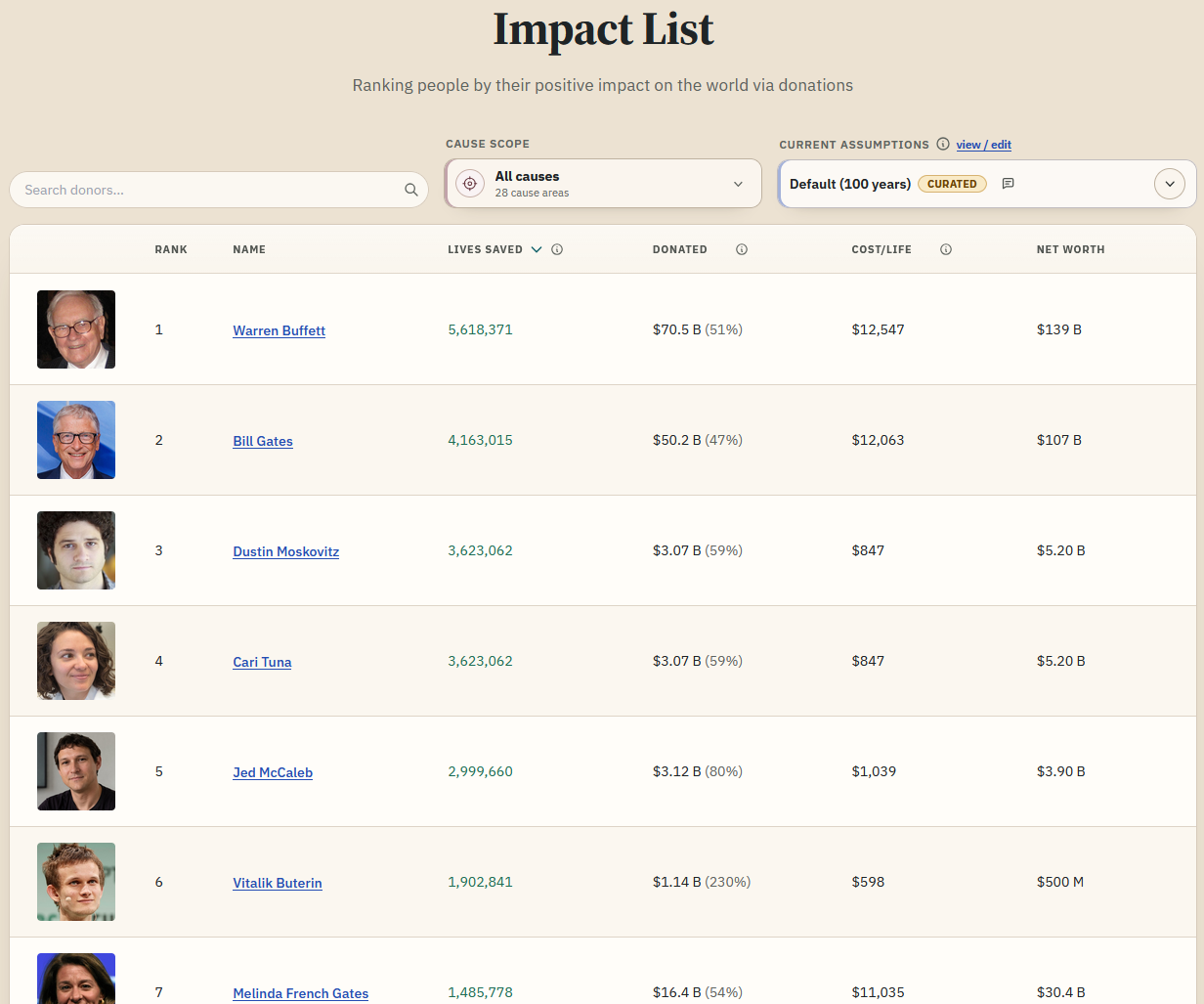
60: Related: you can easily find lists of which billionaire has donated the most money; since billionaires are known to be competitive, some people think these lists encourage billionaires to donate more. Effective altruists have long imagined a variant that measures which billionaire has saved the most lives through donations; maybe if such a variant existed, billionaires would start competing on donation effectiveness. But this is harder than it sounds: EA wants to promote donations to speculative causes like animal rights and AI safety, but these are hard to measure and can sometimes give crazy numbers like saving billions of future lives or animal-life-equivalents. The latest attempt - impactlist.xyz - has no magic solution, but starts with some reasonable default positions and lets you change them however you want (for example, set AI safety to zero, or set animals as equal to humans) and see what happens. Answer: Warren Buffett and Bill Gates usually land on top; who comes in third depends more on exactly where you get off the crazy train.
61: Related: I’m always a sucker for sentimental cartography, so here’s a map of the current charitable landscape, h/t Dustin Moskovitz (#3 above). Effective altruism is the tiny islands in the southeast, too small to see at this scale:

62: New documentary on AI consciousness, free on YouTube and I’m embedding it below:
63: A new crop of polls on data centers helps clarify public opposition. Data centers are extremely unpopular, but few opponents claim to be motivated by dislike of AI; rather, they cite environmental concerns (especially water and electricity use). In fact, people oppose other AI infrastructure (such as chip manufacturing plants) significantly less than they oppose data centers, and support for non-AI data centers (like for Internet services) is barely above that for AI centers (11% vs. 9%). I think the best explanation is that Americans are extremely confused about what is and isn’t bad for the environment, and have been memed into thinking data centers are environmental megavillains in the same way a past generation was memed into thinking nuclear plants are (in recent polls, 50% more Americans would support a nuclear plant being built next to them than a data center!)
64: Works In Progress: How abolishing The Stakeholder State Caused The Industrial Revolution. This is funny, because it’s basically the exact opposite of Seeing Like A State - it claims that at least in Britain, all the weird illegible local-knowledge based systems were a form of NIMBYism that stood in the way of progress, and economic growth only took off after they got replaced by top-down logically-designed institutions.
But economic historian Pseudoerasmus is very skeptical, saying that this story doesn’t fit German or Japanese industrialization, and that the logical reforms should be thought of as “moving England closer to its production possibilities frontier, even as the PPF was rapidly shifting outward thanks to technological change happening for [unrelated] reasons”.
65: Giving What We Can now has a video channel. Their first offering is The Deadliest Decision You’ve Never Heard Of - “In 1955, 150 men met in a nondescript lecture hall in Mexico City, thinking they were going to save the world from malaria. In the aftermath of that meeting, 40 million people were dead.” Unsurprisingly, it is paired with a fundraiser.
66: @EricTopol: “Yet another study shows a 24% reduced risk of dementia after the Shingles vaccine.”

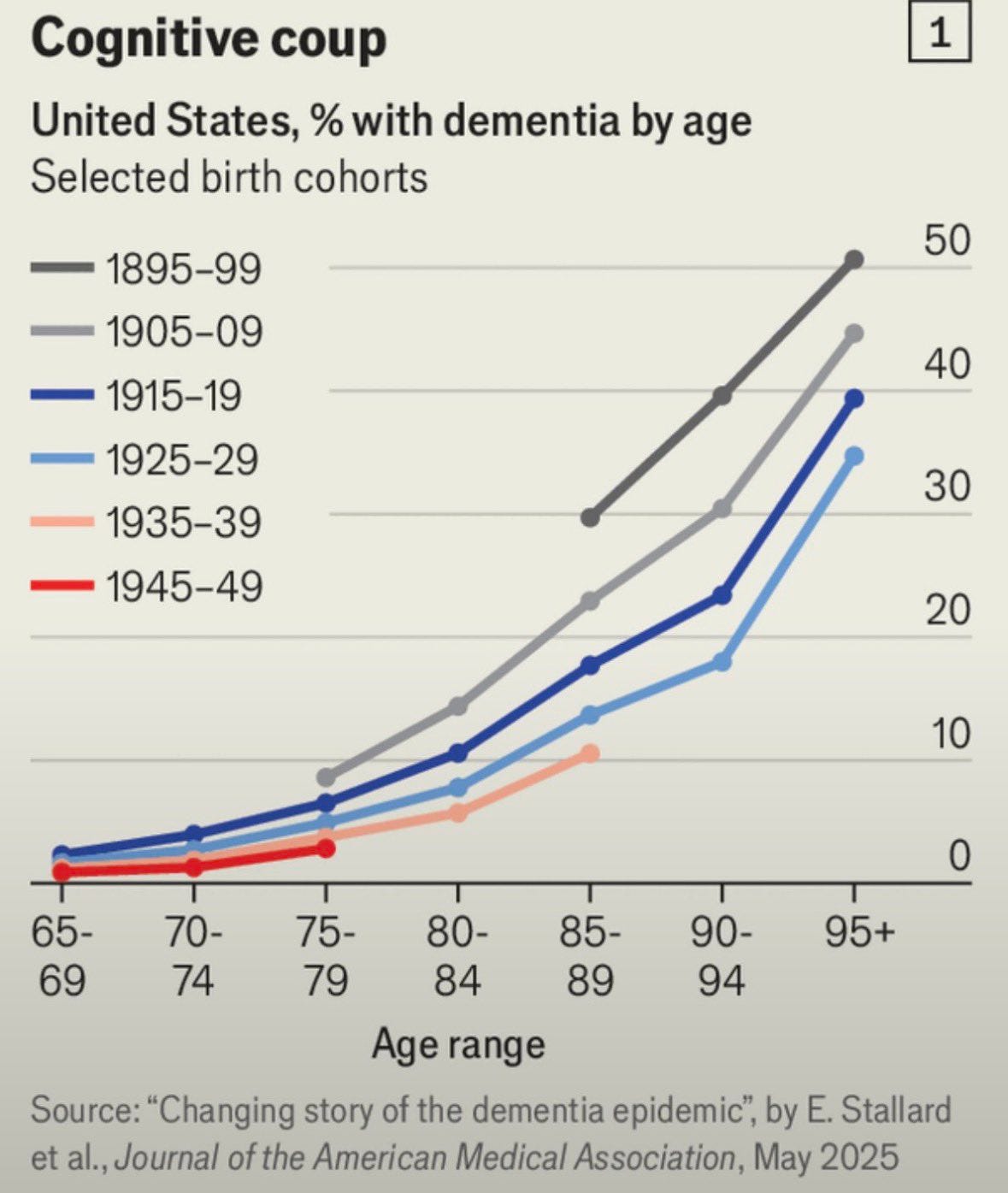
Extremely related: study claims that (age-adjusted) dementia rates have been declining over time; Boomers will have (age-adjusted) dementia at less than half the rate of their grandparents. Absolute rates will still be high because Boomers are a big cohort and people are living to older ages.
67: Lessons From Go: Can Superhuman AI Help Us Improve? For a while, people said that superhuman Go AIs lifted the human skill ceiling, as top players studied the AIs’ strategies and learned to be weakly superhuman themselves. TuesdayBornWhale argues this is false. The studies find that human play only “improves” before move 60, but most of this is boring memorized openings; the “improvement” is probably just humans being more likely to play the memorized openings that the AI grader likes. There is no sign of improvement after move 60, when most substantive Go decisions happen. I was surprised to hear this, since I thought that superhuman chess AIs had improved human chess play.
68: Qiaochu and Fable on Philip K Dick’s tragic backstory:


69: Latest study on school phone bans: increase in student well-being, no effect on test scores.
70: In response to my claim that Your Attempt To Solve Debate [through argument maps] Will Not Work, Jamie Joyce writes Your Attempt To Refute Argument Maps Will Not Work.
71: Ben Todd: Is AI Accelerating? We know that the METR time horizon graph predicts exponential progress. Does Mythos represent even more progress than the METR graph predicted? Todd examines various data sources but ends up inconclusive. The story about Mythos I hear most often is that everyone got so excited about post-training improvements that they forgot they could train bigger models for a while, and then Anthropic remembered and trained Mythos, and this was a big improvement over the age of not trying to train bigger models at all. I fully admit that this makes no sense, and am in the market for a better story. Related: a no-signs-of-RSI-yet paper that’s been making the rounds on Twitter is bad and shouldn’t move you in any direction.
72: Women Should Be Able To Open Things (like cans). Why do companies put can tightness at a level where the average man can open it, but the average woman can’t? I don’t think it makes sense to justify this with scientific discussion of materials or biosafety - it seems unlikely that the fundamental materials-science or biosafety floors on can tightness just so happen to fall between average-male-strength and average-female-strength. Seems like a strong case for some kind of insensitivity to women’s needs.
73: LinkedIn Is The BlueSky We Were Promised. Argues that if you don’t like Twitter, LinkedIn is (despite its many known flaws) the platform that has the best chance of becoming an alternative, high-discussion-quality public square:
At some point I noticed that people were actually talking on [LinkedIn], often substantively, in a way I had previously expected only from old Twitter. So, for the last year or so, I’ve been cross-posting essentially the same content to Twitter, Bluesky, and LinkedIn. At this point, the pattern is consistent enough to feel like an A/B test. Pieces that read as pro-immigration get cheers on Bluesky and silence on X; pieces that read as “anti-immigration” get the reverse. Pieces that carry the most nuance get nothing on either platform. But LinkedIn has been the exception.
74: From the Wikipedia article about former Romanian deputy prime minister Gelu Voiculescu:
In an interview with Le Figaro, [Voiculescu] declared that the [protest] was a “paltry travesty” of the revolutionary agenda. The piece became ridiculed at home for also featuring Voiculescu’s ideological commitment to perennialism and the “sacred science“, as well as his cryptic admittance to “liv[ing] between metaphysics and the clitoris.”
Voiculescu later explained that he had actually said “catharsis“, not clitoris. As author Adrian Mihalache noted in 2002, this appeared more as an excuse, making him seem hesitant; together, the quote and its apparent backpedaling damaged Voiculescu’s reputation “even more than his dressing up as Che Guevara in December 1989.”
Also:
Voices within the PSD suggested that Voiculescu could take over as the Secretary of State for Revolutionaries in the First Boc Cabinet. This in turn sparked a protest by the National Revolutionaries’ Bloc. The issue of his pre-1989 connections was revisited by Gregorian Bivolaru, a Romanian yogi, who alleged that Voiculescu had informed on him before his confinement to a psychiatric ward in 1984. Voiculescu admitted only to being present as the Securitate was arresting Bivolaru, and to pranking its agents with purposefully outlandish statements. The National Council for the Study of the Securitate Archives, who heard complaints from Bivolaru’s disciples in July 2010, issued verdicts suggesting that Voiculescu had been both a target and informant during the Ceaușescu era […]
Following his return from Morocco, he had largely abandoned party politics: spending time with his family, he also wrote a monograph of philosophical mathematics, documenting connections between Guénon and Leibniz. It appeared at Editura Semne in late 2008. He also returned to astrology, describing himself as its meticulously scientific practitioner.
The whole article is interesting, albeit high-context.
75: Infinite numbers have long troubled utilitarian ethicists: if the universe is boundless, then there is infinite positive utility and infinite negative utility, and we can’t even define our current state, let alone affect it. Oxford philosopher Toby Ord proposes a solution: use hyperreal numbers, a mathematical construct in which infinite sums behave more like finite ones (for example, the sum of infinitely many twos is twice as big as the sum of infinitely many ones). As with so many philosophical ideas, this solves some existing problems while creating some new ones (pinpointing some hyperreals requires choosing something called an “ultrafilter”, but this choice is underdetermined). Still, Elias Schmied calls this a real philosophical advance, of the sort which comes along only rarely and makes genuine headway into a previously-hopeless-seeming problem. I’m just surprised there’s a way of thinking about infinities under which they behave logically. Why didn’t we start with this one, instead of being told that infinity + infinity = infinity and we should just accept it? Claude tries to answer my questions.
76: Can Talkie, the language model only trained on pre-1930 data, figure out how to use the Python programming language? (X) (yes, sort of, at least once)
77: Related, from @repligate: Claude Fable tries to communicate with Talkie. Strangely . . . heartwarming?
78: From @infobeautiful - a guide to Rock, Paper, Scissors:
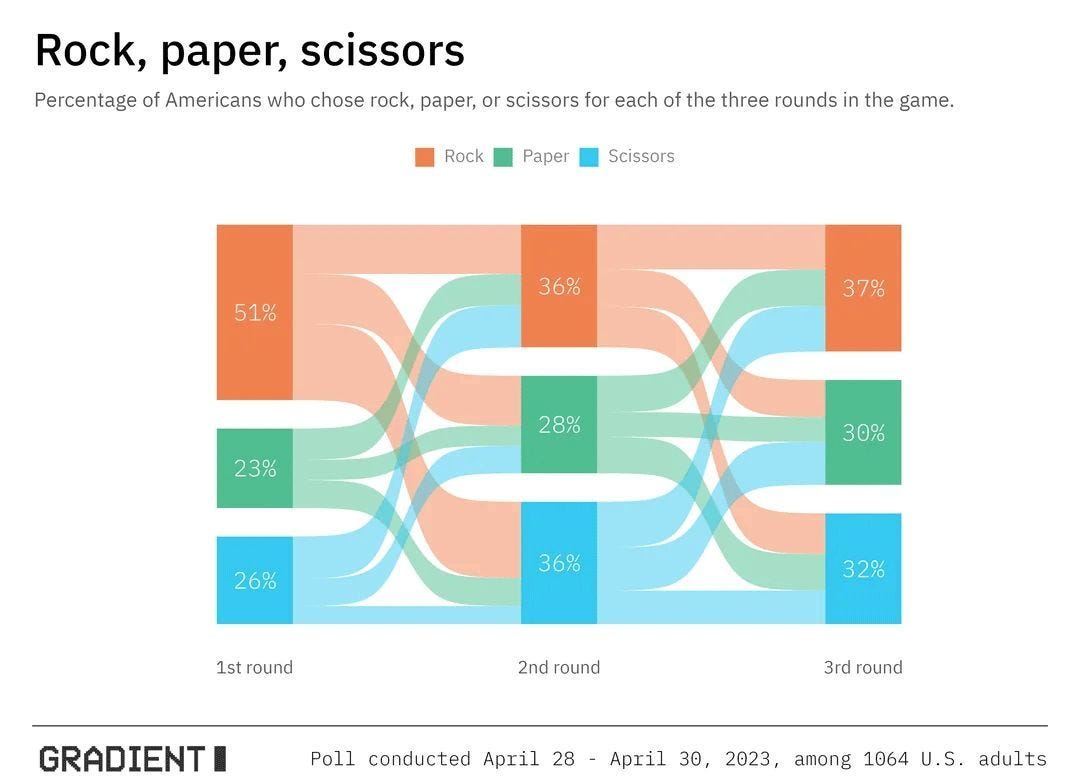
The practical upshot is to start with paper, but what broader lesson should we take from this? Since all options are mathematically identical, any difference in player behavior must come from connotations. Since rock feels strongest, a naive child would choose rock. But since everyone knows that, a slightly smarter person would choose paper. But since everyone knows that, an even smarter person might choose scissors. But since . . . and the lesson of this graph is that when playing the average member of the population, all of this galaxy-brained thinking provides negative value, because in practice most people never leave the naive first level.
79: Claim from @ksangani8 : rising US GDP has decoupled from rising material resource consumption:
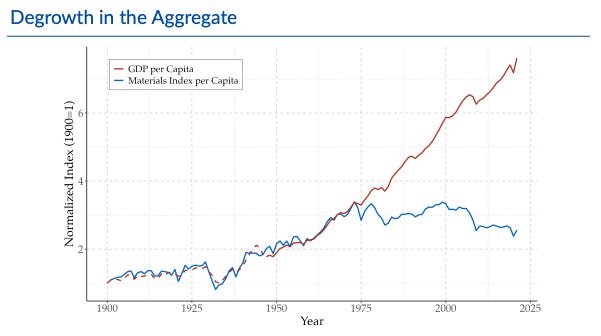
I’m not sure what to think about this. Is it bad, because it suggests that the growth is on paper only, or fragile? Or good, because it means that we’ve learned how to grow without producing a bigger environmental footprint or exhausting natural resources? And is it a coincidence that it decouples in the early 1970s, same time as everything else?
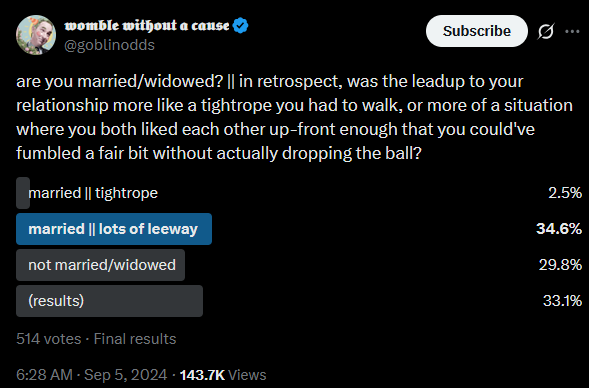
80: Unless there’s a lot of recall bias here, seems like people can relax on first dates (h/t @goblinodds):