

[original post: The Dilbert Afterlife]
Table of Contents:
1: Should I Have Written This At All?
2: Was I Unfair To Adams?
3: Comments On The Substance Of The Piece
4: The Part On Race And Cancellation (INCLUDED UNDER PROTEST)
5: Other Comments
6: Summary/Updates
1: Should I Have Written This At All?
…
Several people said that, since my opinion of Adams was mixed at best, it was unkind to write it just after his death. For example, SaintParamaribo writes:
You should have steelmanned S.Adams more, and be more generous to the guy. He JUST died. He actually recommended your blog. He was a mentor to many of us. And your eulogy could’ve been way more generous. I’ve been a follower of both, and reading your eulogy broke my heart.
I appreciate this perspective and debated it with myself before publishing. The considerations were - I think it is bad to insult someone just after they die. But I also think it is good to remember and memorialize people just after they die. And a vapid post that just said “Adams sure did write some funny cartoons!” without really digging into who he was would have been less good as a memorial, both in the sense of truly engaging with him, and in the grubby prosaic sense of having anyone read it. And I am not a good enough writer to write something equally powerful that was limited entirely to his good qualities. The compromise I worked out with myself was to let myself publish, as long as it ended on an overall positive note and emphasized his good qualities.
This is my second time having this argument - the first was my Elegy For John McCain, which failed much worse - basically everyone thought it was unfairly negative to him and inappropriate just after his death. That was eight years ago, I don’t think I’ve done any more posts, positive or negative, on people’s deaths since then, and I felt ready to try again. For what it’s worth, I still like the elegy, and am glad I memorialized McCain in some way.
This became more awkward after I found out that Adams had said several nice things about me. Sandeep writes:
Among the numerous intellectual gifts I have received from reading Scott Adams is that I started reading slatestarcodex on his recommendation (which then had a huge influence on me). I had known about slatestarcodex even before, but it was Adams’ recommendation that gave me the energy to overcome my reading-inertia and start poring through long articles of Alexander.
I think I’d heard that Adams recommended me at one point, but forgotten by the time I wrote this post. Here’s one of his articles saying nice things about me; someone else dug up a kind tweet, though it was in response to someone else’s deleted message and I couldn’t see exactly what he was praising.
I don’t want to have a blanket policy of never criticizing anyone who’s nice to me; it seems corrupt in the sense of “replacing my journalistic judgment with a policy of praising anyone who gives me favors”. On the other hand, the deepest circle of hell is supposedly reserved for people who betray their benefactors, and this makes game theoretic sense.
Without having a general solution to this problem. In this situation, I mainly considered the point above - I don’t think this was a fully hostile article, and so I didn’t run my full “is it appropriate to write a hostile article about this person?” check. But secondarily, I think Adams linked my blog post as part of the usual blogosphere activity of recommending interesting links, not as a specific attempt to kindle a friendship with mutual obligations. If I were his friend, then I hope I would understand him well enough to know whether he would want a mixed memorial like this (and if not, I wouldn’t do it).
@Eigengender on Twitter ran a poll, and found that:

…which makes me more confident that I landed on the tone I wanted. And several people commented that the essay seemed pro-Adams, or made them like Adams more:
Joel McKinnon writes:
As a chronic sufferer of TDS I've fallen into the "the friend of my enemy is my enemy," and long stopped having any respect for this other Scott A. The post did a great job of contextualizing a complicated and intelligent man's life and ideas.
Jonathan Lipschutz writes:
I loved Dilbert! He had a remarkable ability to identify the absurdity of life/reality. I was not aware of so much other material/information/‘wisdom’?!/ideas. It seems to me he was a true, great contributor to America and Americans and Western intellectual discourse in the vain of other greats like Mark Twain.
What I learned from your piece, which was absolutely amazing in its own right and shined throughout as a tribute and labor of love, was [Adams’] humanity. He was labeled as a racist, which i believe to be bunk and a lack of honesty/courage with addressing the point/argument he was making. He was an eminently flawed human being, like all humans, but he was also acutely aware of this and tried to help others with humor and honesty. Pointing out ways humans fall short, including himself. But he used his special powers in the service of intellectual honesty/inquisitiveness/love for his fellow human beings.
Banjo Kildeer writes:
This is a wonderful piece. Your love for Scott Adams shines through.
@disgruntledcho1 writes:
[This] made me actually feel warmly for Scott Adams, a thus-far unparalleled feat.
The most important question is whether Scott Adams himself would have appreciated the post, and this convinces me that he would have. One of Adams’ favorite persuasion topics was what he called “Two Movies On One Screen”, where people would come away from the same event with totally different narratives - for example, a Democrat might watch a Trump speech and conclude that Trump had openly and clearly announced his racism, while a Republican watching the same speech might think that Trump had just said something patriotic and hadn’t mentioned race at all. Whatever his opinion on what I said, I’m sure he would have found your reactions hilarious.
…
2: Was I Unfair To Adams?
…
Leo Abstract writes:
[The problem with your eulogy] isn’t that it was harsh--he was harsher to himself, frequently. (i.e. when he said he realized at age 8, sadly looking at his nerdy little face in the mirror, he was gonna have to ‘get rich’). [The] problem is it was just wrong, and seemed badly(or un-)researched.
His interest in persuasion was teaching people when others were doing it to them, not teaching them to do it to others. His interest in Trump was Trump doing it BACK at the media, not on his poor voters.
Disagree. Adams’ book Win Bigly includes Persuasion Tips, persuasion checklists, and a Persuasion Resource Reading List, all of which take it as a given that he is teaching you to persuade others:
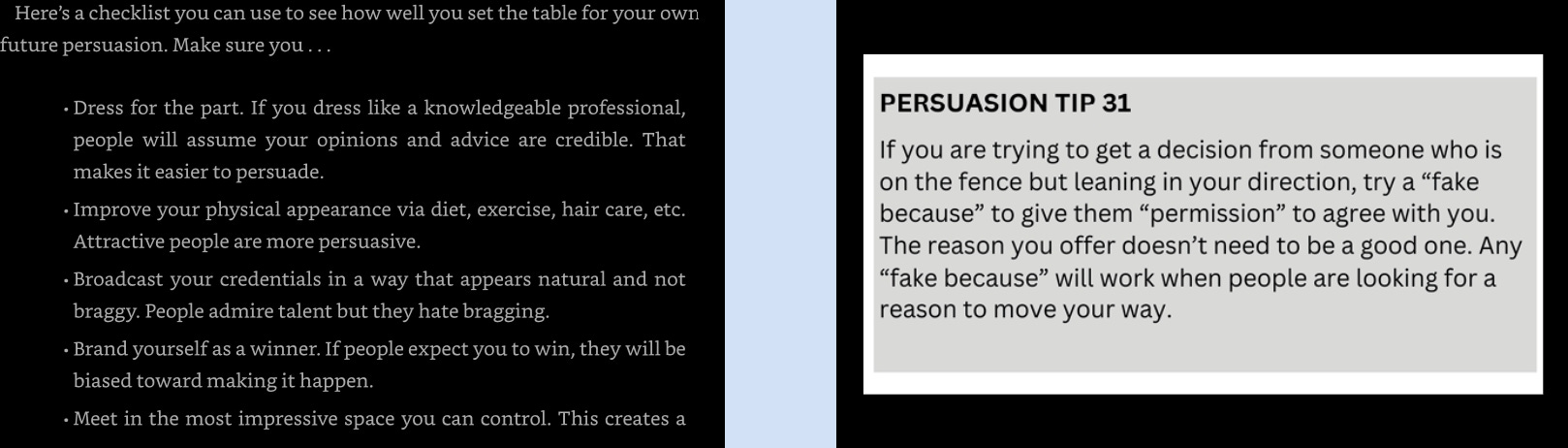
I haven’t watched his videos, but they have names like You Could Be MUCH More Persuasive, The Persuasion Playbook (“Learn practical techniques to harness the power of persuasion”), and Persuasion Techniques That Will Improve Your Business And Life.
Adams absolutely did not limit his interest in Trump’s persuasion to the media, and praised Trump (for example) using persuasion techniques to take down other Republican candidates. You can find his discussion of how Adams “publicly predicted Ben Carson’s demise” after Trump acted out a mocking version of Carson’s description of getting stabbed in the belt buckle (according to Adams, a masterful example of “visual persuasion”).
Leo continues:
A good example would be spinning a whole tale about him as an ‘ivermectin true believer’, when he was open about his skepticism. if you knew his history with medically-assisted suicide, you’d know he didn’t plan on fighting the cancer and only did IVM because his fans begged him.
I half-apologize for this one.
I didn’t try to “spin a whole tale” about Adams as “an ivermectin true believer”. What I said was:
» “In 2024, diagnosed with terminal cancer, Adams decided to treat it via ivermectin, according to a protocol recommended by fellow right-wing contrarian Dr. William Makis. This doesn’t seem to me like a story about a cynic milking right-wingers for the grift. It sounds like a true believer.”
I stand by that paragraph. I don’t think someone who was milking right-wingers as a cynical grift would have gone so far as to trust their recommendations on what to take for his cancer. I think Adams became a sincere right-winger, and so was willing to listen to right-wing medical advice.
But I agree that it was written sloppily and sort of suggests he was an ivermectin true believer. He wasn’t, and I apologize for that.
I later realized I didn’t need to read tea leaves about this - he says, very explicitly, in one of his books, that yes, after getting attacked by too many left-wing trolls, he decided to commit to fully joining the right wing:
» “If you want to see the world more clearly, avoid joining a tribe. But if you are going to war, leave your clear thinking behind and join a tribe. Trumped joined the Republican tribe to win the presidency. Now I was joining the Trump tribe. For a war against Hillbullies [ie pro-Hillary Clinton bullies]. I was all in.”
After I made some of these arguments to Leo, he said:
I do think that people who listened to thousands of hours of him speaking off-the-cuff might have a better understanding than someone attempting to gain the same by reading a few of his old blog posts.
This is a fair criticism. I tried listening to a couple of his shows, and they had a different, friendlier tone than his books / interviews / tweets. Arguably Adams thought of formal written communication as a place to do manipulation, and verbal communication as a cozier spot where he could relate to people normally and explain all the manipulation he was doing.
@Ashwin V writes:
If you knew anything about Scott, you would know that he never considered anyone a "lesser human" as you've so confidently asserted. He was streaming and trying to pass on his wisdom on his death bed.
This was a response to my claim that Adams “longed to be a manipulator of lesser humans”. Several people including Ashwin objected that Adams didn’t see anyone as lesser, nor think of manipulation as demeaning. For example, nutter_just: “Your error is in thinking you must be a lesser human to be manipulable. My impression was Scott believed everyone was like this even himself which is why he believed self affirmations worked. It’s you manipulating your dumb self.”
Again, I’ll half-apologize. I regret my exact framing (“lesser humans”), which I think was unnecessarily inflammatory since it implies he was sort of thinking in those terms. But I think he was doing a bad thing which requires that on some philosophical level he has to be treating other people as his lessers in an unacceptable way, even if he wasn’t consciously thinking that they were.
I think trying to manipulate people is inherently demeaning to the dignity of humankind. Nor is it exonerating to say “I also manipulate myself” (even if this is true). For analogy, suppose that Adams was a literal telepathic mind controller. If he used his powers on himself (mind controlling himself to work harder), that sounds like a good lifehack. But if he used his powers to turn everyone else into his zombie slaves, he would be offending the dignity of humankind, and “I also use my powers on myself!” would be no excuse.
There are a thousand edge cases, complications, things that are sort of manipulation but not quite, and ways that some of those things might be permissible for the greater good. But none of them change the fact that in the simplest and most typical of cases, like the telepathic mind controller with his zombie slaves, manipulation is wrong.
One might object that there are simple, typical cases on the other side too. When a job candidate shaves, dresses nicely, and gives a firm handshake, this is in some sense “manipulating” the interviewer, since it’s an attempt to influence his decision through some channel other than facts. I can’t draw a perfect bright line here between the good and the bad cases, but I would apply tests like “is this an attempt to more effectively convey true information?” (eg when I shave, it conveys that I’m capable of remembering to shave and care a lot about the interview), “is this something where failing to do the thing would also convey even more information?” (eg if I didn’t shave, it would falsely suggest I really didn’t want the job), and “is this something where the target has basically given implied consent to this level of manipulation” (eg the interviewer wants and even hopes that people will dress nicely for the interview).

I think some of Adams’ manipulations seem closer to the bad cases than the good ones. He wrote about the moment he decided to use his persuasion powers to convince America to elect Trump. One day when he was doing his dispassionate observer act, he heard about Hillary’s estate tax plan and realized it would cost his estate lots of money. He had no particular principled stance against it (“You can argue whether an estate tax is fair or unfair, but fairness is an argument for idiots and children”) but concluded that:
This was personal. This was also the day I decided to move from observer to persuader. Until then I was happy to simply observe and predict. But once Clinton announced her plans to use government force to rob me on my deathbed, it was war. Persuasion war.”
Accepting for the sake of argument that Adams’ persuasive powers are as impressive as he thinks, he manipulated thousands of people who might have stood to benefit from an estate tax, or who sincerely believed in fairness-based arguments for an estate tax, to vote against their own interests/beliefs, in order to enrich him personally1. I think this requires some sort of standpoint where you consider their agency and interests less important than your own, and that’s why I described him as wanting to manipulate “lesser humans”.
This coexists with him often being very nice, with many people saying his podcast helped them become better people, etc.
@janiesaysyay writes:
This essay is a great demonstration of the kind of leftist, myopic thinking Scott [Adams] was fighting.
This is how [Alexander] describes [Coffee With Scott Adams], one of the most influential online shows:
» "I had been vaguely aware that he had some community around him, but on the event of his death, I tried watching an episode or two of his show. I couldn’t entirely follow..."
“Some community"?! CWSA was one of the first long running, online, interactive, alternative news shows. Scott was a trailblazer host with his reasonable, thoughtful take on current events, often describing the "2 screens” views of both the left and right political opinions on current events.
Scott [Adams]' question and answer discussions with his audience brought varied insights, and gave Americans a nuanced view of news. At the end of his life, Scott was highly influential in American thought, culture and politics.
CWSA made it acceptable to be an American, someone who was proud of the country, unashamed of their race; proud of the culture, and proud of the heritage which built the country.
This made me wonder whether I was underestimating the reach of Adams’ podcast, so I tried to find statistics.
CWSA ranks 50th on Apple’s top 100 news/politics podcasts2. It’s very close to the rankings of Jen Psaki (Biden’s ex-press-secretary) and Al Franken (ex-Senator), but also to very many people I have never heard of. I’m not sure how to interpret this.
Comparing YouTube subscribers of Adams and various other podcasts I’ve heard of, all numbers in thousands:
Joe Rogan: 21,000
Lex Fridman: 5,000
Dwarkesh Patel: 1,000
A16Z: 241
Scott Adams: 210
Ross Douthat: 85
80,000 Hours: 55
Tyler Cowen: 53
So I conclude that yes, Adams’ podcast was a bigger deal than I thought.
Joel Pollak writes:
[The post is] snarky and factually inaccurate in places. Not unsympathetic, but clearly put off by Scott’s political views. In some places it reads as an attack. It also gets one of Scott’s best predictions wrong, about “hunting.” Enjoyed parts, disliked others.
Pollak was a friend of Adams and is working on his biography, so he’s an expert and I take his opinion seriously. I asked him what he meant on Twitter but haven’t gotten a response. I’ll add it in once I get one, but for now, let me defend my previous interpretation here and see what he thinks.
The “hunting” prediction is a reference to the following:

I have seen people try to walk this back by saying Adams only meant they would be persecuted in some way that was metaphorically equivalent to hunting, but I feel like “good chance you will be dead within the year” is saying he means the kind of hunting which literally kills you, and “police will stand down” means that it will be the sort of extremely illegal thing that police would normally react to.
I have seen other people try to link this to examples of Republicans actually getting killed, such as Charlie Kirk. But Adams was telling his readers there was “a good chance” that “they” would be dead within a year, which I think implies this fate happening to a significant proportion of ordinary Republicans, not just one prominent person. Also, Kirk was five years after the comment was posted.
Can we dismiss this as a joke? I think Adams has used the manipulation technique of saying things that might or might not be jokes and then strategically sticking to them or saying “What? Me? I was only joking! Haha! You can’t take a joke!” depending on which was more convenient to him at that exact second, enough times that I’m not comfortable letting him have that escape.
Also, when I was replying to Joel Pollak about this, I happened to glance at his Twitter account, and one of the top tweets was a repost of someone saying that “The Democrat playbook is to arrest every single person who disagrees with them”. I think if I forced Pollak into some kind of extremely literal frame of mind - maybe asked him to bet money on whether I could tweet the words “the Democrats are wrong about immigration” in my Democrat-controlled state without getting arrested - he would admit that, okay, they don’t want to arrest literally every single person who disagrees with them. He was exaggerating for effect, probably in much the way he’s going to say that Scott Adams was exaggerating for effect. You say stuff like “The Democrats are going to HUNT YOU DOWN and LITERALLY MURDER YOU. They will TORTURE YOUR FAMILY and RAPE YOUR DAUGHTER and EAT YOUR PETS and TURN YOUR HOUSE INTO A CHURCH OF SATAN”, and what you mean is “I disagree with the Democrats and sometimes they go overboard cancelling people”.

I have a post called If It’s Worth Your Time To Lie, It’s Worth My Time To Correct It. My thesis is that tolerating claims of “directional correctness” - the thing where someone asks to get a pass because even if they said wasn’t literally true, it “points to” an “emotionally correct” thing - is eventually totally corrosive. It means everyone ratchets up their claims to the highest level they think they can get away with (ie walk back later if challenged, as a motte and bailey). And then you end up with this miasma where maybe 5% of people totally believe you, and 50% of people sort of absorb the connotation and think something like that is true, and then people get terrified of the Democrats and think of them as monsters and treat politics as an existential struggle where they will genuinely get arrested or murdered unless they do it to the Democrats first, and then you get a civil war or something. I think Adams and Pollak’s milieu has in fact reached this point, and their love for these kinds of exaggerations is a big part of the cause.
Adams was one of the funniest people in the world. If he was actually telling a joke, you could tell by the fact that you were laughing hysterically. “Democrats will hunt and kill you” isn’t funny. I’ll refrain from judgment about whether it was Adams’ sincerely held belief, some kind of annoying manipulation attempt, or whether Adams even recognized a difference between the two. But I think judging him on the fact that it didn’t happen is completely within bounds.
…
3: Comments On The Substance Of The Piece
…
Zanzibar BuckBuck McFate writes:
This business where boomers are tolerant of contradictions and find them amusing whereas millennials are horrified is a dynamic I've noticed as well, it seems to be true in politics also, I myself feel this hunger to be authentic all the time. I think it has something to do with the difficulty children have in putting negativity in context. They can't distinguish between a parent having a bad day and venting, or having an existential crisis. So the 50s guy was half right - you don't have to love your boss in your heart of hearts but careful what you say to your kids.
Feral Finster writes:
» “This is the basic engine of Dilbert: everyone is rewarded in exact inverse proportion to their virtue. Dilbert and Alice are brilliant and hard-working, so they get crumbs. Wally is brilliant but lazy, so he at least enjoys a fool’s paradise of endless coffee and donuts while his co-workers clean up his messes. The P.H.B. is neither smart nor industrious, so he is forever on top, reaping the rewards of everyone else’s toil. Dogbert, an inveterate scammer with a passing resemblance to various trickster deities, makes out best of all.”
Compare with the famous observation that executives are sociopaths, management are clueless, and the workers losers.
Yeah, it’s interesting to compare Rao and Adams. Rao formulated his Gervais Principle as a specific response to Adams’ Dilbert Principle, which I guess means Rao thought Adams got it wrong. Did he?
The Pointy Haired Boss seems to go back and forth between Clueless and Sociopath, which is probably why Rao thought Adams’ work fell short. Dogbert is clearly Sociopath, but has no permanent role in the corporation, and doesn’t really represent a real thing you can be - his character was a ridiculous scammer who succeeded at near-impossible endeavours (like convincing people he was a Nostradamus-style mystical prophet) because the logic of the strip demanded it. Later, Adams foregrounded the CEO character more, maybe to create a purer Sociopath, letting the Boss go closer to Clueless.
This is making me somewhat regret accusing Adams of wanting to be the Pointy-Haired Boss. It would have been fairer (and less of an accusation/surprise) to accuse him of wanting to be Dogbert. But again, Dogbert doesn’t represent a real thing you could be, which might have been why the PHB made a better metaphor.
(contra my claim, the cover of Win Bigly shows a mashup of Dogbert and Trump. Fine, Dogbert is a thing one person can be.)
You can read my full review of The Gervais Principle here.
cincilator writes:
Scott Alexander, former tribune of nerds now says that the sneerclub was right about everything all along? I didn’t expect that, let me tell you.
Several people interpreted me as attacking nerds. I disagree - I think I was attacking self-hating nerds, because nerdiness is fine and you shouldn’t have to hate yourself for it. To spell it out more explicitly:
All nerds must eventually realize they’re not going to immediately dominate everything by intellect alone. This isn’t because intellect isn’t great, it’s because 1) it’s only one of many skills, and 2) you probably aren’t even the person with the most intellect. Again, every mildly-talented person has to face this realization, whether it’s a nerd realizing he won’t be the next Einstein or a jock realizing he won’t be the next LeBron.
If someone deals with this using denial (one of Freud’s maladaptive defenses), you get the nerd who says no, I really am the next Einstein, ie a crackpot, aka the sort of person who gets featured on Sneerclub. If they deal with it using reaction formation (another of Freud’s maladaptive defenses), you get the self-hating nerd, aka the sort of person who joins Sneerclub4.
If they just deal with it maturely instead of spinning up maladaptive defenses against it, they’re a nerd who is hopefully good-natured and accepting of their nerdiness, and hopefully does some good work in some specific small area, and changes the world in some specific small way (or some very large way, if they can work together with other people and get lucky).
Bugmaster writes:
I think Adams is basically correct. Yes, facts and evidence do exist and are real; but they have virtually no impact on anything socially important -- i.e., on anything important whatsoever. Memes and charisma and persuasion are what matters if you want to achieve life goals that extend beyound yourself and your immediate family.
I worry that Adams (and you) are doing something where unless the average person can solve every problem by facts and intelligence alone, then facts+intelligence lose and memes and persuasion win. But the average person also can’t solve every problem by memes+persuasion alone!
If Dilbert is an 80th percentile nerd, the 80th percentile persuader is - I don’t know, a used-car salesman? Dilbert’s probably earning more money, especially nowadays when he could make L5 at Google.
And if Donald Trump is a 99.9999th percentile persuader, the 99.9999th percentile nerd is Ilya Sutskever. Probably most people would slightly prefer being Trump to Sutskever, but Sutksever does have a couple billion dollars, plus the more ethereal rewards of genius; it still seems like a pretty good deal.
I also think you’re doing a sort of black-and-white thinking here. Every day, great persuaders like Sam Bankman-Fried and Elizabeth Holmes end up in jail, because in fact the things that they said were true were not true. Every day, smooth-talking charismatic manipulators successfully seduce the girl into bed with them, then totally fail to turn it into a happy stable marriage, because after a few years even the dumbest woman catches on and figures out whether her mate provides real value or not. Even Donald Trump has only a 37% approval rating, because he can’t make “we should alienate our allies over Greenland” sound plausible to most of the American people. When someone’s very good at it, persuasion sometimes helps them blur facts around the edges. But that’s it.
Nobody except Scott Adams and a few psychotherapists ever go to hypnotist school. Most don’t even go to any formal persuasion classes. That’s because hypnotism/persuasion isn’t really a lifehack that helps you win all the time at everything. If the world’s best hypnotist asked a room of VCs for money with a stupid business plan, he would probably fail.
This isn’t to say persuasion is useless, and in certain fields it can be very powerful indeed. But let’s not go crazy and start worshipping it. The grass is always greener on the other side. The nerd sits in his cubicle and thinks “If only I were more charismatic.” But the salesman with the bright teeth and the firm handshake thinks “Man, I bet I could get out of this dead-end job if only I were smarter.”5
…
4: The Part On Race And Cancellation (INCLUDED UNDER PROTEST)
…
Ilya Lozovsky writes:
Ninety percent of this essay is brilliant — smarter and realer than anything anyone else has written about Adams — but the end lost me. It's too generous, to the point of being a whitewash. Adams was vicious and hateful and played a material role in convincing Americans to vote for actual fascism. I don't think it's right to "hand it to him."
JJ McCullough (JJM’s Shortstack) writes:
Good essay, but I think you kinda yadda-yadda'd away his racist rant, which was extremely explicit and extended. I think it was the opposite of a "bog-standard cancellation," which we think of as being a slightly unfair, overzealous policing of an at least slightly subjectively offensive comment, often from years ago. But Scott went on quite a long diatribe about why black people, as a group, are dangerous and undesirable to be around, and why he, personally, goes out of his way to avoid them. Some conservatives have tried to use "bog-standard" anti-woke logic in defending him, but no, his comments really are quite explicitly and undeniably racist, if that term has any useful definition at all.
Alex Wotbot writes:
Now, you quoted Adams saying: “the best advice I would give to white people is to get the hell away from black people; just get the fuck away” If this was the intended point, does it really make sense that only the far-left freaked out?
It’s kind of important to mention this was within a hypothetical. Suppose a survey reported that 26% of a population believes “The phrase ‘It’s OK to be blonde’ is hate speech” and another 21% weren’t sure if they agree with the statement or not. Now suppose you were blonde, would you hang around that population? Now go read the February 2022 Rasmussen Reports survey.
Please do better than this, I don’t want to have to Gell-Mann memoryhole this.
Many people had strong opinions on this, so I have to respond to it. But first, I want to make it extra clear in capital letters: I AM DOING THIS IN THE COMMENTS POST, TO RESPOND TO YOUR COMMENTS, AND NOT BECAUSE I THINK IT IS THE MOST IMPORTANT THING.
Certain people screenshotted the one paragraph of my ten thousand word essay that discussed this and posted it on Twitter, in order to make it look like I was joining in some kind of chorus of liberals reducing Adams to his worst moment. I posted what I thought was a no-nonsense, factual description of what happened, in order not to be accused of hiding it or covering it up. It was the least important part of my essay, I’m aware that writing about it at all opens me to attack from both sides, and I discuss it here only to respond to all of you who wanted to know my opinion on it. Just don’t screenshot it on Twitter and say “LOOK SCOTT IS STILL HARPING ON THE RACE THING”, that’s all I’m asking.
That having been said…
To make sure we’re all on the same page - Adams’ comments were prompted by this poll, conducted February 2023. The question was: “Do you agree or disagree with this statement: ‘It’s OK to be white’” Among blacks, 53% agreed, 26% disagreed, and 21% were “not sure”. Among whites, the numbers were 81/7/13.
Here’s the video of Adams’ comments:
Transcript:
If nearly half of all blacks are not okay with white people - according to this poll, not according to me - that’s a hate group. And I don’t want to have anything to do with them. And I would say, based on the current way things are going, the best advice I would give to white people is to get the hell away from black people. Just get the f**k away. Wherever you have to go. Just get away. Cause there’s no fixing this. This can’t be fixed. You just have to escape.
That’s what I did. I went to a neighborhood with a very low black population. Because unfortunately, there’s a high correlation between the density - this is according to Don Lemon, here I’m just quoting Don Lemon, who said when he lived in a mostly black neighborhood, there were a bunch of problems he didn’t see in white neighborhoods. So even Don Lemon sees a big difference, for your quality of living, based on where you live and who’s there.
So I think it makes no sense whatsoever as a white citizen of America to try to help black citizens anymore. It doesn’t make sense. Because there’s no longer a rational impulse. And so I’m… I’m gonna, uh, I’m gonna back off from being helpful to black America, because it doesn’t seem like it pays off. Like I’ve been doing it all my life, and I’ve been… the only outcome is I get called a racist. That’s the only outcome. [cackles] It makes no sense to help black Americans if you’re white… it’s over. Don’t even think it’s worth trying. Totally not trying.
Is this racist?
I have a piece called Against Murderism, where I talk about why it’s so hard for people to agree on questions about “racism”. The summary: although it would be possible to have someone be purely, axiomatically racist - having it be a premise of their reasoning that they hate black people - in practice few people are like this. More typically, people have some argument more like:
I don’t like [specific bad thing]
Minorities are more likely to have [specific bad thing]
Therefore I like minorities less than whites.
You can’t argue with (1), because the bad thing might be something like ‘crime’, which everyone dislikes. You can’t argue with (2), because sometimes you can find statistics showing it’s literally true. Your ability to argue with (3) depends on the exact form, but some forms - like “if I knew nothing about two neighborhoods except that one were 100% black and the other 100% white, I would probably prefer to live in the 100% white one” - seem pretty strong. But then what’s left of being against racism?
We could think of racism as a bias that makes people update on racial topics far beyond what the data allow. For example, if 0.1% of whites are murderers, and 0.2% of blacks are murderers, this hardly means that you can’t be nice to your white-collar Harvard-educated black colleague, or that you should think of him as a potential-murderer-in-waiting. But even this might be giving the racists too much credit. If 0.1% of whites are murderers, and 0.2% of blacks are murderers, does that mean you should make a Twitter account NGGRKILLER1488 who posts “u look like CHIMP i will enjoy murdering ur family during the race war” under every picture of a black person that comes across your timeline? No? Because a lot of people do do that!
I’m not Language Czar, but if you force me to define the word “racism”6, I would call it a bias which makes people take the flaw of an ethnic group (whether real or imagined) further than they would normally go, until whatever core of useful insight they contained becomes caricatured and exaggerated, and they’re being used more to spread hatred and fear than to communicate useful information. None of this is original or interesting, and I’m only saying this cliched and obvious thing so we’re all on the same page.

So was Adams’ comment racist in this sense? By now we can probably rehearse the arguments of both sides:
LIBERAL: “It’s Okay To Be White” is a known 4chan white supremacist slogan. They chose it as their slogan precisely so it would be awkward when people called them out for saying it, and so they could retreat to saying “We just said it was okay to be white, which surely nobody can hold against us”. This is stupid, we’re under no obligation to pretend we don’t know this, and those 26% of black people who were against it, were against it on this basis.
CONSERVATIVE: Yeah, but the poll didn’t ask “do you agree with it as a 4chan white supremacist slogan?”, it just asked about the statement. And besides, most random Americans don’t even know the latest 4chan white supremacist slogans. At least some of the respondents probably meant it literally.
My opinion - it seems plausible to me that many of the 26% of respondents who said they disagreed meant they disagreed with the 4chan slogan version, and that many of the rest were doing “symbolic belief”/”emotive responding” such that they interpreted the question as something like “in the history of interactions between the white race and other races, do you believe the white race has behaved in an okay way?”, and that some of the ones left over were Lizardmen.
Adams isn’t required to know all of the weird sorts of symbolic belief biases that affect polls (although isn’t “our responses aren’t based on factual beliefs, but constantly malleable based on frame and emotion” sort of his entire shtick?). But at this point, he had lived in the USA for 60 years. He had already had many interactions with black people, both personally and through the news. Given how much other information he had, updating from one ambiguous poll where 26% of people gave an ambiguously bad answer, to “this entire ethnic group of 30 million people is a hate group, and white people should flee them, and try to avoid all interaction with them, and shouldn’t help them in any way” is exactly the sort of caricatured exaggerated7 leaping-to-conclusions that the word “racism” means if it means anything at all8.
Does that mean Adams should have been cancelled and lost his livelihood? I’m against this sort of cancellation full stop, so I say no. I think it’s a dumb opinion, and maybe a bit evil in the complicated sense where it’s hard to disentangle evil from ignorance. But many people hold opinions of approximately that level of badness, and it’s not worth hating them all9.
…
5: Other Comments
…
Calvin Collins writes:
I learned of you through Scott [Adams]. Think a lot of what you say is valid but have to admit I’m one of the people whose lives he changed for the better. When I first listened I was a 25 year old 3x college dropout and 10 years later I have a great career and family. A lot of that comes from applying his advice. Subjectively I’ll always love him because of what he gave me, without even knowing who I am. [What helped the most were] the reframes and micro lessons. Almost everyday at work or home there’s a situation where one pops into my head:
“I’m not anxious, I’m excited”
“laziness is caused by thinking about the cost instead of the pay off”
“systems are better than goals”
The main idea, that by changing my thoughts I can change my reality, is simple but went a long way for me. It opened up my imagination to what’s possible and made my thinking more positive.
Cinna the Poet writes:
To share a different perspective on Adams, my uncle was an avid follower. He went from being a principled libertarian whose ideas I respected very much to (I’m sad to say) an alt right bigot. Under the influence of Adams, he had no interest anymore in objective truth or the actual scientific method. Reality was all a matter of spin and “persuasion.”
The phrase “post truth” gets thrown around too much, but Adams fit that description perfectly.
Alex Poterack writes:
I just need to note you’re not the only one who read every Dilbert book before graduating elementary school. I’m the other one.
Dozens of people chimed in, here and on social media, to say they did this too.
Alyssa Briggs writes:
This is a great article, but you left out that he handed out king-sized candy bars on Halloween. He will be very missed by the local kiddos.
…
6: Summary/Updates
…
This was a tough post to write, and I think many people will continue to find it unfair.
For example, I claimed that Adams said he joined Team Trump because he didn’t want to pay Hillary’s proposed estate tax - and that he said he didn’t care whether the estate tax was unfair or not, he just personally hated the idea of losing money.
But an Adams backer could justly point out that a few sentences later, he does talk about how it’s unfair to make him pay an estate tax when he worked hard his whole life. And then a few paragraphs later, he gives a different, more sympathetic story about how he thought Hillary supporters were bullies and it was important to stand up to them (although he then says maybe Trump supporters were exactly equal bullies, but he selfishly was more against the bullies who were bullying him - but then elsewhere he says no, the Hillary supporters’ bullying was worse.)
Adams keeps trying to eat his cake and have it too. He gives one prosocial altruistic explanation (so that if someone accuses him of being selfish, he can show they’re wrong), and then one amoral selfish explanation (so that if someone argues with him about whether it’s really altruistic to oppose estate taxes for millionaires, he can say “Ha, you can’t get me, I already admitted I’m a cold hard realist who doesn’t worry about that kind of fuzzy stuff.”) This is much like how he first said Donald Trump was amazing (but didn’t endorse him), then said he was endorsing Hillary Clinton (but only for his own safety), then endorsed libertarian Gary Johnson (???), then when it looked like Trump would win again walked it back and said obviously he had really been for Trump the whole time. If someone else had won, he would have spun a story where his endorsement of them had been real. He admits all of this!
So someone who is charitably inclined to Adams can tell a story where he’s a great predictor, has always done everything for good patriotic altruistic reasons, and only teaches persuasion so that people can better understand themselves and their world. Someone who is uncharitably inclined can tell a different story where his predictions are mostly wrong, he does everything for selfish reasons, and uses persuasion to manipulate others and enrich himself.
I usually try to err on the side of charity. But Adams is wearing a metaphorical “I AM GOING TO USE YOUR CHARITABLE INSTINCTS TO MANIPULATE YOU” t-shirt. So I’m happy to suspend charity in this case and judge him on some kind of average of his conflicting statements, or even to default to the less-advantageous one to make sure he can’t get away with it.
So here are the updates I made based on your comments:
Adams wasn’t an ivermectin true believer, and although my piece very narrowly avoided saying that he was, I should have been clearer about this and avoided implying it.
Adams’ manipulation coexisted with his being a nice person who cared about others. I shouldn’t have described him thinking of his manipulation targets as “lesser humans” in a way that implied this was a conscious thought, as opposed to (as I claim) a background stance his actions indirectly implied.
Adams’ podcast was a bigger deal than I thought, and many people thought it seriously improved their lives. I should have concentrated more on this.
Adams does try to defend this, saying that “I earned my money through hard work, and I already paid taxes on it,” but I don’t understand what he means by saying this just a few sentences after he says that you shouldn’t debate fairness because that’s for children, and in that context it doesn’t really feel very exonerating.
In December, it was #67, so it may have gotten a small publicity bump from Adams’ death, but only a small one.
This is probably unfairly low because it has its own website and doesn’t rely on YouTube subscriptions. YouTube subscriptions are a lossy metric and I’m just trying to get an order of magnitude estimate.
Or maybe this would be projection, or both, idk.
A better answer here would differentiate “facts are worse than memes” and “persuasion is worse than intelligence”. Persuasion can be fact-based! Here I think of Ezra Klein and Matt Yglesias, two of our most influential public intellectuals, each with a reach far greater than Adams’. Both are excellent writers and have nonzero charisma, but they are mostly respected for being knowledgable and likely to be right about things.
Of course it’s always valid to Taboo Your Words and Replace The Symbol With The Substance, and as soon as we reach some debate where the impasse is the definition of “racism” I’m fine with agreeing that this word is hard to define and trying to switch the debate to something more substantial in every particular case.
I realize Adams felt like he had the god-given right to exaggerate and caricature anything he wanted because it was a “manipulation technique”, but one important part of manipulation is that sometimes the people who you’re trying to manipulate notice and don’t like it and retaliate against you, and would-be manipulators aren’t allowed to opt out of that part!
Could “whites should flee blacks” be operationalized as a statement like “black neighborhoods are bad and whites should be afraid to live in them?”, which would then be somewhat justifiable? First, I think this has no relationship to the poll Adams’ was citing, so now we’re really steelmanning him. But second, this is still a super-low-res caricature. I’ve lived in plurality-black neighborhoods twice in my life, and although they had their problems I never felt afraid for my life. I assume there is some much worse 99% black horribly poor ghetto where I would feel afraid for my life, but I also imagine there are some horribly poor 99%-white towns where blacks feel afraid for their lives, and the difference between “if you’re white, have some prudence about living in the horribly poor 99% black ghetto” vs. “blacks are a hate group and you should flee from them” is the difference between good justifiable reasoning and racism. I’m fine with admitting that we tolerate low-res-caricature unsophisticated statements on other topics in a way that we don’t tolerate them on race, but different topics suggest different levels of caution (if you asked me where the kidney is, I would answer with different levels of sophistication depending on whether you were curious vs. about to perform surgery), a country where 25% of the population is chomping at the bit for race war is a place where you should use high sophistication for race-related statements (and yes, I agree that woke people also fail at this and are blameworthy), and the word for when people in that particular country instead use culpably low-resolution and unsophisticated statements is “racism”, and although in general I try not to use it so I don’t have to get into interminable debates like this one, I don’t think it’s wrong to use it here.
Although I don’t think Adams’ cancellation was fair according to normal human logic, I think it had a certain odd sort of cosmic justice. 4chan’s deployment of the “It’s Okay To Be White” slogan was (maybe literally) out of Adams’ book - say something completely inoffensive, make sure everyone knows it has a secret offensive meaning, then retreat back to “What? You’re upset at our totally inoffensive thing? How silly!” when anyone calls you on it. This manuever didn’t fool woke people at all; the people wearing “It’s Okay To Be White” t-shirts got exactly as many accusations of racism as they would have gotten for wearing swastikas directly. The only person it apparently fooled was Adams, the professional not-being-fooled-by-political-manipulation expert, whose life it randomly destroyed as collateral damage. Oh well.