

[This is a guest post, written by David Speiser, author of the Ollantay review in last year’s Non-Book Review contest. David provided the concept and original draft; Scott edited the final version. Remaining mistakes are likely mine (Scott’s)]
The Problem
Everyone hates Congress. That poll showing that cockroaches are more popular than Congress is now thirteen years old, and things haven’t improved in those thirteen years. Congressional approval dipped below 20% during the Great Recession and hasn’t recovered since.
A republic where a supermajority of citizens neither like nor trust their representatives is not the most stable of foundations, so it should not be shocking that the legislative branch is being subsumed by the executive.
What’s the solution? Many have been proposed, some with very snazzy websites. FairVote thinks that ranked choice voting and proportional representation will solve it. The Congressional Reform Project has another snazzy website with such bold proposals as “Increase the opportunity for Members to form relationships across party lines, including by bipartisan issues conferences.” There are more think tanks. They want to enlarge the House by a few hundred members, switch to a biennial budget system, spend more on Congressional staffers, and introduce term limits, among many other suggestions.
There are op-eds too. Here’s how the Atlantic wants to fix Congress. The New York Times of course has a solution. Here on Substack, Matt Yglesias thinks proportional representation is the solution, and Nicholas Decker has an especially interesting solution.
These proposals, no matter which direction they’re coming from, have two things in common. The first is that they largely agree on the problem: members of Congress are disconnected from their constituents. Thanks to a combination of huge gerrymandered districts, national partisan polarization, and the influence of large donors, a representative has little incentive to care about the experience of individual people in their district.
The second thing that all these proposed solutions have in common is that none of them will ever be implemented. They all involve acts of Congress - and members of Congress have no incentive to vote to change broken systems that currently benefit them. Why would you want to stop gerrymandering when it’s the reason you don’t have to run a real campaign to stay in office? Why would you vote to give yourself more work? Why would you vote to make it harder for people to give you money? If we want to fix Congress, we need a solution that doesn’t involve Congress.
Luckily for us, such a solution exists: if we get 27 states to ratify the Congressional Apportionment Amendment, then we can make some real progress towards fixing Congress without Congressional buy-in. This solution is not a new idea. It comes up every few years and gets little traction. My hope in writing this piece is that it gets more traction now.
The Only A+ Ever Given At The University Of Texas
In 1789, Congress passed the Bill of Rights, containing twelve Constitutional amendments meant to protect the American people. Ten of these twelve were ratified by the states and became law. Two failed and were forgotten.
Eighty three years later - in 1872 - a Congress voted themselves a pay raise1. In fact, they voted themselves a pay raise effective as of two years ago, meaning that every member of Congress immediately received two years of back pay.
The American people were outraged, especially after an economic crisis hit later that year. In the midst of the backlash, a member of the Ohio state legislature remembered the failed eleventh amendment in the Bill of Rights, which read:
No law, varying the compensation for the services of the Senators and Representatives, shall take effect, until an election of Representatives shall have intervened.
In other words, if Congress votes themselves a pay raise, it can’t take effect before the next election cycle. Ohio decided - better late than never - and became the 9th state to ratify the amendment, almost a century after the first eight. But it still wasn’t enough, and besides, the American people punished Congress in a more traditional way: they voted the Republican majority out of office and handed the chamber to the Democrats. Everyone forgot the eleventh amendment a second time.
One hundred ten years later - in 1982 - an undergrad at University of Texas in Austin wrote a paper on the pay-raise amendment, mentioning that there wasn’t technically anything in the Constitution that said that amendments had expiration dates. He got a C on the paper and very reasonably turned that into a decade-long crusade to prove his history teacher wrong. He started a nationwide campaign to get state legislatures to ratify the amendment. In 1992, he succeeded: the 38th state approved the provision, and it was added to the Constitution as what is now the Twenty-Seventh Amendment. The crusade worked; thirty-four years after the original paper, his political science teacher submitted a petition to the university to retroactively change his grade to an A+; since there is no A+ on the official UT grading rubric, this became the only A+ ever given in the history of the University of Texas.
That means eleven of the original twelve Bill of Rights amendments have made it into the Constitution. There’s only one left. It’s been ratified by eleven states already. If twenty-seven more states agree, it will become the law of the land. It is the right to Giant Congress.
The Right To Giant Congress
Here is the text of the Congressional Apportionment Amendment, the sole unratified amendment from the Bill of Rights:
After the first enumeration required by the first article of the Constitution, there shall be one Representative for every thirty thousand, until the number shall amount to one hundred, after which the proportion shall be so regulated by Congress, that there shall be not less than one hundred Representatives, nor less than one Representative for every forty thousand persons, until the number of Representatives shall amount to two hundred, after which the proportion shall be so regulated by Congress, that there shall not be less than two hundred Representatives, nor more than one Representative for every fifty thousand persons.
In other words, there will be one Representative per X people, depending on the size of the US. Once the US is big enough, it will top out at one Representative per 50,000 citizens.
(if you’ve noticed something off about this description, good work - we’ll cover it in the section “A Troublesome Typo”, near the end)
The US is far bigger than in the Framers’ time, so it’s the 50,000 number that would apply in the present day. This would increase the size of the House of Representatives from 435 reps to 6,6412. Wyoming would have 12 seats; California would have 791. Here’s a map:
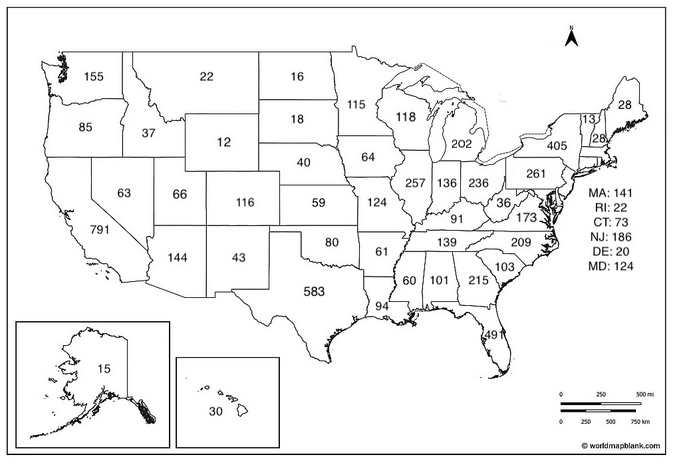
This would give the U.S. the largest legislature in the world, topping the 2,904-member National People’s Congress of China. It would land us right about the middle of the list of citizens per representative, at #104, right between Hungary and Qatar (we currently sit at #3, right between Afghanistan and Pakistan).
Would this solve the issues that make Congress so hated? It would be a step in the right direction. Our various think tanks identified three primary reasons behind the estrangement of Congress and citizens: gerrymandering, national partisan polarization, and the influence of large donors. This fixes, or at least ameliorates, all of them.
Gerrymandering: Gerrymandering many small districts is a harder problem than gerrymandering a few big ones. Durable gerrymandering requires drawing districts with the exact right combination of cities and rural areas, but there are only a limited number of each per state. With too many districts, achievable margins decrease and the gerrymander is more likely to fail.
We can see this with state legislatures vs. congressional delegations. A dominant party has equal incentive to gerrymander each, but most states have more legislature seats than Congressional ones, and so the legislatures end up less gerrymandered. Here are some real numbers from last election cycle3:

So for example, in Republican-dominated North Carolina, 50.9% of people voted Trump, 60% of state senate seats are held by Republicans, and 71.4% of their House seats belong to Republicans. The state senate (50 seats) is only half as gerrymandered as the House delegation (14 seats).
In many states, the new CAA-compliant delegation would be about the same size as the state legislature, and so could also be expected to halve gerrymandering.
As a bonus, the Electoral College bias towards small states would be essentially solved. Currently, a Wyomingite’s presidential vote controls three times as many electoral votes as a Californian’s. Under the CAA, both states would be about equal.
Money: This one is intuitive. If you can effectively buy 1/435 elections, you’ve bought 0.23% of Congress. If the same money only buys you 0.02% of Congress, you’re less incentivized to try to buy House elections and more incentivized to try to buy Senate seats or just to gain influence within a given political party. Money in politics is still a thing, but it becomes much harder to coordinate among people. This makes it easier for somebody to run for Congress without having to fundraise millions of dollars. Because it’s less worth it to spend so much money on any one seat, elections to the House become cheaper4.
Polarization: Some of the think tanks that want to increase the size of Congress by a few hundred members rather than a few thousand claim that this increase will fix political polarization by making representatives more answerable to their constituents who tend to care more about local issues than national ones.
I’m more skeptical of this claim, mainly because it seems that all politics is national politics now. There’s one newspaper and three websites and all they care about is national politics. My Congressional representative ran for office touting her background in energy conservation and water management, arguing that in a drying state and a warming climate we really need somebody in Congress who knows water problems inside and out. Now that she’s actually in Congress, it seems that her main job is calling Donald Trump a pedophile5. The incentives here are to get noticed by the press and to go viral talking about how evil the other side is, so that people who are angry at the evil other side will give you money and you can win your next election.
But maybe Big Congress can solve that. Maybe in a district of less than 50,000 there will be less incentive to go viral and more incentive to connect with your constituents. At the very least, it seems that people trust their state representatives more. And when my state representative and my state Senator tell me about the good work that they’ve done and ask for me to vote for them again, they point to legislation that they’ve passed, not clips of them calling their opponents pedophiles.
Won’t Congress Become Unmanageable?
At first, probably yes!
The Capitol Building couldn’t fit a 6,641 person Congress, let alone all of the extra staffers and administrative personnel who would come with it. We’d need to build a new monument to the largest democratic body in the history of the world. This is a good thing.
But it would also become conceptually unmanageable, with individual members having more trouble networking with one another and sounding out consensus. I expect that out of necessity, the House would take on a more parliamentary form with the party as the baseline for decision making. Then the big negotiations become those between parties, not between individuals.
Why Should I Support This?
Democrats: You’re about to take a beating in the next census. California is moving to gerrymander its Congressional delegation, but it’s also going to lose four seats. Texas is moving to gerrymander its delegation even more aggressively, and it’s going to gain four seats. Florida is going to gain three. Illinois and New York are losing seats. Across the board it’s bad news; while you might come out on top in this year’s elections, you’re going to lose the gerrymandering battle come 2030. Ratifying the CAA will make the battle that much fairer for you.
Republicans: You’re about to take a beating in the midterms. The aggressive gerrymandering in Texas could easily backfire in a blue year, and California just passed the “I Hate Republicans” act to gerrymander that state as well. Ratifying the CAA is a way to blunt the effect, and let your colleagues in Illinois and California and New England have their voices heard. But there’s a bigger reason for you to want to support this. If you’re a Republican in 2026, you exist to serve Donald Trump and his vision for America. You want to help Donald Trump recreate America in his image. The image of America will be the image of the new Capitol Building, and Donald Trump will lead this design. You saw how excited he was about the east wing of the White House; imagine how ecstatic he would be to get to design the Donald J. Trump Capitol Building. Imagine how owned all those Washington libs will be when they walk by the giant golden statue of Donald Trump that hosts Congress.
Libertarians/Communists/Greens/etc: Third parties are at their nadir right now. Zero state or national legislative seats are currently occupied by third parties, which is historically unusual. But increasing the size of Congress would give a shot in the arm to third parties. Getting 25,000 people to vote for you seems much more doable, especially if the whole party goes all-in on one seat. And it only takes one. I gotta believe that the Libertarians could win a Congressional seat in New Hampshire. The Communists could win one in Seattle. And once you get one seat, then it’s off to the races. Getting national recognition as one of 6,641 is really hard - joining or forming a third party is the kind of thing that gets you press. This is speculation, I have no data to back it up, but I fully expect that we would see a big upshot in third party representation and membership. The CAA is exactly what the Libertarians need to break out of their funk.
State legislators: Because you have an opportunity here. The most likely people to be elected to the new Big Congress are those who already have political experience and know what it takes to win an election in a small district. If you vote to ratify the CAA, odds are good that you’ll be among those elected to fill the ranks of Big Congress. And you’ve always wanted to be there in Washington. We both know it.
A Troublesome Typo
The second clause of the amendment describes the situation when the US population is between 3 million and 8 million. It says (my bolding):
There shall be not less than one hundred Representatives, nor less than one Representative for every forty thousand persons
Sounds reasonable enough. This is making the straightforward claim that there should be many representatives, and a high representative-to-constituent ratio.
The third clause of the amendment describes the situation when the US population is greater than 8 million people (i.e. the situation we’re in now). It says:
There shall not be less than two hundred Representatives, nor more than one Representative for every fifty thousand persons.
Notice the non-parallelism with the second clause. The second clause was two less-thans, meaning many representatives and low representative-to-constituent ratio. The third clause is a less-than followed by a more-than, meaning many representatives and a low representative-to-constituent ratio.
Aren’t these two goals - many representatives, and a low representative-to-constituent ratio - in tension?
Yes. In fact, the clause is mathematically impossible to satisfy at populations between eight and ten million. For example, with nine million Americans, we need at least two hundred representatives, but fewer than 9,000,000/50,000 = 180 representatives. Obviously there is no number which is both above 200 and less than 180, so this makes no sense.
At other population sizes, the clause does the opposite of what its founders intended, saying that the legislator-to-constituent ratio should be low and Congress has to be small. For example, at the current US population of 350 million, the clause merely says that Congress must be smaller than 6,641 representatives, meaning that the current Congress size is fine and nothing changes.
The simple explanation is that this is a typo. The people who wrote the law had three clauses, and meant to say “less than . . . less than” in each. But in the third clause, they said “less than . . . more than”. This has been noticed and acknowledged for over two hundred years.
So we have a potential Constitutional amendment which says the opposite of what it definitely means. If passed, this would set us up for a court case that directly pits the legal school of textualism (you need to follow the law as written) against originalism (you need to follow what the people who wrote the law meant). These two schools are often in oblique and complicated conflict. But as far as we know, they’ve never faced so direct a test as a section of the Constitution with an obvious-for-two-hundred-years typo that inverts its meaning. All the Supreme Court Justices who have previously gotten away with talking about how the law is subtle and complicated would have to finally just decide whether textualism or originalism is right, no-take-backs, once and for all. It would be hilarious.
The most likely outcome would be that they would bow to two hundred years of obvious criticism of this incorrectly-worded law, agree that it meant to say that the legislator-to-constituent ratio must be high, and we would get Giant Congress.
But there’s a remote chance that the textualists would win after all. This wouldn’t make things worse - Congress would be constitutionally banned from having more than 6,641 representatives, but this was hardly in the cards anyway. It would also mean that if the US population ever declined to between eight and ten million - admittedly another thing that’s not really in the cards - the Constitution would become logically impossible to follow, and America would officially be a paradox. If the population ever declined to between eight and ten million people, this probably would not be our biggest problem. But it might be the funniest.
The Path To 38

A constitutional amendment must be ratified by 3/4 of states; that’s 38/50. Eleven have ratified it already, so we need 27 more. Of the 39 states that have not ratified the CAA, 13 have legislatures run by Democrats and 25 have legislatures run by Republicans. This has to be a bipartisan effort.
But it’s no worse than the situation with the Twenty-Seventh Amendment. Gregory Watson, the previously mentioned Texas undergraduate, got it passed with $6,000 of his own money and a very dedicated letter-writing campaign. The Congressional Apportionment Amendment may require more work, but the precedent is there.
If you’re a state legislator, or if you know a state legislator, or if you want to be a state legislator after they all move up to Washington, then please introduce a motion to ratify this amendment. And tell all your colleagues that, if they ratify it too, they’ll get to be real Congressmen and Congresswomen. We can have the largest legislative body in the world. We can build monuments again. We can have real third parties again.
Either that, or we’ll turn the Constitution into a paradox and our government will vanish in a puff of logic. Still probably beats what’s going on now.
Of around $67k/year in 2026 dollars.
Under the 2020 census. The number would change upon each subsequent census. In 2030, it will probably be around 6,980.
In case this smacks of cherry-picking, here is a breakdown of the “error” in every state’s Congressional delegation, state house delegation, and state senate delegation. “Error” here is defined as the difference between the representation of each state’s delegation and the percentage of that state that voted for Trump over Harris (or vice versa). In only two states, Florida and Virginia, is the error greatest in the largest body, and both of those states would have Congressional delegations larger than that largest body. In the case of Florida, their delegation would be nearly quadruple the size of their state house.
There could also be an effect from the structure of the TV market. Stations sell ads by region, and each existing media region is larger than the new Congressional districts. So absent a change in market structure, a candidate who wanted to purchase TV advertising couldn’t target their own district easily; they would have to overpay to target a much larger region.
And just to harp on this more, we just blew by the Colorado River Compact agreement deadline and now the federal government is going to start mandating cuts; everybody’s going to sue everybody else. Lake Powell is quite possibly going to dead pool this year, and as far as I can find the congressperson who ran on water issues is saying nothing about it.