

Hi, this is Lars Doucet, author of the book review of Henry George’s Progress and Poverty that won the first ACX book review contest, as well as the three-part follow-up guest post series, “Does Georgism Work?” A lot has happened since then, including land value tax (LVT) enablement laws passing this year in two U.S. states and the election of LVT-friendly national leaders in the UK and South Korea. As for me, I now work full-time for the Center for Land Economics and write for Progress & Poverty substack.
I’d like to reflect on what I wrote five years ago: what I was right about, what I’ve changed my mind on, and what the outlook for LVT is in 2026. But first, here’s a brief summary for those who either have no idea what I’m talking about or just need a refresher.
I. Progress and Poverty
In 2021, I wrote a book review for ACX on the book Progress and Poverty, the magnum opus of the famed 19th-century economist and populist firebrand Henry George:
If I had to summarize the book in a single sentence I would put it this way: poverty and wealth disparity appear to be perversely linked with progress, The Rent is Too Damn High, and it’s all because of land.
George argues that poverty paradoxically advances alongside progress because, as material conditions improve, landowners can charge more rent for locational benefits they didn’t create. People who earn more than the local average salary (e.g., software engineers) can stay ahead of this trend, whereas those who don’t (teachers and service workers) are priced out of the homes they rent. Eventually, even upper-middle-class families can struggle to afford services like daycare, because daycare businesses must charge more to pay business rent and employee wages. Landlords, rather than daycare owners or workers, collect most of the service price increase parents pay.
Henry George’s remedy is the land value tax, or LVT. In its ideal form, this tax would capture and redistribute the annual rental value of land; that is, the recurring value of the land excluding the value of any buildings or other improvements on top of it. In practice, this looks a lot like a conventional property tax paired with a “universal building exemption.” Notably, George isn’t simply in favor of a land value tax; he’s also opposed to taxes on both labor and capital.
George further proposed the single tax—a policy in which land is taxed at its full annual rental value, and LVT is the only tax.1 Although the feasibility of the “single tax” remains controversial among economists, land value tax itself is surprisingly well accepted by economists left, right, and center as the ideal tax policy, with mainstream criticism mostly centered on practical and political concerns.
After the book review contest results were announced, ACX readers inundated me with questions, which led to the three follow-up posts. After those ran, I reposted all four articles on the standalone site www.gameofrent.com, and later consolidated them into a book, Land is a Big Deal.
Here’s what’s happened since.
II. LVT Momentum is Growing
Five years ago, LVT was mostly a hypothetical idea people debated on blogs. Today, it has the most legislative momentum it’s seen in decades. Many states introduced bills this year, and Virginia and Kentucky passed land value tax enablement laws in April. These laws allow municipalities to opt into split-rate property taxes, which lower tax rates on buildings and raise them on land. My organization, the Center for Land Economics, maintains a public legislation tracker with an interactive map that makes it easy to keep tabs on these trends.
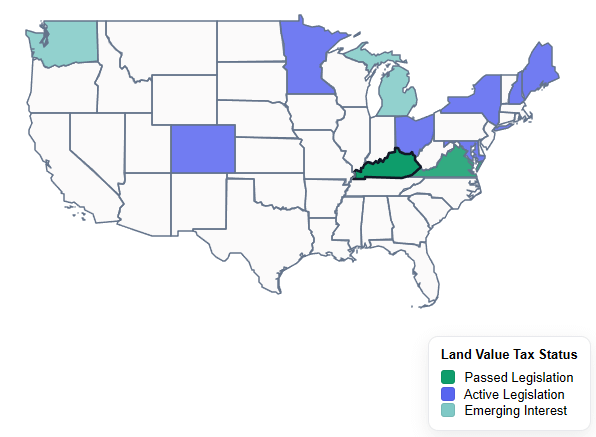
Virginia and Kentucky were the big winners for the 2026 legislative season, enabling various cities in those states to implement land value taxes. However, even bigger opportunities are coming. In Washington State, my organization is collaborating with the Sightline Institute on an upcoming LVT bill. Meanwhile, in New York, Governor Hochul extended authority for cities to utilize land value capture to fund new transit stops, a tool that can be used for the new Inter-Borough Expressway (IBX) subway expansion. We’re working with Niskanen Center, Center for Public Enterprise, and Institute for Progress to turn this idea into a real policy proposal.
Nor is interest in land value tax limited to the United States. The UK just elected a new prime minister, Andy Burnham, who has long openly advocated for a land value tax, and South Korea did the same last year with the election of new president Lee Jae Myung. Additionally, in January 2025, the German state of Baden-Württemberg implemented a new LVT that survived a subsequent court challenge. Although we’re tempering our expectations (the effective tax rate of the German LVT is quite low, and it remains to be seen how ambitious the Burnham and Lee administrations will be), it’s clear that LVT is no longer an obscure idea, nationally or internationally.
Finally, many now believe that the economic effects of AI developments may accelerate support for LVT and Georgism more generally. As newly minted AI millionaires bid up land prices in San Francisco and Seoul, Adam Ozimek argues that land will be a winner in the age of AI. Similarly, Aksel Sterri, co-founder of the Norwegian Effective Altruist think tank Langsikt, calls for an explicitly Georgist framework for understanding the AI era. (I’m also Norwegian; see my piece on Norway’s century-old Georgist tradition in natural resource management for more context on what Aksel’s talking about.)
So what have I learned?
III. My Theory of Change Was Wrong
I used to think LVT advocates had to change popular and elite consensus before moving on to the boring scut work of implementation. Now I realize that the boring scut work is actually what precedes, and even leads to, changing the consensus.
Overrated: winning online arguments
If you go back to the original series’ comments, you’ll see me trying to answer every concern that comes up, and falling for the bait when someone drags me into a tendentious comment thread dozens of replies deep. These would sometimes terminate in the interlocutor declaring that they’re the “exact kind of person Georgists need to convince!”
I’ve since learned that overly online keyboard warriors are the least important people to convince. The most important people are on your local city council or state legislature. Furthermore, instead of wasting time with hard cases or elected officials who are dead-set against your ideas, you’re much better off finding and working with people who are already interested in your principles. This often means giving up on your own city or state, at least for the time being, and pursuing a “succeed anywhere” strategy instead.
Changing policy where people want to change it is also how you overcome the “cold start problem,” when someone likes your idea but wants to see someone else do it first. Rather than trying to change that person’s risk aversion, find the person who is adventurous enough to try something new and work with them first. This builds case studies that you can use as social proof for the second, more cautious, wave of reforms.
I’ve also found that many online and academic objections are somewhat imaginary. When you talk to actual people in office, either their objections are entirely different from the ones you see in social media and comment threads, or they’re surprisingly open to being convinced if you listen patiently and present a clear argument backed by data and research.
Which brings me to…
Underrated: doing policymakers’ homework for them
No politician on earth has the time or inclination to independently learn about your philosophy, ingest all the arguments for it, evaluate a bunch of empirical and theoretical research, model its impacts on their locality, anticipate and respond to all possible objections, then wrap it all up into a tidy package complete with PowerPoint presentations, slick graphs, interactive websites, and a convenient, printable “one-pager” to hand out to interested parties.
You know who can do all those things? You.
For instance, some people get confused about land value tax, thinking it will wreck single-family homeowners, or that I’m out to get them personally, because obviously all the land value in town is concentrated directly underneath their specific home. This isn’t a disagreement about values or mechanics but rather a simple misunderstanding of what land value is and where it is most concentrated.
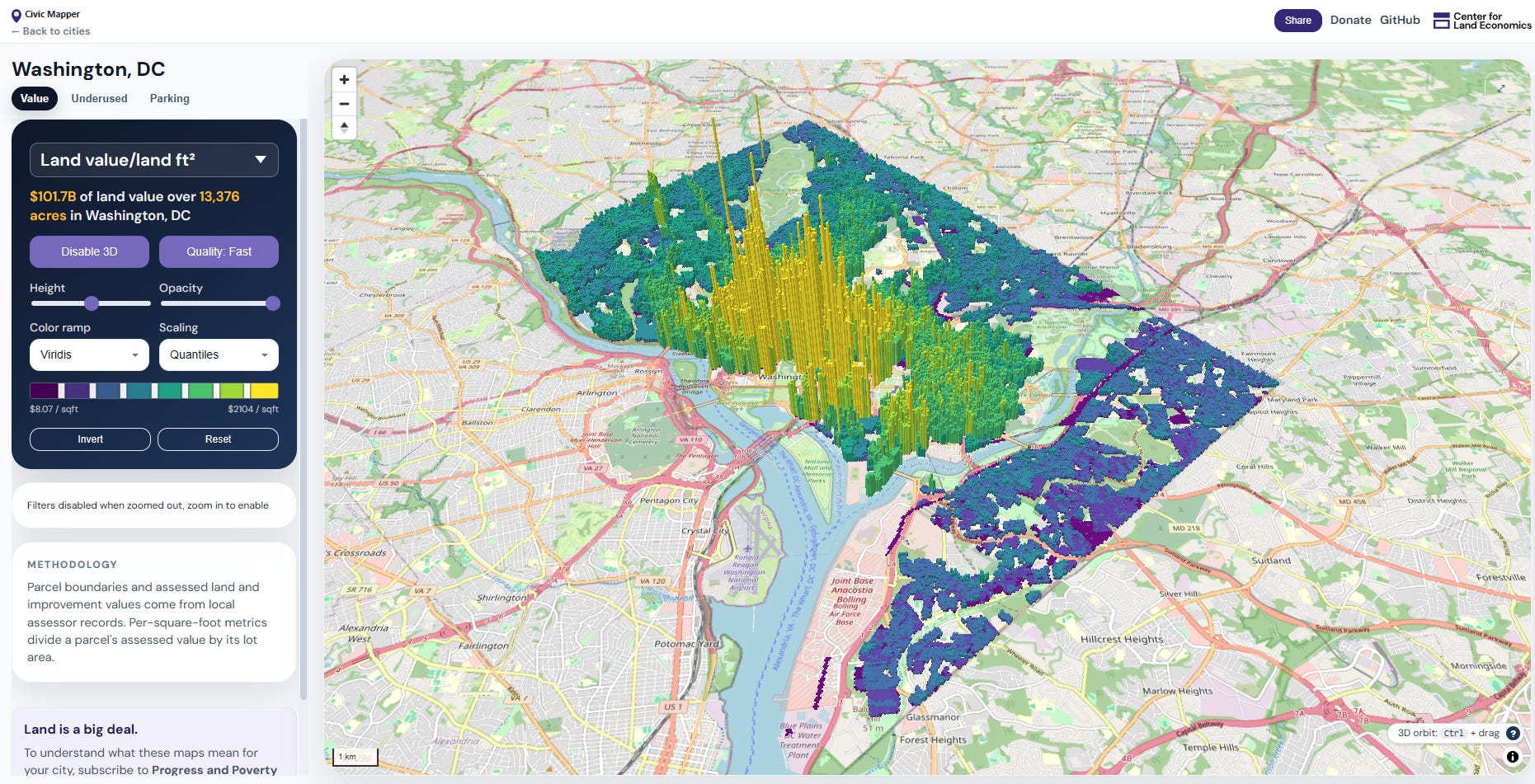
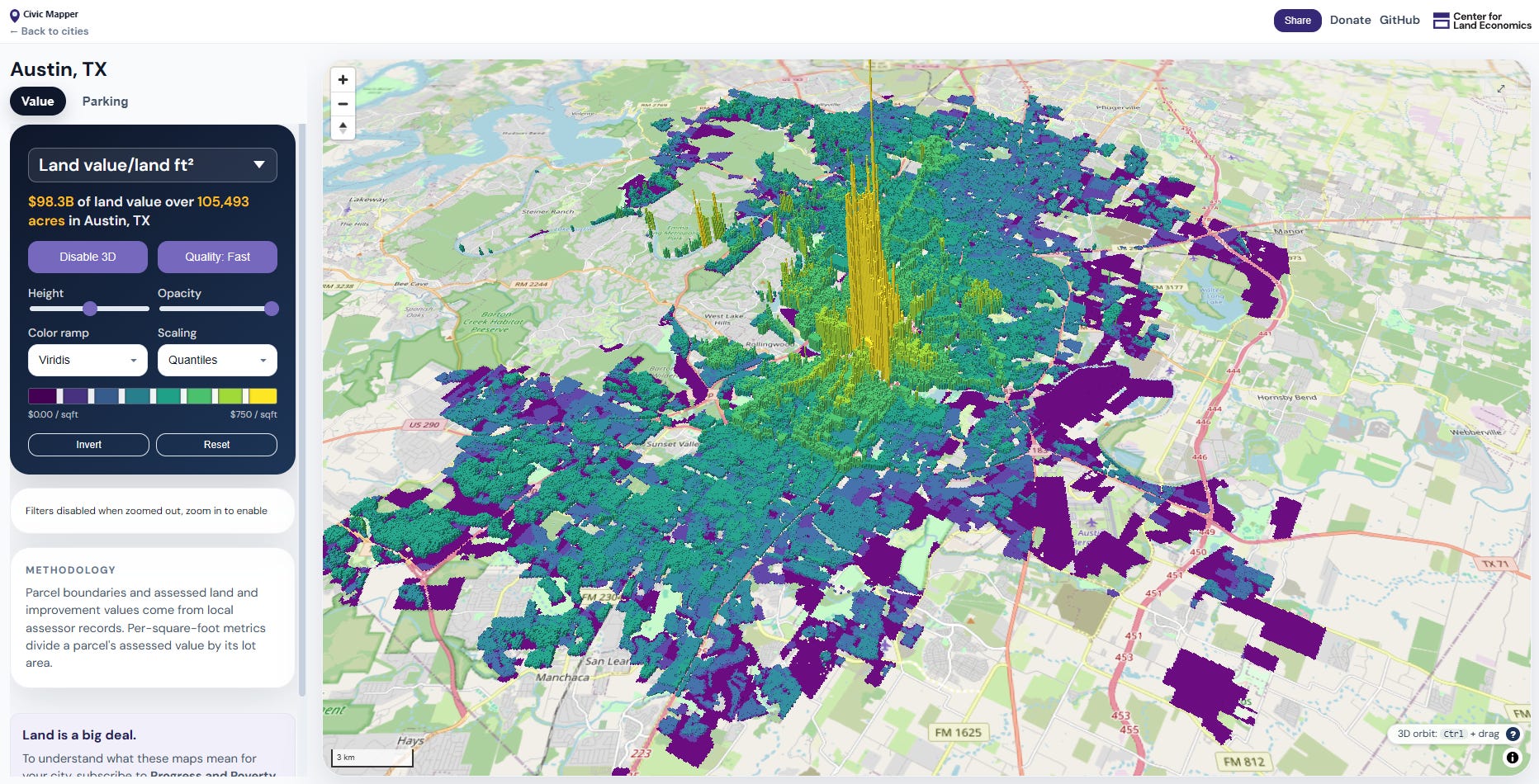
The first thing I do to disabuse people of this notion is to point out how much land value in any typical U.S. city is concentrated in downtown areas, and how much that value attenuates in the suburbs. We do this by loading up CivicMapper, our free, open-source 3D visualizer that takes local assessed land values and puts them on a map.
Here’s Washington, D.C.
Here’s Austin, Texas.
Here’s Seattle, Washington.
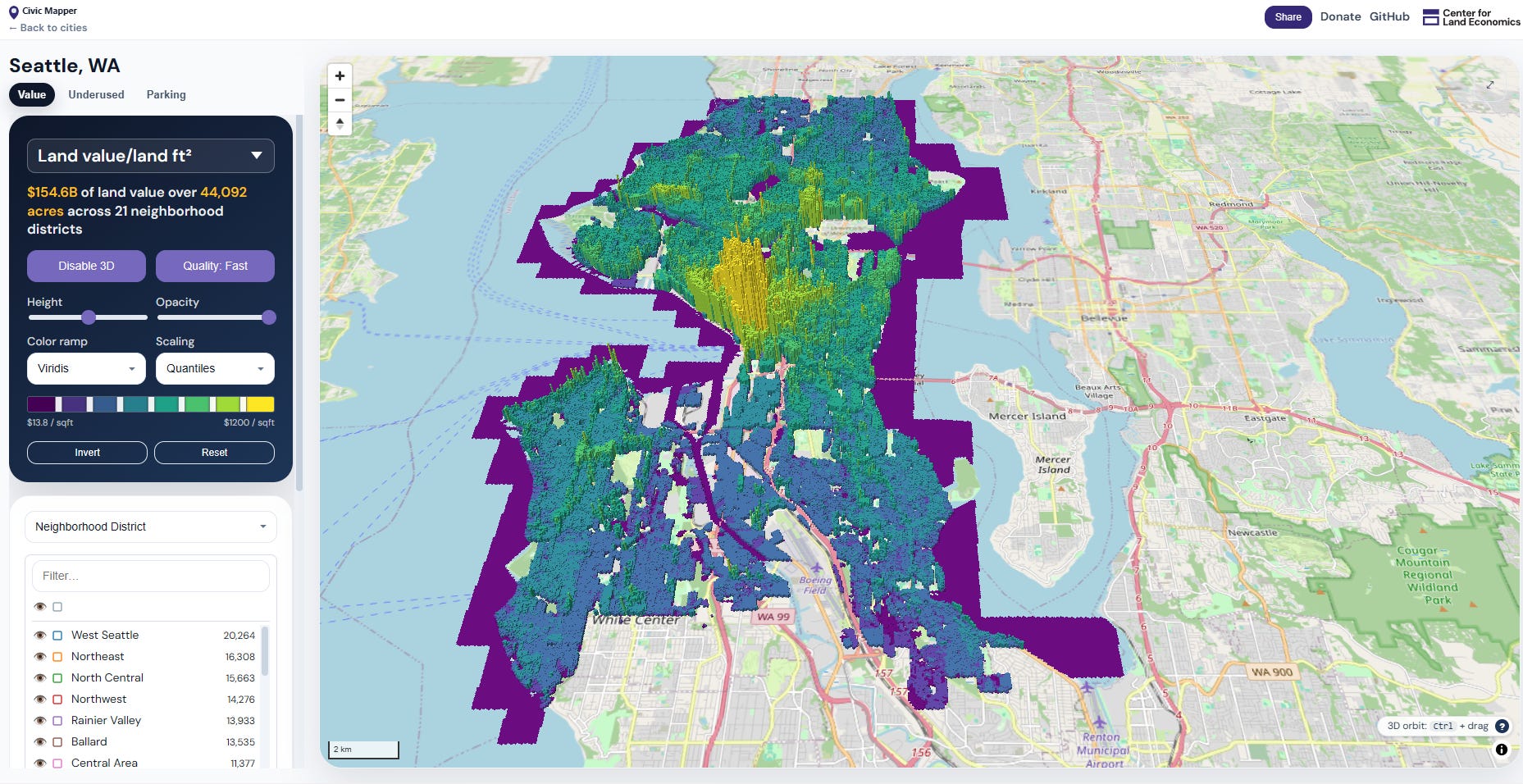
Not all cities look the same, and not all assessments are of equal quality, but you see the same basic patterns everywhere. Land in the city center is worth much, much more than outlying areas.
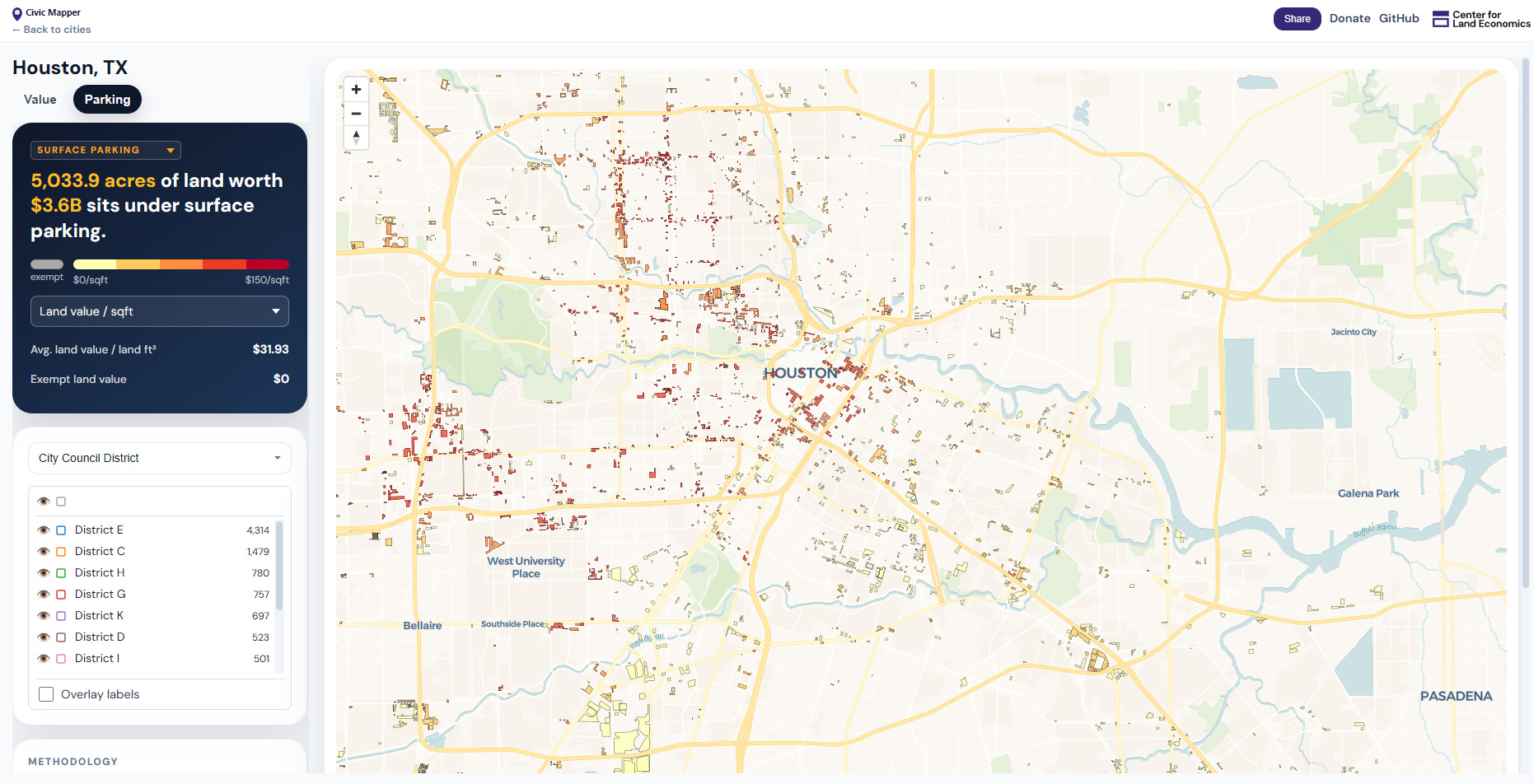
Then, we show people how much of that high-value land is dedicated to extremely low-value uses, like surface parking. Here’s Houston, which has over 3.5 billion dollars of land value locked up in surface parking alone.2
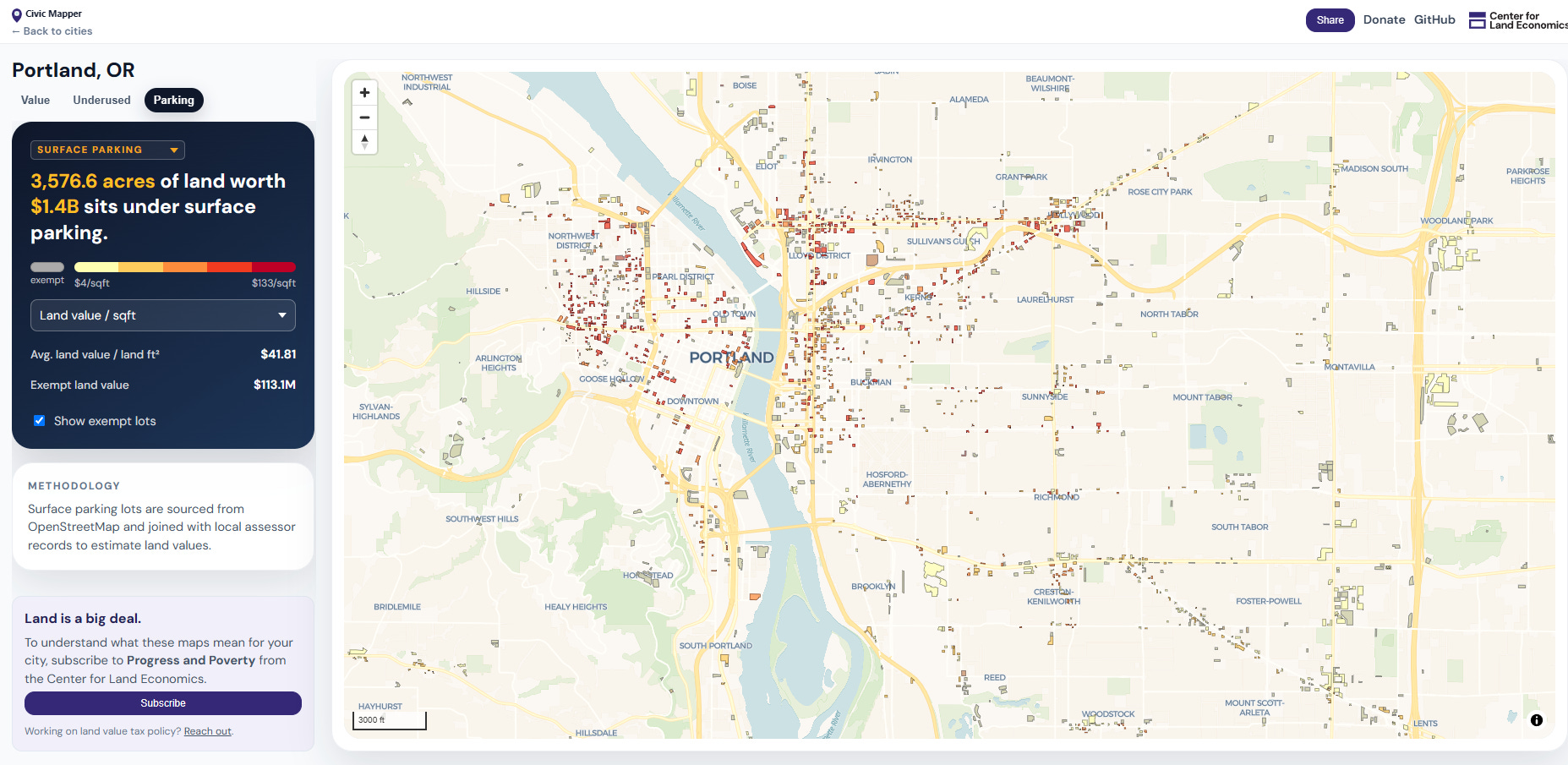
And no, it’s not just Texas. Here’s Portland, Oregon.
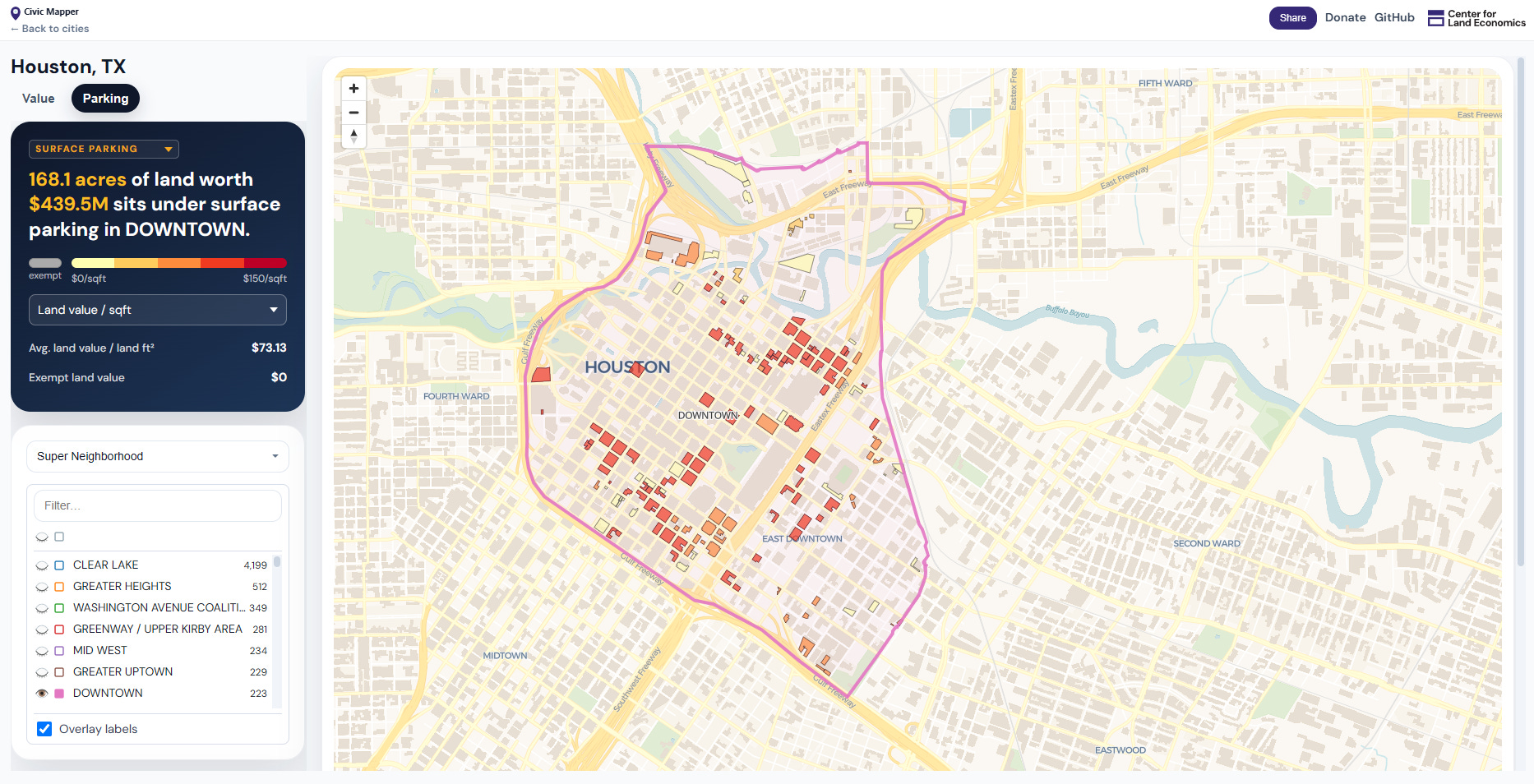
We can even zoom in and show how much of that surface parking occurs in the most valuable areas, such as Houston’s downtown district, which alone accounts for nearly half a billion dollars’ worth. These are exactly the places where it makes the most sense to concentrate development.
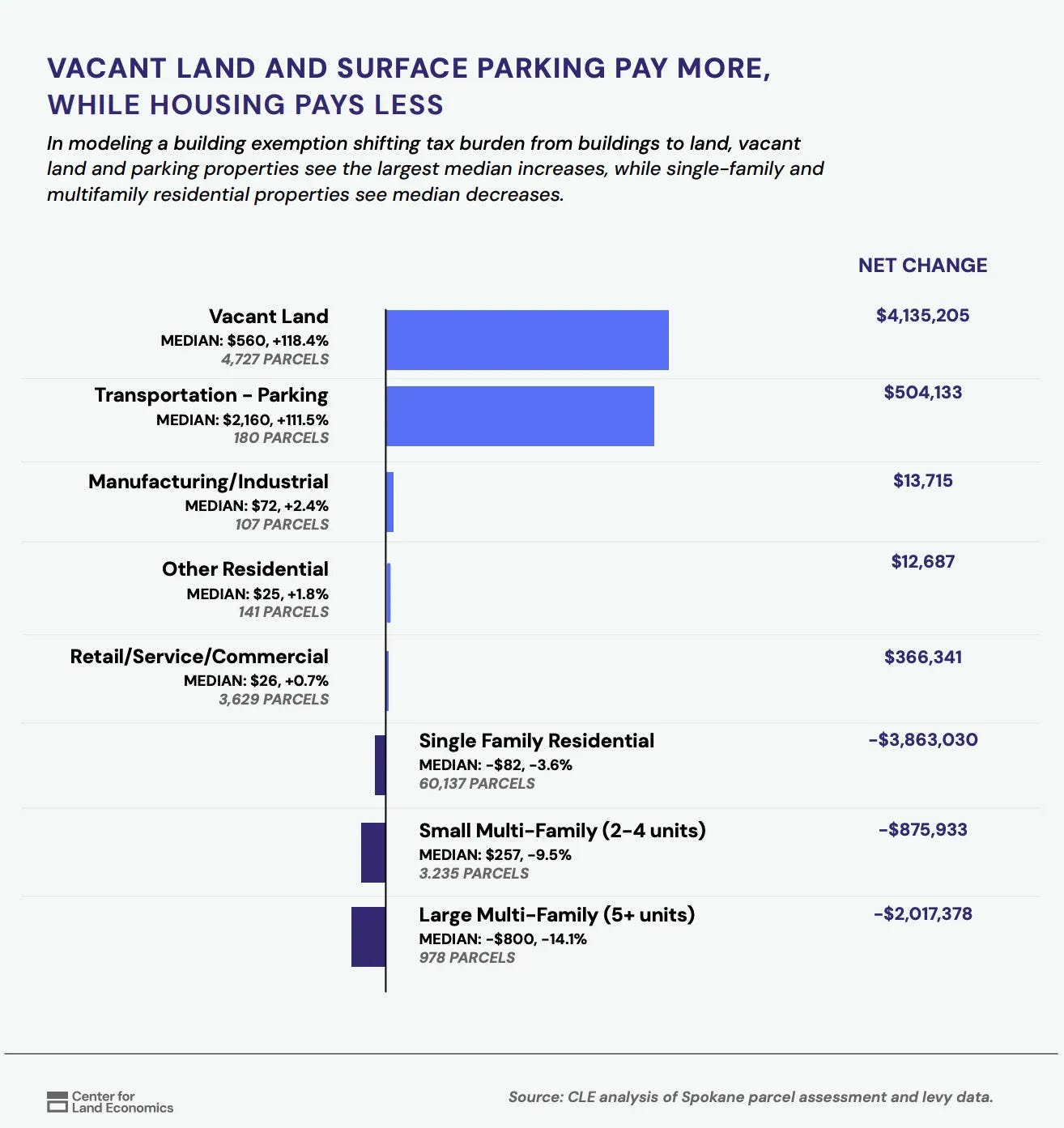
Having established that Land Is a Big Deal and that we’re also squandering it, we do the math and build a model of who wins and who loses under a revenue-neutral land value tax shift, or “Universal Building Exemption.” To do this, we use LVTShift, a free, open-source Python library maintained by the Center for Land Economics. In most of our models, the biggest losers are vacant land and surface parking lots, and among the net winners is the typical median single-family homeowner.
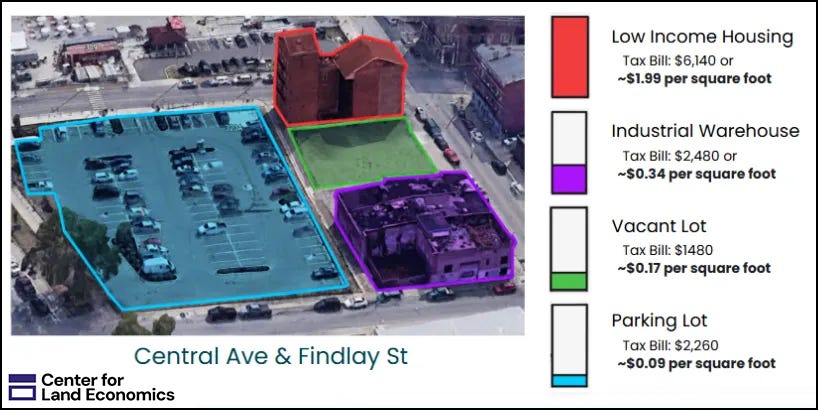
In addition to doing the math, we find compelling stories to tell. For instance, in this report on Cincinnati that we collaborated on with the Notre Dame Student Policy Network, we illustrate how conventional property taxes punish those who improve properties and invest in the city by providing housing and business, while those who own vacant lots or surface parking lots are rewarded for holding land out of use.
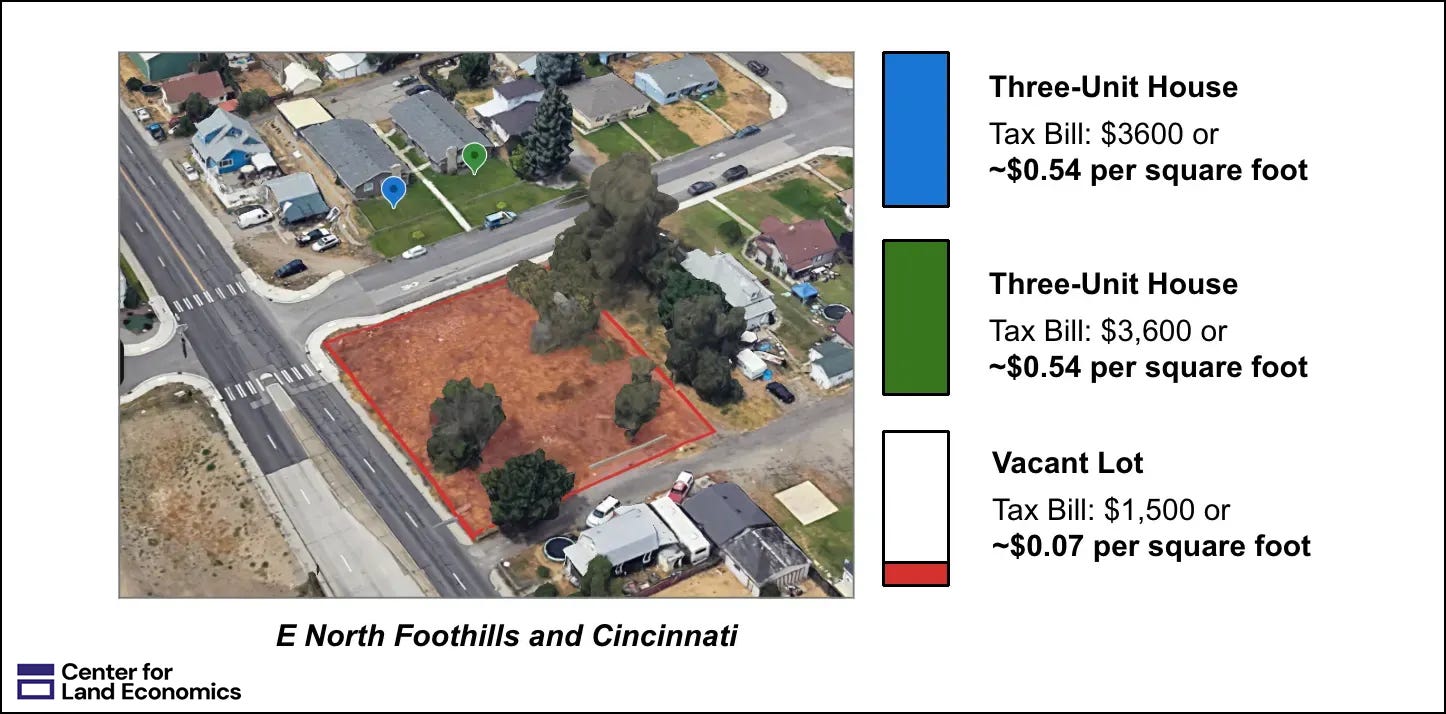
Here’s a similar comparison from our report on Spokane, Washington. The lots with houses on them pay more than seven times as much per square foot of land as the vacant lot does, even though all the land is equivalently zoned and similarly located.
We built up this methodology from crude beginnings by talking to people, trying things, learning from our mistakes, and refining our approach. Finally, we condensed everything we learned into a concrete political playbook entitled Enacting Land Value Return in Your Hometown, then published it as a guide for others to follow.
This playbook is now leading to wins. One of our activists, Jackson Arnold, a member of the Abundance Network, wanted to implement LVT in his hometown of Louisville, Kentucky. He got in touch with us, joined the OpenAVMKit Discord,3 and ran the playbook all the way from inception to getting a bill passed in his state legislature. We are now trying to figure out how to inspire and enable more Jackson Arnolds.
While the first wave of LVT fans were local citizens, we’re now attracting lawmakers’ attention. The most salient example is Bill Blessing, a Republican state senator from Ohio and chair of the Ways and Means Committee, who introduced an amendment to Ohio’s state constitution this year to legalize local opt-in LVT.
That’s all very exciting. But we still have one question to ask before we get carried away.
IV. Does Georgism work?
My three-part article series was structured as an investigation into the three most common objections to Georgism. We should revisit those and see where things stand in light of what I’ve learned since. The three objections were:
Land just isn’t a big deal anymore in the modern economy.
Land value tax will just be passed on to tenants.
Land value can’t be accurately assessed separately from buildings.
1. Is Land a Big Deal?
In Part 1, Is Land A Big Deal?, I ran the “land isn’t a big deal” theory against several testable hypotheses. Among the findings was the fact that sky-high urban real estate prices were primarily driven by land appreciation, and that land was a large and steadily increasing share of bank loans.4 The article’s centerpiece was an original estimate of the total land value of the United States, which was much larger than many had expected. Although this estimate fell short of what a “single tax” would require, it was still large enough to convince many that LVT had been unfairly dismissed as a serious policy proposal.
This article has aged the best of the three, but I still have a few updates to share.
Korea is a Big Deal
If land is a big deal in the USA, it’s an even bigger deal in South Korea, which has all the prerequisites for a national LVT and enough land value to approach a full-on single tax, or other ambitious projects like Universal Basic Income (UBI). Here’s a snippet from my piece, UBI Advocates should watch South Korea:
For UBI or LVT to succeed anywhere, they must first succeed somewhere…therefore, if you want UBI or LVT to succeed, you should scour the world for a place where these two policies are the most:
Economically feasible
Technically feasible
Politically possible
Socially and politically urgent
That place is South Korea.
South Korea has the highest land value-to-GDP ratio in the entire OECD, in excess of 500%. To put that in perspective, the figures from my own estimates of the USA’s total land values—which surpassed many readers’ expectations—were a mere 200% of GDP. My first instinct was that Korean land values must reflect a temporary, anomalous bubble and would soon revert. However, long-run land value-to-GDP ratios over the last 50+ years have ranged from 400%, and current values aren’t even the all-time peak, which clocks in at around 600%. Prime land is just that valuable and scarce in South Korea.
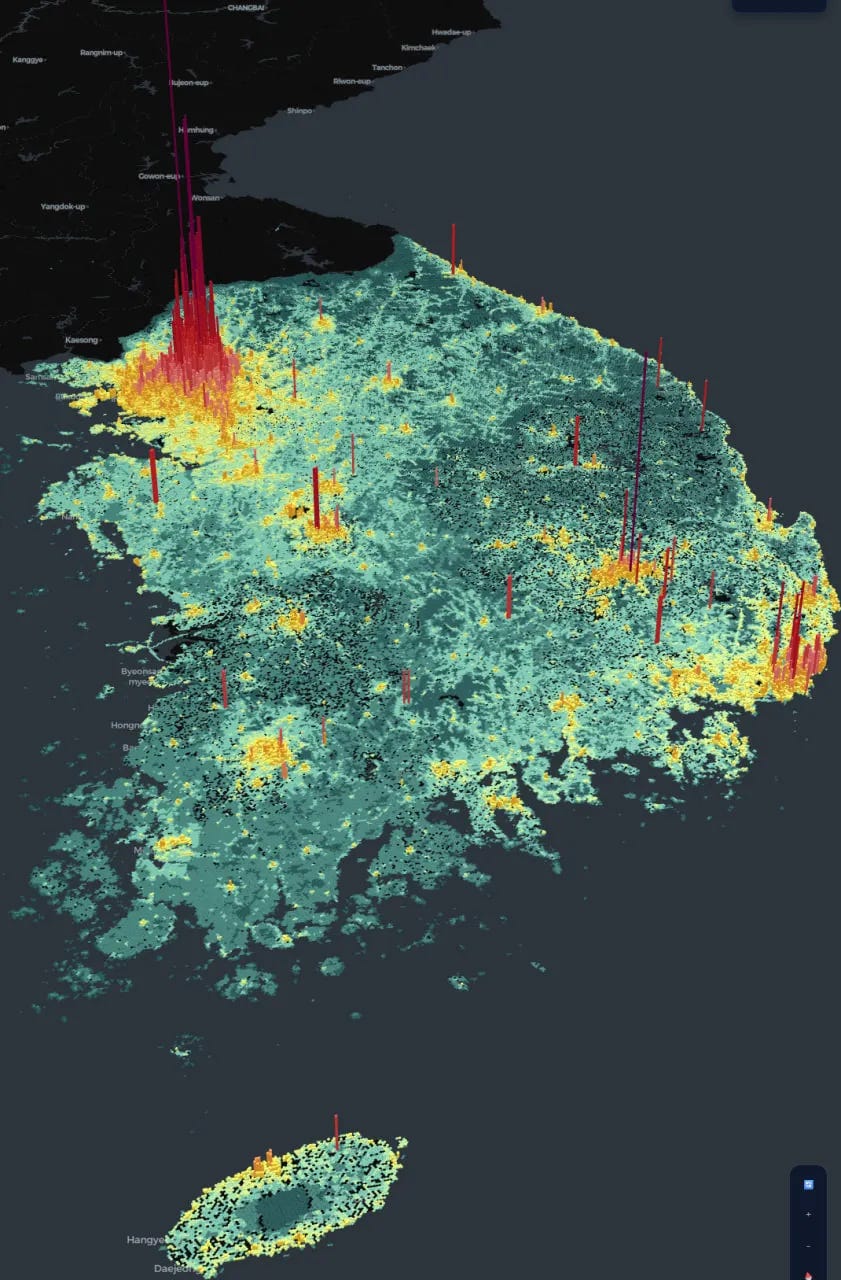
Where do these land value figures come from, by the way? Turns out, South Korea has one of the best-organized land valuation systems in the entire world, despite not having a land value tax, which we’ll discuss later.
In short, LVT in South Korea could raise enormous revenue. Land is already valued down to the individual parcel annually, the current president is sympathetic to LVT, and the urgency for socioeconomic reform in South Korea has never been higher. Although many daunting political obstacles remain, South Korea’s example makes it clear that land is, if anything, an even bigger deal than I originally thought.
Next, let’s address a few counter-arguments to the “Land is a Big Deal” thesis that I didn’t fully address last time.
What About Zoning?
One argument that often came up in comment threads was, “All we need to do to solve the housing crisis is upzone.” I certainly agree that upzoning is necessary, but I don’t agree that it is sufficient (which is something I also believe about LVT). Stephen Hoskins’ essay Land and Liberty to Build makes a great philosophical case for why YIMBYs should also be Georgists and Georgists, YIMBYs, to which I will add a few arguments of my own.
First, history falsifies the “upzoning is sufficient for affordability” hypothesis. If upzoning is all we need, we should not see housing affordability crises before zoning, which was not fully entrenched until the 1920’s. Instead, we see the opposite. The Georgist movement itself sprang from a massive housing crisis in the late 1800’s, decades before zoning became widespread. One could say, “Well, high-rise buildings hadn’t been invented yet, which is what you need to overcome land scarcity pre-zoning.” However, skyscrapers had been around for decades prior to the 1920’s.
Second, not every location is equally constrained by zoning. Michael Wiebe has a great article reviewing a recent paper that estimates the implicit “zoning tax” of various metros, finding that San Francisco is the most constrained, and cities like Cincinnati the least.
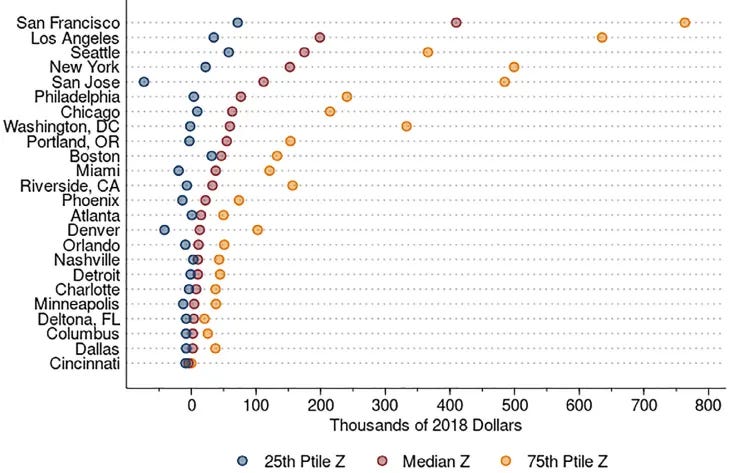
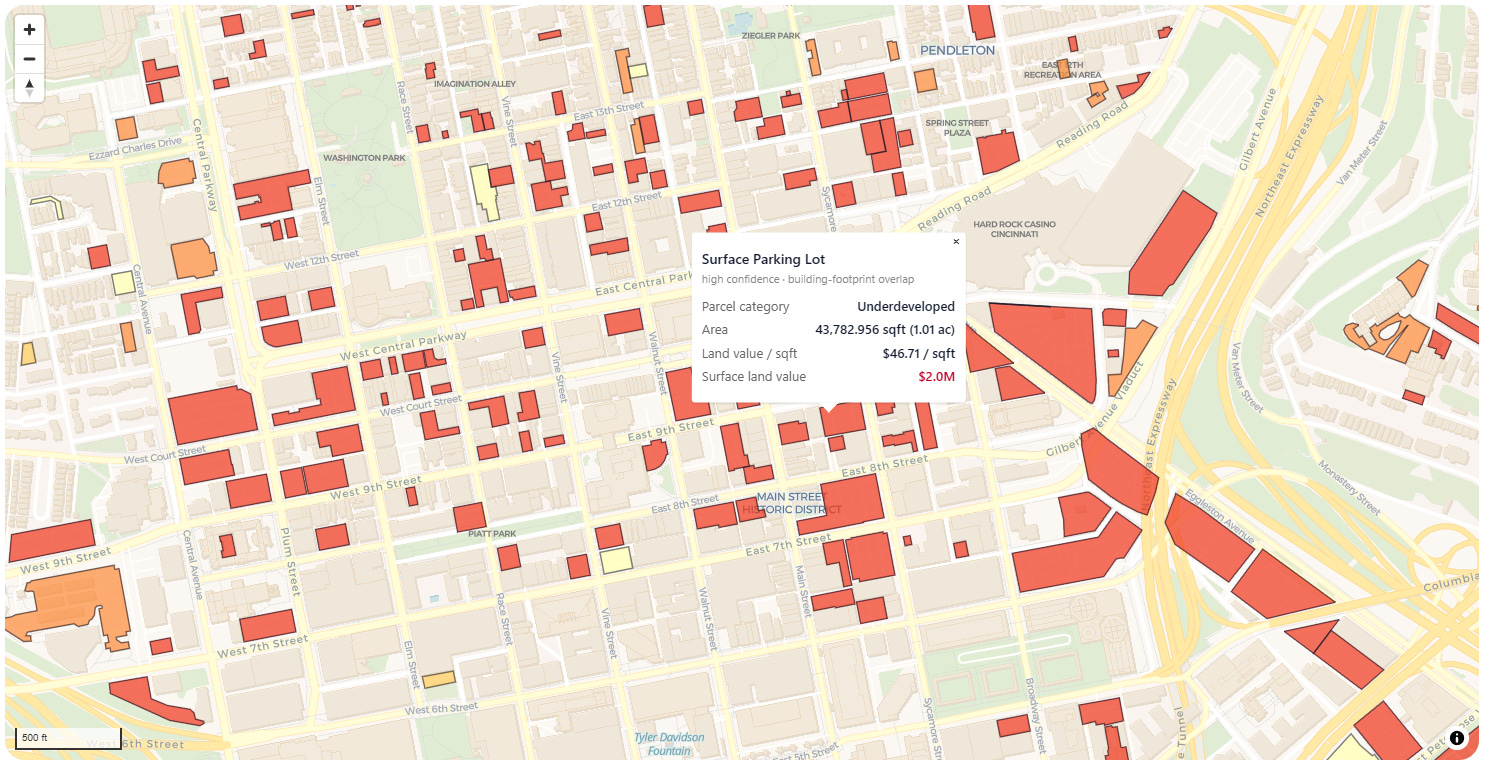
Even though cities like Cincinnati aren’t as expensive as San Francisco, they still have problems. It’s easy to find concrete examples of the most valuable land being held out of use even in the least constrained cities, which contradicts the “upzoning solves everything” argument. We’ve already shown you Houston (which has no zoning), but here’s a look at surface parking lots in Cincinnati’s downtown. You can find this pattern of wasted valuable land in just about any American city.
Let’s go back to this chart from Cincinnati.
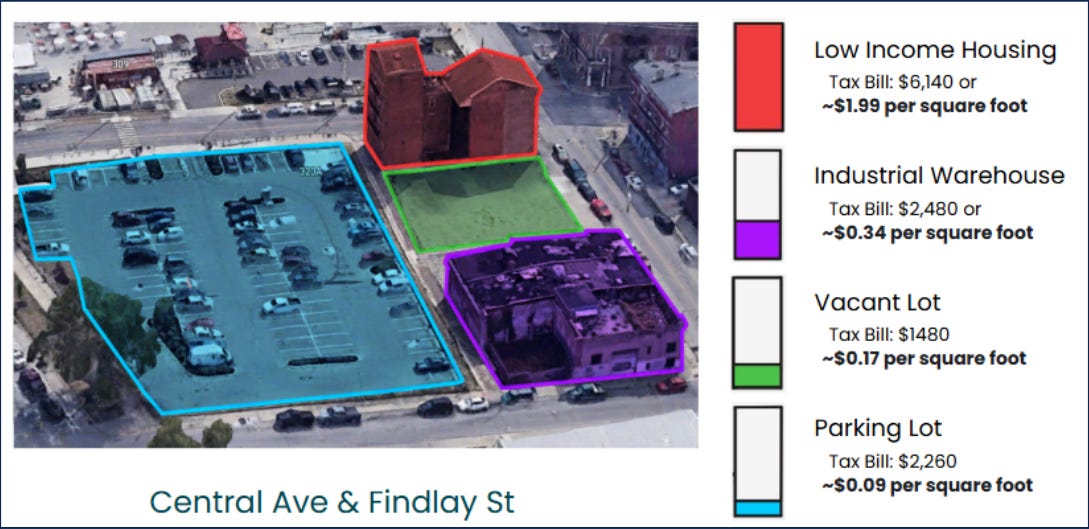
We can see that although all four parcels share the same zoning, the building component of the property tax gives them very different tax assessments per square foot of land. The tax system actively punishes the affordable housing complex for the crime of being denser than its neighbors.
Some LVT-skeptical YIMBYs also argue that, “Land is already taxed by conventional property tax, therefore we don’t need LVT.” The problem is that YIMBYs generally oppose “impact fees,” which are arbitrary extra costs local governments impose on new development. In Property Taxes are not Land Value Taxes, I argue that the building component of a property tax mathematically amounts to the same thing. I am more than happy to defend property taxes against those that wish to abolish them entirely, but I will continue to insist that the building component of the property tax is distortive in essentially the same way that impact fees are. My position is not to layer on an additional LVT but to lower (or eliminate) the effective tax rate on buildings, and simultaneously raise it on land.
The final thing I’m updating on is to give more attention to other ways of capturing land value than LVT alone, such as through ground rent leases. Jeff Fong, a prominent member of YIMBY Action (as well as our board of advisors), has an excellent piece called Georgism through Land Leasing that explores this potential.
That’s it for the “Land is a Big Deal” thesis. Here’s how I’ve changed my thinking on the other two articles.
2. Can Land Value Tax Be Passed on to Tenants?
In Part 2, Can Landlords Pass Land Value Tax on to Tenants?, I read more than a dozen papers on tax incidence and capitalization effects of land value tax and conventional property taxes. The evidence overwhelmingly showed that LVT is not passed on to tenants.
However, I’ve since found at least one condition under which LVT can be “passed on” to tenants: when housing is pervasively rent-controlled, and landlords are granted a special exemption to raise rents in direct response to tax increases.
To understand why, let’s review the traditional argument for why, in general, LVT is not passed on to tenants. Rents are not set by a landlord’s costs or desires but by supply and demand. The opposing view, the “cost plus” theory of rental pricing, makes several testable hypotheses, which this research brief by the Progress and Poverty Institute evaluates.5
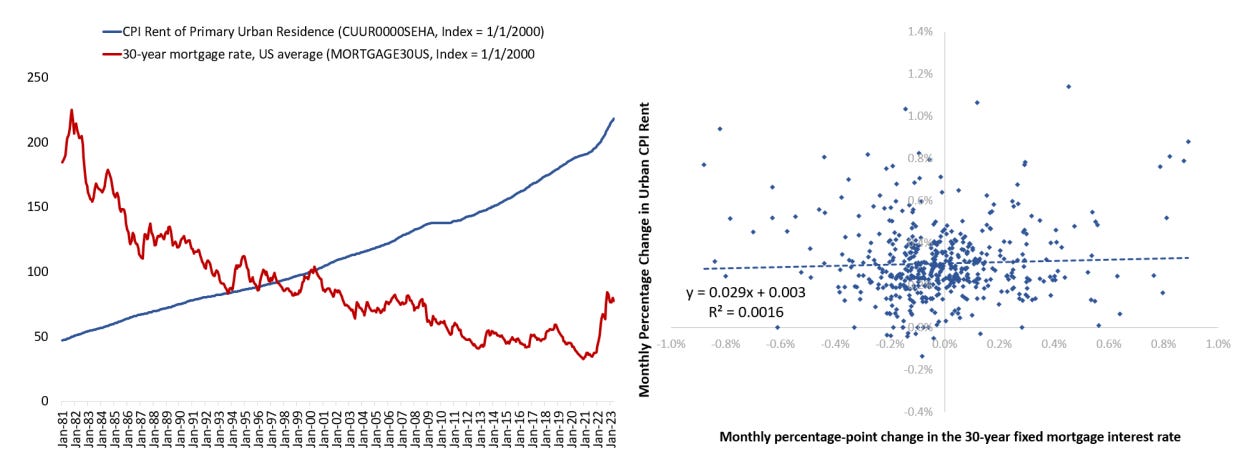
For instance, if landlords reflexively pass on costs (including holding costs like land value taxes) as higher rents, doesn’t that also imply they should cut rents when their costs decrease? Mortgage interest rates have fallen sharply over the past 40 years, yet rents have increased over the same time. Also, landlords who own their properties outright (and thus have no mortgage interest costs) don’t seem to charge different rents than nearby landlords of equivalent properties who are still paying off their loans.
However, these conditions don’t hold under pervasive rent control. If the prevailing rent is already well below what the market will bear, and a landlord is specifically allowed to raise rents by the increased tax amount to some new level that is still below true market rent, then logically, the tax will be mechanically “passed on.” This appears to be the case in Denmark, according to a 2024 paper by Nielsson, Wroblewski, and Yding.
Here’s a diagram illustrating the effect.
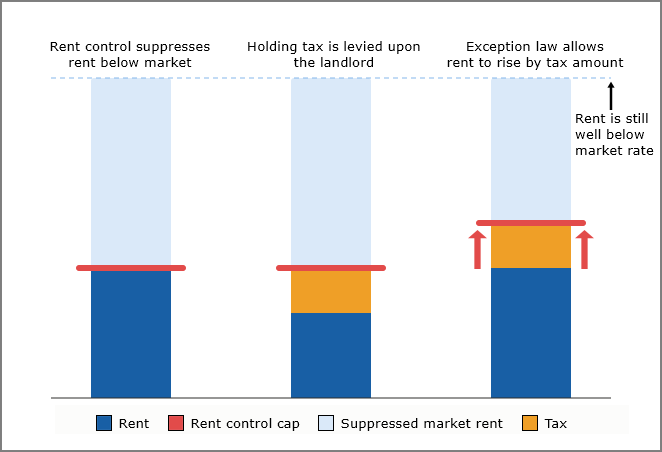
Without pervasive rent control paired with a special landlord tax break, the picture would look more like this.
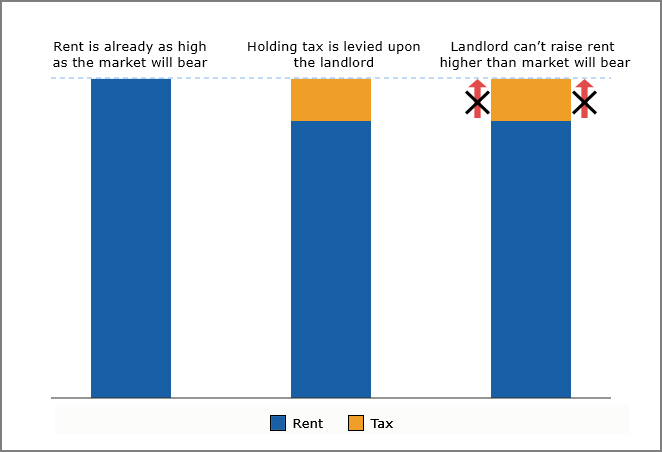
To raise rents in response to taxes, the tax must affect the supply of housing somehow. For taxes on buildings, this mechanism is obvious. Taxing buildings reduces the labor and capital spent producing and maintaining them, just like development impact fees. Less supply of buildings, with unchanged demand, means higher building prices.
Land, however, is not built. Land is inelastic in supply, and landowners don’t “provide” land the way laborers provide labor and investors provide capital; they un-provide land by excluding others from using it. Building supply can change in response to a tax change, but land supply cannot.
The Nielsson, et al. paper’s finding does make me discount the older Danish paper I cited in my second article somewhat, and I’m updating that there is at least this one exception that policymakers should be aware of. However, I don’t think Nielsson, et al. have made a convincing general case outside of these specific conditions, because the Danish case is only one data point among more than a dozen others, and the pass-through mechanism they describe is so narrow, specific, and clearly explainable.
An explanation sufficient to convince me otherwise would need good answers to these four questions:
Why don’t landlords cut rents when their operating costs fall?
When landlords threaten to raise rents in response to a future land value tax, why don’t they just raise the rents right now? Why do they have to wait until the tax is enacted?
Why do property developers subtract all holding costs (which would include both land value taxes and conventional property taxes) from their net operating income, which fully capitalizes into a lower offering price in their discounted cash flow pro-formas?
Will rents/housing prices, ceteris paribus, rise or fall in response to all property taxes in a jurisdiction being suddenly abolished?
I’ve always been happy to concede that the research on conventional property taxes has been more mixed, with some studies finding full capitalization, others finding partial capitalization, and yet others finding full pass-through. My understanding is that in those cases, local results depend on how responsive the supply of buildings is to marginal tax changes, which varies considerably from place to place. It makes sense that if you’re in a very NIMBY area that never builds anything no matter what, a tax change is unlikely to affect local supply.
Now, on to how I’ve updated my thinking in the final article on land valuation.
3. Assessing the Value of Land
In Part 3, Can Unimproved Land Value be Accurately Assessed Separately from Buildings?, I researched how assessors and academics estimate land value. I concluded: “It’s quite plausible but not a slam dunk. That said, if the objection is, ‘valuing land separately from improvements is fundamentally impossible, and we can never get better at it, so we shouldn’t try,’ I think that’s plainly ruled out.”
This is the article I feel has aged the least well—not because I’ve drastically changed my conclusion, but because for years now I have been studying property taxes, interviewing assessors, and evaluating valuation methodologies as my full-time job, which has given me a much better understanding of the details and procedures.
I have many updates on this topic, but we’ll start with the biggest one, which comes from South Korea, an existence proof that at least one country can do this efficiently and regularly on a national scale.
Maybe Just Send Your Office to South Korea
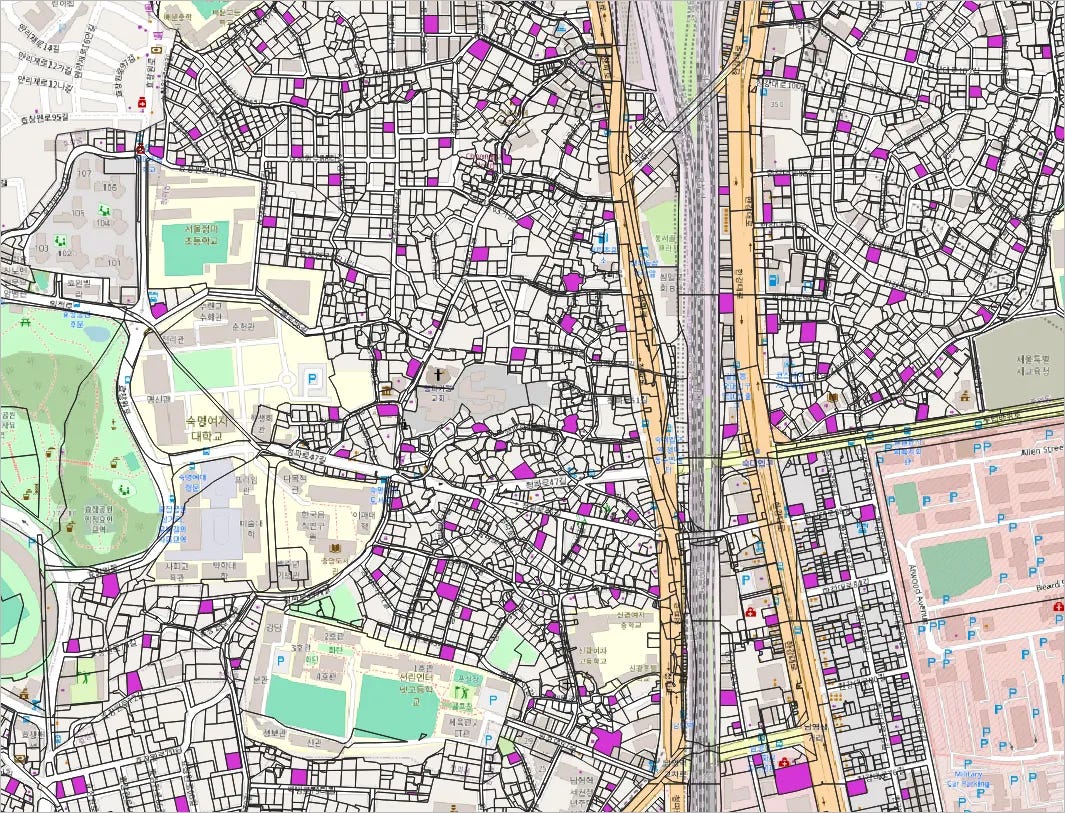
For my article How to Value Land: Korean Style, I interviewed Korean researchers Jinsu Lee and Vitnarae Kang and read hundreds of pages of dense Korean-language6 procedural documents published by MOLIT.7 The short version is that South Korea values all its land—the land value specifically, not just the total value—every year, down to the individual parcel, and gets the entire operation done in five months flat.
This is organized as a simultaneous joint effort by national and local governments, with the national government responsible for 500,000 “standard parcels,” chosen as locally representative parcels of that type in any given area. In all but exceptional cases, each “standard parcel” receives no less than two individual appraisals,8 and the final valuations for these are handed to local governments as valuation anchors. The local governments are then responsible for valuing all other parcels in their jurisdictions. This simultaneous top-down and bottom-up collaboration combines irreducible local knowledge with centralized support and standardization.9
The Korean case reveals that many arguments against land valuation’s feasibility are fundamentally provincial. The first such example is Wales, where a land value tax is being actively considered and where the government commissioned a report on the feasibility of land valuation, employing no fewer than six separate consultants. Although the findings seem comprehensive at first glance, not one of the consultants examines the Korean system, the single most relevant international example, in any detail. The closest we got was a single line in a report by Alma Economics, which buried the lede as follows:
In Korea, for instance, about 1,300 appraisers (2011 data) value sampled plots, with prices extrapolated to adjacent plots.
Another good example is Sam Watling’s “The failure of the land value tax,” published in Works in Progress magazine last March, which details the Liberal Party’s failed push for a UK land value tax in the early 1900s. In “Contra Watling on the failure of the land value tax,” I show that Watling’s assertion that a “pure” land value tax has never been implemented is plainly contradicted by easy-to-find historical examples, several of which even occurred at the same time as his singular UK episode. As for his other claim that land valuation is practically impossible, his main proof is simply that the UK couldn’t pull it off more than a hundred years ago, paired with the unevidenced assertion that the UK can’t manage it today. As of this writing, the UK’s per capita GDP is $24K higher than South Korea’s, and it has 18 million more people. The state capacity limits that he asserts prevent Britain from successfully implementing LVT would be a specific local dysfunction, and would presumably impede any reform the country pursued to address its housing crisis.
As for the Korean methodology itself, I was surprised at how little “magic” I found when digging into the details. The key differences from what I was used to were procedural and organizational. The valuation techniques themselves were no different from what you would expect to find in a particularly well-run Texas or North Carolina appraisal office. This brings me to my next major update.
There’s No Single Magic Algorithm
This will come as no surprise to anyone with a background in data science, but data quality and running a tight ship matter far more than which cutting-edge predictive methods you pick. South Korea is a great example, but other things I discovered kept pointing to the same finding.
First, I’ve learned that there’s a vast gulf between the world of academia and the world of working assessors. This gulf is not necessarily about knowledge or skill—I know many equally brilliant assessors and academics—it’s simply the traditional divide between pragmatic practitioners and theoretical researchers. Whereas academics are obsessed with r-squared metrics and pristinely crafted multivariate regression equations, assessors are obsessed with whether Jimmy has uploaded new sketches for the River Heights neighborhood yet, if Nancy’s new model can produce adjustments compatible with the new comp grid meant for valuation defense, and if anyone can get the damn CAMA10 vendor on the phone about whether that bug from six months ago has finally been fixed.
I’ve tried my best to help bridge that divide. My Mass Appraisal for the Masses article series is meant to help outsiders understand assessors, and my open-source Python library OpenAVMKit helps assessors understand and use academic machine learning models. I also routinely attend industry conferences; come see my presentation this year at IAAO National in Calgary, or next year at GIS/Valtech in Louisville, Kentucky!
Second, in Amateurs talk Algorithms, Professionals talk Data Cleaning, I explain that the single most important thing any office can do to improve its results is to check its data for invalid and anomalous sales, as well as mismeasured or unobserved building characteristics (particularly physical condition). The most valuable part of OpenAVMKit turned out not to be the fancy machine learning predictors, but simply better heuristics for detecting and diagnosing bad data inputs.
Third, I’ve changed my mind about the cost approach and now believe it is basically fine. For context, the “cost approach” estimates a building’s value by using construction cost tables to calculate the cost to rebuild a property, then applying depreciation based on age and condition. This was a method I criticized somewhat naively in my last article without fully understanding how and where it should be used. In fact, the prevailing methodology used in property tax offices in the United States, the “sales-adjusted cost approach,” yields reasonable land values as a side effect, at least when it’s performed correctly. I describe this method in How Appraisers Value Land, an interview conducted with veteran North Carolina property assessor Thomas Holding, who has thirty years of experience on every side of the appraisal industry, public and private, fee appraisal,11 and mass appraisal.12
Fourth, in How Georgists valued land in the 1900s, I researched how land was valued in the United States before the advent of computers and discovered a method favored by turn-of-the-century Georgists called the Somers system. Their secret? They just asked people what the land values were.
The Somers system sounded crazy to me at first, but the historical records indicate it was a serious method used for decades throughout the United States. The facilitators held a series of meetings where they gathered locals together and asked their opinions about relative land values, street by street. The whole assembly would argue back and forth until it reached consensus, which the moderator would record on a gridded map on the back wall. The goal was to encode relative values based on irreducible local knowledge, then calibrate them against market evidence to produce absolute valuations. This method gradually waned sometime around the 1950’s, but you can still detect tiny vestiges of it in the IAAO’s modern land valuation course.
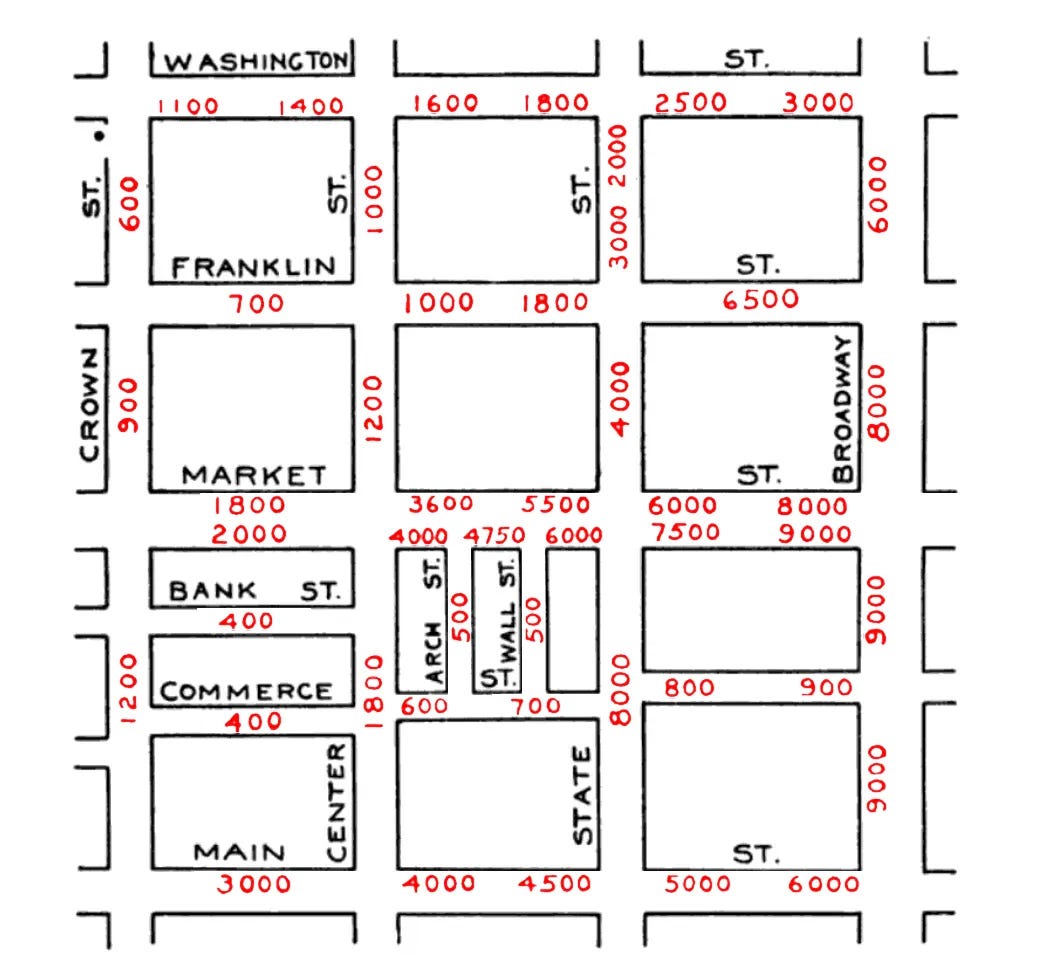
The most striking feature of the Somers system is that it was specifically optimized for maximum community buy-in. It did this by inverting the usual process of doing valuations first and then hearing citizen protests. Here, the “protest” phase came first, and valuations themselves flowed directly from citizen feedback. Although the Somers system is no longer in use in any jurisdiction I know of, more than one appraiser I’ve interviewed has said they have independently re-invented some variant of the method for areas with thin sales by gathering locals together and asking them to assign values to different areas by consensus.
Fifth, I discovered that even surprisingly crude land valuation methods can still work. In the late 1800’s, the German colony in Qingdao, China, instituted an aggressive tax on the unimproved value of land. Although Imperial Japan eventually conquered it and ended the LVT experiment, the regime lasted long enough, and the LVT was levied at a high enough rate (a whopping 6%), for the expected theoretical effects to be clearly observed. The case of Qingdao is well known, but a researcher recently discovered new German-language primary sources, including meticulous budget records and even full-color land value maps. These documents reveal that the land valuation methodology was to simply carve the city up into tax districts which locals judged to be of similar value and assign the same flat land value rate to all parcels within them.
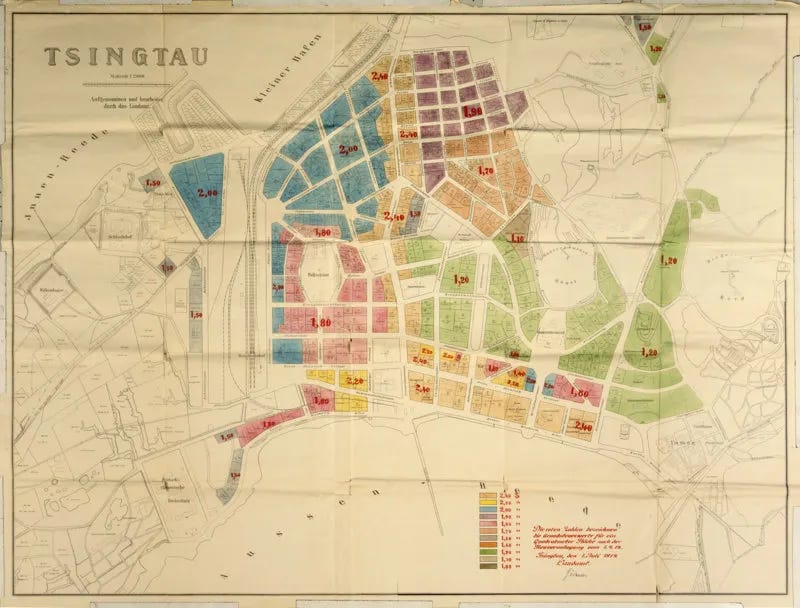
One of the chief things this style of land assessment gets right is ensuring local uniformity of land valuation for all parcels locals judge to be economically similar. This gives a potential answer to the question I raised in the last article: how good do land values have to be to be “good enough?” The Qingdao case, as well as other cases I’ve encountered, has led me to believe that the most important features of good land valuation are to:
broadly track market value and stay up to date
comport with local common sense expectations
be locally uniform across similarly situated and zoned land
Horizontal Uniformity
One deputy chief assessor told me that one category alone—complaints about unequal side-by-side property valuations for neighboring properties—accounts for fully 40% of his office’s annual protest volume. We uncovered exactly these kinds of horizontal inequities in our report on side-by-side land valuation anomalies in Baltimore, Maryland. Vacant lots in neighborhoods were valued at nominal rates, while equivalently zoned, similarly sized improved lots next door would have their land valued for ten times more on a dollar per square foot basis, providing a large subsidy to vacant lot owners and shifting the tax burden to homeowners and businesses.
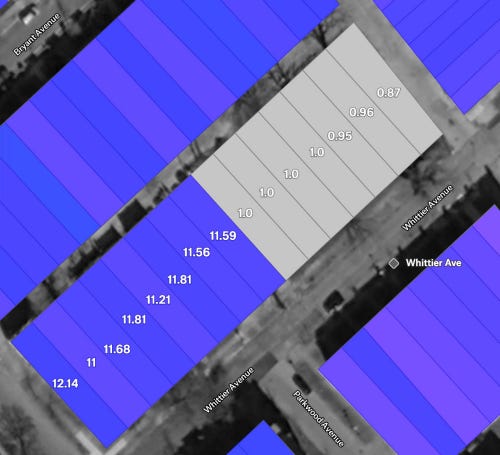
This error was simple to explain and easy for local stakeholders to understand. Shortly after our report went live, SDAT, the Maryland state agency responsible for valuation, announced an initiative to address the problem and has now begun correcting the undervaluation of vacant land.
Another common mistake is treating vacant land as having only nominal value and misapplying the “allocation method,” where land is assigned a fixed percentage of total property value, such as 20%. Assessors are supposed to apply the allocation rate to the prevailing median property price in the local area, thereby arriving at a uniform local land rate. When using this method, all similar land in the same area should be assigned the same local land rate.13 Instead, some assessors will mistakenly multiply each individual parcel’s total assessed value by the same fixed rate to arrive at a land value, resulting in land values that jump sharply from parcel to parcel, even when they all have essentially the same size, zoning, and location. This diagram illustrates the difference.
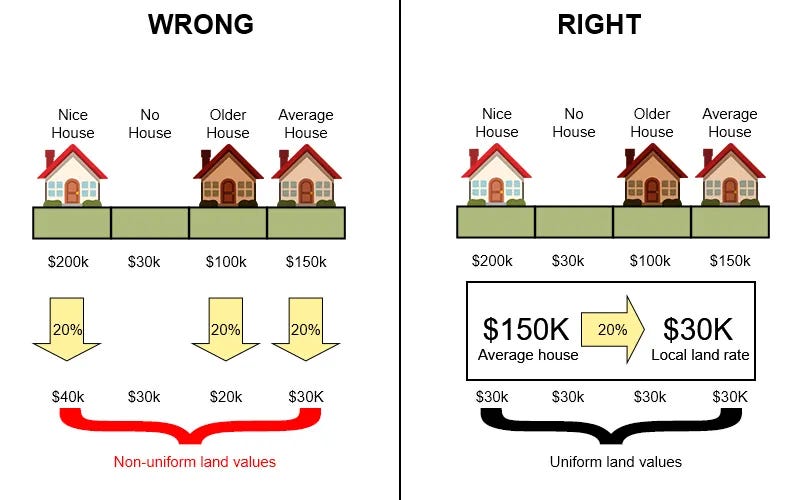
I demonstrate in my article Valuing Land: The Simplest Viable Method that, although we can and should value land more precisely than this wherever we are able, even this dead-simple land valuation method is sufficient to achieve the economic incentives of LVT. Qingdao provides us at least one empirical proof of that approach working in real life. Jurisdictions should make sure baseline land valuations meet this minimum standard.
Whatever you do, keep values up to date
I’ve also updated big time on what the single most dangerous mistake with land valuation and property valuation in general is: not updating your values. The North Star of property tax valuation is “equal and uniform,” and massively out-of-date valuations make a mockery of this principle.
“Equal and uniform” means everything should be valued by the same consistent rule, and similar properties should be similarly calibrated to their revealed market value. Even when mass appraisal methods involve estimates or errors, those estimates and errors should be applied consistently under a transparent rule.
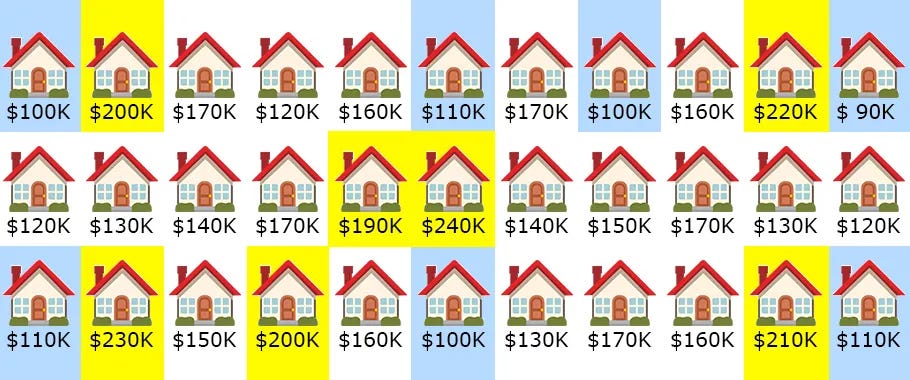
However, if property values haven’t been updated in twenty years, then the valuations have almost no relationship whatsoever with what the market is currently paying for those properties. Some people will be paying far more than their house is worth, and others will be paying far less. This is also why “just value the house at exactly what it sold for” is such a bad idea, because not every home sells every year. If you were to do that, a neighborhood full of identical houses, all starting at $100K, with prices going up by an average ~$10K a year, will look like this after ten years, with massive side by side inequities in valuation based purely on when a home sold, even though they all would sell for about the same price today.
Simple fairness and equal treatment under the law should be enough to establish regular reassessments for property tax purposes. If you’re an LVT advocate, however, the stakes are even higher, and there’s no better illustration of the cost of stale valuations than the repeal of Pittsburgh’s LVT.
Pittsburgh is one of several Pennsylvania cities that have historically had a split-rate property tax. However, long-delayed valuations followed by a poorly implemented revaluation triggered a tax revolt that led to the policy’s reversal. LVT advocates need to honestly grapple with this failure case if we hope to avoid it in the future.
Stale valuations create several problems at once. First, when valuations were finally updated, taxpayers got sticker shock because they had gotten used to values never changing. Second, the local government had become dependent on an outsourced vendor to perform the valuations. Third, public messaging was poor, and the outsourced valuations were opaque, drawing sharp criticism and widespread protest. One thing led to another, and the split-rate property tax was repealed.
This is another place I notice the provinciality of objections. In the Northeast, where many jurisdictions revalue infrequently, many see revaluations as inherently fraught, expensive, and politically risky. At the same time, I know plenty of jurisdictions in the Sunbelt that uncontroversially revalue on three-, two-, or one-year cycles and efficiently process enormous volumes of routine property tax protests.
Revaluation only seems daunting for the same reason that going to the gym does when you haven’t done that in a decade, either. The more frequently you revalue, the more quickly you notice and fix errors in your data, bugs in your process, and anomalies in your algorithms. You’ll have better accuracy, better horizontal uniformity, and better vertical equity. You’ll also get better at explaining and defending your values to the public. If you do the reps, you’ll get the gains.
On the other hand, if you let revaluations slide four years, then six, then 10, soon no one in the office will have been around for the last revaluation, let alone anyone who gains compounding experience and knowledge year over year. Before you know it, you’ll be on the phone with an outsourced vendor who knows they have you over a barrel, insisting on a multi-million-dollar contract, take it or leave it.
The good news is there’s hope. Decades after Pittsburgh’s LVT repeal, members of Pro-Housing Pittsburgh got so tired of the mounting valuation inequities that they took matters into their own hands. They downloaded OpenAVMKit, fed it local public data, and built their own AVM. They generated fresh valuations, ran statistical tests, and proved that their values tracked market value more closely than the outdated official figures.
Finally, the last thing I’ve learned is the answer to the last unanswered question.
V. Why did Historical Georgism disappear?
The short answer is cars.
The long answer is that America is a nation with a frontier mentality which has lost its frontier.
The looooong answer is so long it takes two articles to explain: What happens when America’s Monopoly board fills up?, and The Housing Ladder’s Broken Promise.
Let me summarize key parts of those here.
The frontier was always America’s answer to the land problem, and it still is in many people’s minds. “Just work hard, save money, and buy cheap, high-opportunity land, as I did.” The first American frontier was literal: “Go West, young man.” It worked out great for the settlers, and less great for those excluded from it (Indians, slaves, and others). When the first frontier closed, the first Gilded Age dawned, as did the scarcity and inequality that stirred Henry George to action.
However, in the century that followed, amid two world wars and a great depression, we also invented the automobile, and with it the ability to sprawl. Whereas before you had to live close to your job, fighting over scarce supply and struggling under crushing land rents, now you could keep a nice paying job in the city but live cheaply out in the suburbs. The power of sprawl released land-rent pressure for about a century. Ironically, George should have predicted this effect, as it’s a straightforward application of Ricardo’s Law of Rent.
To be sure, sprawl came with a cost—massively inefficient use of land, environmental damage, fossil fuel consumption, weak municipal finance, redlining—and it also had natural limits, because commutes can only get so long. However, America was happy to pay those costs, and it served its purpose for as long as it lasted. Unfortunately, the second frontier is now effectively closed. Pressure is mounting again, and a time has dawned that historians are already calling the Second Gilded Age.
Switching gears, I’d like to take a moment to talk about how weird it is that talking about land value tax is somehow my full-time job.
VI. I Guess This is My Life Now
Everything happened so fast.
After I wrote the LVT articles, my social media feeds suddenly blew up. My DM’s overflowed. Famous personalities like Noah Smith, Vitalik Buterin, and Scott himself endorsed my book. I got cold calls from prominent writers and politicians wanting to talk to me about land value tax, and I even got invited on a tiny up and coming podcast by some guy called Dwarkesh. Scott gave me a research grant from ACX to study land valuation, which led to an opportunity with a venture-backed property valuation startup.
Then, barely a year later, tragedy struck.
On October 20, 2023, while undergoing a routine medical test, my 7-year-old son, Nikolas, suffered a catastrophic brain injury, leaving him alive but severely disabled and in need of constant, intensive care. We were shocked, devastated, grief-stricken. There are no words profound enough for such a loss, and yet, there was no time to process or mourn. Overnight, my wife and I were thrust into the relentless world of full-time caregiving, all while parenting our other two children, working full-time, meeting family and community obligations, and battling the medical insurance industrial complex to avoid going bankrupt. On November 8, 2024, a little over a year after his brain injury, Nikolas died suddenly from cardiac arrest. I quit the startup and almost everything else in my life.
At this point, I was forty years old and had just lost my beloved son. I had no idea what I’d do next or how I’d take care of my family. I gave up on the movement, my career, and every dream I’d ever had. That’s when I got a call from a young man named Greg Miller.
I remembered Greg. He had originally reached out while I was still working for the startup, when he was working for the federal Department of Housing and Urban Development (HUD). This was in the immediate wake of the Lahaina wildfires in Hawaii in August 2023, and Greg wanted to discuss policy recommendations for deterring “disaster speculators” who liked to take advantage of families’ grief to buy their land for cheap right after a disaster.14
It had been more than a year since then, and Greg had just taken over as head of the Tom Johnson Foundation, another ACX grantee I had helped get started as an outside advisor. Greg’s pitch was that with my theoretical and technical background, and his policy chops and personal network, we should be able to make significant progress in getting LVT policies enacted throughout the United States. Besides, I needed a job anyway, right? I said yes.
We re-christened the Tom Johnson Foundation the Center for Land Economics, revived the then-sporadically updated Progress and Poverty substack with a new weekly posting schedule, and got to work. The results are chronicled above.
On behalf of my wife and me, I’d like to say that Greg Miller was there for me in the darkest and most hopeless moment of my life, throwing me the lifeline I needed to pull me out of the deepest emotional pit my family has ever been in. If it wasn’t for him, however things would have turned out, I certainly wouldn’t be involved in the LVT project today. I will forever be grateful to him.
So, how have we accomplished everything we have in the (less than) two short years the CLE has been around? That was another big lesson.
VII. It’s not who you know; it’s who knows you
All of this started with writing blog posts, and much of what came later at the Center for Land Economics also came from writing blog posts.
Getting even one local land value tax implemented in the USA requires many stars to align. You need a jurisdiction with surmountable legal barriers, decent land assessments, a persuadable local government, and a capable and motivated local activist. If you go searching for that needle in a haystack with your bare hands, you’ll never find it. However, if you stop searching with your hands and start searching with a magnet, you’ll find it immediately, because then the needle finds you.
I could never have accomplished any of this without the people who have helped me along the way. I also could never have found those people by myself, because I wouldn’t have known to reach out to them, or how. Instead, they reached out to me. Not because I’m rich and famous, or well connected and influential, because I am none of those things. Nor was it because I lived in one of the cool global cities where such connections are naturally forged just by going to parties, because I can’t afford the land rent, so I live in some Texas town nobody outside the state has heard of.
No, the only reason I’m writing this today is that I wrote a book review for a contest, and a lot of people liked it.
But why did they like it?
Why did so many people reach out to me?
Why did the LVT movement hijack my entire life?
I don’t think it’s because I’m particularly smart or persuasive. I think it was something else. I think my articles took off because I put into words something many people were already thinking.
VIII. Why I even care about any of this
When my son died, I spent a lot of time thinking about what I wanted out of life and whether it would be better to give up on this whole LVT project, whether it was all in vain or just some pointless, ego-stroking pursuit.
Then I thought about how much AI is driving real estate prices up. I thought about how politicians in Texas and Florida are trying to abolish property taxes, and the disastrous effects that will have if nobody offers a credible alternative. I thought about how many young people say they’re putting off getting married and having kids until they can afford a house. I thought about how my house has nearly doubled in value, even though it’s definitely not in any better shape than when I bought it. I thought about how I could never afford to buy a house today in the same neighborhood I grew up in, and how there are no trick-or-treaters there on Halloween anymore. I thought about how little my wife and I used to pay in rent, how lucky we were to buy a house at just the right time, and how expensive housing will surely be by the time my daughters grow up.
Land is a big deal.
By George, let’s do something about it.
If not for ourselves, then for all the children counting on us to share the earth with them.
Sincerely,
Lars A. Doucet
Center for Land Economics
Progress & Poverty Substack
Although the single tax was a bold proposal in its own time, it was not quite as audacious as it might sound today. Back then, government spending was much lower and highly dependent on tariffs, and the modern federal income tax had not yet been enshrined.
This is almost certainly an underestimate, because our current algorithm relies on Open Street Map tags, which we know for a fact misses many surface lots.
OpenAVMKit is our open source mass appraisal library, which also serves as a community for like-minded technologists.
Mike Bird, writer for the Economist, would later cover this subject in his book The Land Trap.
Formerly the Robert Schalkenbach foundation. Also, Progress and Poverty Institute should not be confused with Progress and Poverty Substack, which is run by us, the Center for Land Economics. Yes, I know it’s confusing.
Ministry of Land, Infrastructure, and Transportation
These are individual appraisals, equivalent to what would be called “fee appraisals” in American assessor parlance, which is distinguished from mass appraisal.
This is not to say that the Korean system is perfect–a search of Korean language sources easily turns up complaints and controversies, much like any mass appraisal system does. Among other concerns, Korean Georgists insist the official land valuations understate the true value of land, while others complain the specific valuation mechanics that led to each individual valuation are not fully transparent.
Computer Aided Mass Appraisal, the name for the software packages assessors use; basically glorified databases with valuation features.
This is when you get an individual appraisal, typically to secure a loan from a bank for a property you want to buy.
This is when you need to value a whole bunch of properties at once, either for government tax purposes, or for real estate websites like Zillow or Redfin.
This is a simplification, glossing over procedures such as selecting the appropriate land unit (fixed lot, linear frontage, frontage with depth curve, square foot/acre, etc), as well as applying additional adjustments for deviations and hyper-local effects.
Incidentally, Greg and I finally put together a post-disaster anti-speculation policy together, you can read it right here.