

A friend asked me to investigate the following mystery: why do 5-10% of skulls from 10,000 BC to 3,000 BC, all over the world, have holes in them? Why do bone growth patterns indicate that most skull-hole-havers survived years after their holes were drilled, even though brain surgery today requires careful sterilization (and frequently, prophylactic antibiotics) to prevent fatal infections? And why did everyone stop doing this sometime around the beginning of recorded history?
Was it cultural diffusion? No. Trepanation (the technical term for drilling a hole in the skull) was common across Europe and South America, with scattered cases in Africa and other continents. The Old and New Worlds had limited contact after about 10,000 BC, and most customs don’t survive for five thousand plus years with no reason.
Was it good medicine? Sort of, but not in a way that entirely solves the mystery. Trepanation is an effective treatment for epidural hematoma: a patient ruptures a blood vessel in their skull, filling the cranial cavity with blood, and the pressure rises so high that it squashes various vital blood vessels and brain regions, killing the patient. Drilling a hole in the skull releases the blood, relieves the pressure, and saves the patient’s life. This is great, but these kinds of hematomas are very rare: today, about 1/100,000 per year, mostly skewed toward older people.
So how do you get 5-10% of people trepanned? I think there are two reasons. First, prehistory was very violent. People were frequently hunting ferocious animals and murdering their friends in tribal quarrels. Epidural hematoma is 1/100,000 in our modern society where people almost never hit their next-door neighbors with flint axes. In a prehistoric culture where people hit their next-door neighbors with flint axes all the time, you presumably get hematoma rates far beyond any in recorded history.
Does that get you a 5-10% hematoma rate? No, there is no plausible amount of axe-hitting and mammoth-hunting that can do that. And although more men than women were trepanned, there were still a lot of trepanned women, even though they were presumably staying out of these quarrels. And although some trepanned skulls show head trauma, others don’t. So there must have been something else going on.
I think the second reason is overgeneralization. Many different cultures observed that trepanning sometimes worked for hematomas. These cases were rare, but they were very dramatic: a comatose person on the edge of death suddenly wakes up and feels fine. The prehistoric people who observed this didn’t know what a hematoma was, so they came up with some other explanation (classically “it lets out the evil spirits”). Then they tried the same procedure for other ailments, just in case they were caused by the same sort of evil spirits who caused hematomas. Having generated this hypothesis, the usual placebo effect and occasional coincidental recovery ensured that they kept doing it.
(5-10% of people do get migraines; if you already know that drilling a hole in the skull to let the evil spirits out works sometimes, it probably feels pretty tempting several hours into a migraine attack)
Next question: how did these people survive, when modern brain surgery requires careful sterilization?
Primitive surgeons drew on thousands of years of trepanation experience and stopped at the dura, a layer partway between the scalp and brain. This was enough to relieve epidural hematoma, but stopped short of the most vulnerable and infection-prone areas. They might or might not have been able to examine the dura and determine the rare cases where it was necessary to escalate to a subdural incision, but it wouldn’t have been very often. The scalp has unusually good blood flow, and if you’ve got to make an incision without antibiotics, it’s probably your best bet.
Also, primitive bacteria are weaker than modern hospital bacteria. Modern bacteria have co-lived with large agglomerations of humans for thousands of years; hospital-based variants have gotten transferred from patient to patient by any hospital staff who don’t wash their hands effectively. Wounds that would lead to disaster in modern patient without careful antisepsis and antibiotics might just not be a problem in the primitive environment.
Why did trepanation stop? The most technically correct answer is that it didn’t; occasional examples survive into historical times, and surgeons use a functionally-similar procedure to relieve hematoma today. But it stopped happening to 5-10% of people, probably because the rate of injuries declined with the advent of civilization. As people got fewer head traumas, there were fewer cases of miraculous recovery, people stopped being so impressed with “letting the evil spirits out” as a cure for everything, and they came up with better placebos like prayer or amulets or resveratrol.
When did the Western world give up belief in the classical good-for-everything version of trepanation? I can’t tell for sure, but it seems to have been sometime between 2015 and 2020, which is when the trail goes dark for the International Trepanation Advocacy Group, ITAG. According to its founder, Peter Halvorson:
ITAG is a grass roots organization comprised of people from many backgrounds and races who have experienced the benefits of being trepanned. Some of us are willing to present ourselves publicly so that the old stigma associated with making a hole in the skull will be worn down over time. When people say that they need something or other... "like they need a hole in the head", I laugh and think, '...if they could only have the experience themselves.' At age 57, I've been trepanned now for thirty years. I had the unique opportunity to learn how trepanation can improve mental functions back in my twenties when I traveled abroad. In Amsterdam, I met Bart Huges, the originator of the scientific concepts of consciousness expansion. I gave the subject a thorough review. Enhanced brain functions seemed a perfect antidote to the suffering and despair I observed in the world around me. I saw how people settle for less and have diminished expectations as their energy fades; how they lose direction and settle into an identity much smaller than who they really are.
They speculate about the meaning of life without ever doing much of anything to make their lives meaningful. I wanted none of that suffering for myself. I chose an uncharted course. I managed to get myself trepanned as a young adult. I've seized advantages as they've come my way. I'm committed to my own well being; I've never had a regret about it. You could say I'm a maverick. Through my own trials and tribulations I've been strengthened by the enhanced physiology that's stayed with me. It's there when I'm sleeping. It operates in the background. I find myself busy long after others are asleep. I'm ready to start again early in the A.M. The truth is I can't get enough of life. Some have called it "the fire from within." In mythology it's known as "opening the third eye." For me it's been the energy to stay the course, to persevere, to be the last man standing.
They argue that trepanning increases the volume of blood that can get to the brain. Analogizing it to the fontanelle (the “soft spot” that all babies have in their skull at birth), they conclude that it restores childlike health, creativity, and ability to grow. They join mainstream medicine in recommending against self-trepanation, but seem to have found an anonymous Mexican surgeon who would do it for only $2,400. No wonder they got so many volunteers:
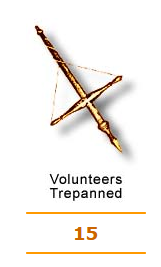
As late as 2018, the ITAG website (trepan.com) said they were busy trying to do pilot studies to verify their claims. But in 2019, the site went down, and I can’t find any evidence that the organization continues to exist. After over 10,000 years, it seems like this ancient practice is well and truly gone.