

There Were Lots Of Invitations, And I Know You Sent Me Some
In 1917, three children in Fatima, Portugal claimed to have seen the Virgin Mary. They promised she would perform a miracle on a certain day in October. Nearly 100,000 pilgrims arrived, hoping to see whatever happened, and nearly all report that the sun turned pale, changed color, and spun around.
Many other writers have investigated the children and their visions, but I was fixated on this sun miracle. Despite popular discussion of “mass hallucinations”, this is AFAICT the only example of tens thousands of people all saying they witnessed the same impossible thing, at the same time. I got kind of obsessed with this; you can read my preliminary investigations in this, this, and this post.
One of the first things I found was that there were many other sun miracles - at least ten! - similar to Fatima. Most were associated with Marian apparitions, but one was at a Buddhist temple. Bigfoot only gets sighted by lone hikers; ghosts are only ever in the corner of your eye; UFOs are just blurs in the sky. Of all the countries and outposts in the vast empire of the unexplained, it’s only this one phenomenon - the spinning, multicolored sun - that regularly gets seen by thousands of people at once, in broad daylight.
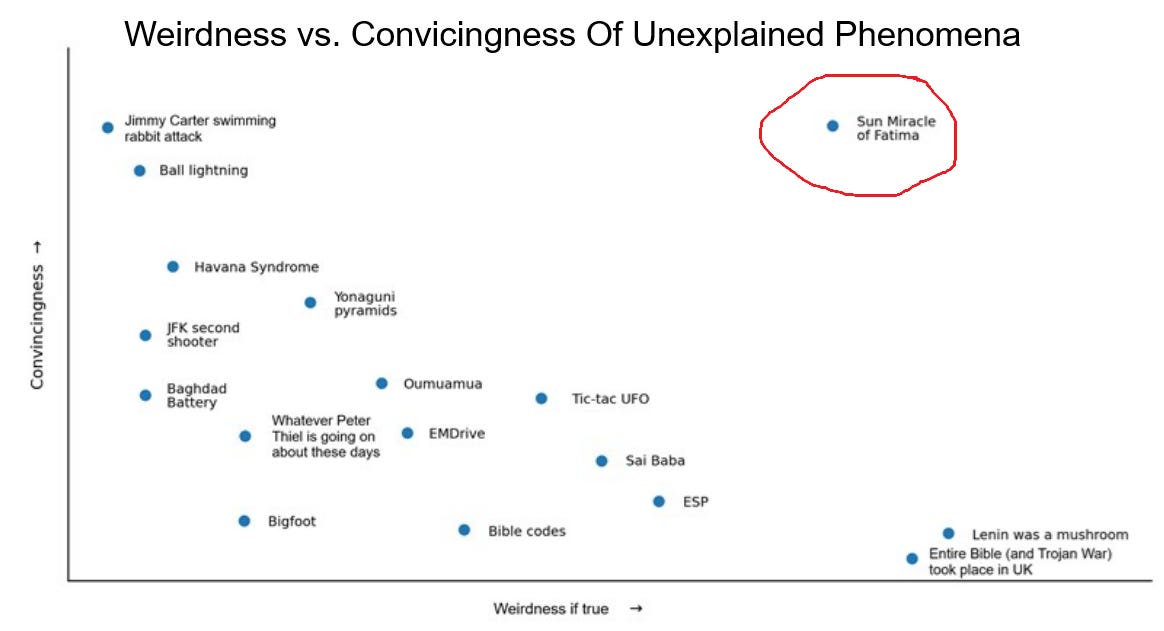
Speaking of “regularly”, there’s one spot where it continues even today. Fifty years ago, the Virgin Mary appeared to six children in Medjugorje, Bosnia. Now those children are well past middle-age, but she continues to come. Three of them report that she’s appeared less frequently as the years go by, but the others still see her every day at 6:40 sharp. Travelers to Medjugorje, especially those passing through around 6:40, report a slew of miracles, including the spinning sun. Certainly this is true of those whose hearts are pure. But even the atheists get lucky sometimes.
I was shocked never to have heard about this before. There’s a place you can just go, and have a decent chance of seeing a real miracle? People take vacations to the Bahamas for the beaches, when they could go instead to Medjugorje and see the natural law of the universe get violated in real time? Seems crazy!
So in early April, I and my extremely-accommodating, long-suffering wife flew to Dubrovnik, rented a car, and drove down a series of windy mountain roads toward the Bosnian border, hoping for a miracle.
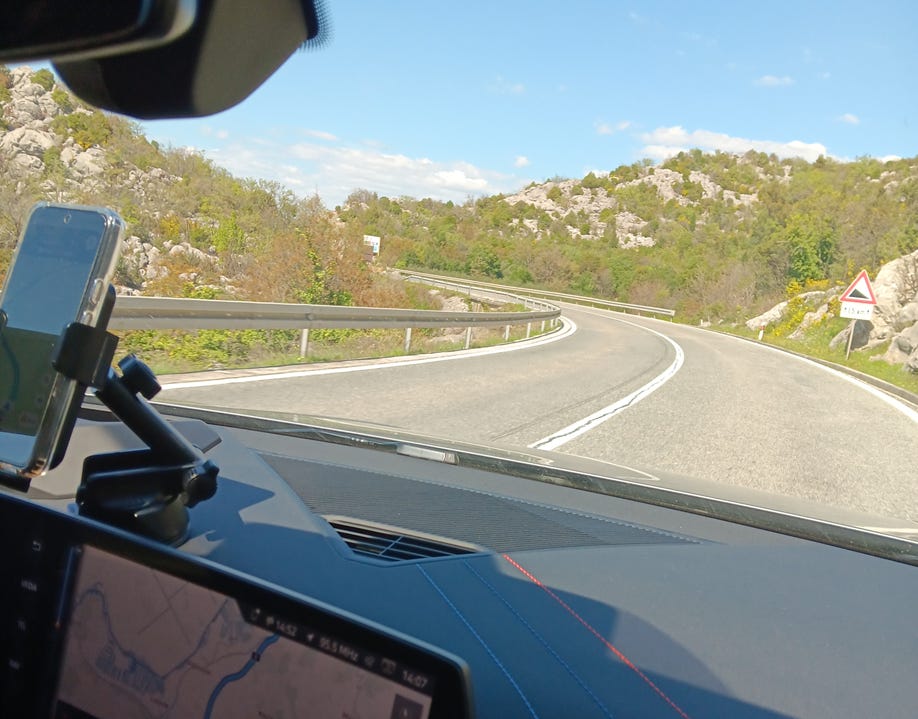
The Sands Of Time Were Falling, From Your Finger And Your Thumb
Our story begins at 6:40 on June 24, 1981, at the very beginning of the slow-motion collapse of Yugoslav communism. Two teenage girls walking in the countryside suddenly perceived a glowing woman on a nearby hill, but were too scared to approach. The next night, a group of villagers came to investigate. Most of them saw nothing, but six children - including the two original visionaries - saw the woman again. Compelled by a force they couldn’t understand, they ran up the hill at a speed later determined to be impossibly fast, then fell to their knees on the rocky ground.
“Be not afraid,” said the figure, was now clearly visible as a girl about their own age. She introduced herself as the Virgin Mary, and said she had chosen this town for a special role in her project of bringing peace to the world. “Give us a sign,” pled one of the children. The Virgin suggested they check the time, a suggestion so bizarre that they instead remained transfixed on her. She said1 that she would give them ten secrets to keep until the appointed time. In addition, each would play their own special role bringing her message to a different demographic: Vicka and Jackov to the sick, Ivan to the young, Ivanka to families, Marija to the souls in Purgatory, and Mirjana to the unbelievers. Then she vanished, promising to return at 6:40 the next night.
Mirjana, the girl charged with ministering to the unbelievers, was the first to finally check the time, and found that her watch had reversed. Not in the sense of “it was running backward”, but in the sense of:

And as part of her ministry to the unbelievers, it was Mirjana who wrote the definitive book about the apparitions:

As an unbeliever, I was happy to have it, and it’s my source for the rest of this story.
The next few weeks were a whirlwind demonstration of both the best and worst of humanity. Thousands of pilgrims descended on Medjugorje, begging for scraps of information, miracle cures, or word about the fate of dead relatives. The visionaries tried their best to relay the flood of requests to the Virgin during their daily meetings; she answered some requests and denied others, without obvious pattern. The children’s families and the local priests tried to shield the children from getting totally overwhelmed, from angry unbelievers, and from angry Christians who thought this was a scam and a blasphemy against the Virgin’s name.
The Communists interpreted the whole thing as a threat and decided to move against it. They didn’t want the PR blowback of persecuting innocent pure-hearted children, so they focused on the surrounding village - blocking the roads, arresting the priests, posting guards over the hillside where the apparitions occurred. None of it worked: desperate pilgrims walked around the roadblocks, the revival continued apace without any clergy, and it turned out that although the Virgin had first appeared on that spot of hillside she was equally happy to show up elsewhere.
After a few weeks of this, the Communists decided that okay, fine, they would persecute innocent pure-hearted children, and they whisked the six visionaries off to terrifying interrogations at various police stations, jails, and mental hospitals (though the government never worked up the nerve to actually imprison them). “Confess your deception immediately, or we’ll lock you up and throw away the key!” the bad cop would say. Then the good cop: “Just tell us who it was who put these silly notions into your head, and this can all be papered over without any trouble.”
Mirjana goes more into her own personal story. Her parents lived in Sarajevo; she had been in Medjugorje visiting an aunt and uncle. The authorities carted her back to Sarajevo and told her to not to return to Medjugorje if she knew what was good for her and her family. The Virgin continued to visit her in Sarajevo, even while the rest of her life fell apart. The Communists arranged for her to be expelled from school, and she had to go to a remedial school for the worst and most hopeless students (needless to say, she ministered to the teenage criminals and prostitutes with perfect Christian grace and love). Then, hoping to starve her out, they began making arrangements to fire her parents. The family considered their options, and decided on a sham divorce. They had a “fight” where Mirjana’s father “demanded” she recant, “leaving” her and her mother alone and penniless when she refused. As a result, he was allowed to keep his job - and used it to pass money under the table to Mirjana and her now-single mother. The Communists never did figure out why she wasn’t starving, and failed to come up with any more schemes to force her compliance.
Even as she dealt with these practical crises, she struggled with a more spiritual one: the Virgin Mary is so much more beautiful and glorious than any part of earthly existence that, after seeing her, it becomes hard to appreciate ordinary life. Mirjana described whiling away the hours, listlessly waiting for her 6:40 visitation. After a few years, the Virgin Mary declared their work together mostly finished, switching their daily schedule to an annual one, and the visionary fell into a deep depression. Her parents, her friends, and the Virgin Mary all got concerned for her, urging her to try to bring spirituality and religion into her ordinary life by praying and doing good deeds. This worked a medium amount, and she was able to go on living in between visitations, though always with a sense of loss and longing.
If you can’t beat ‘em, join ‘em. Eventually the Communists decided that the role of Medjugorje in the global revolution was as a revenue-generating tourist trap, and they relaxed restrictions on the site. Mirjana was allowed to return. She reintegrated into the village, married, and had children, thinking to live a normal life. It wouldn’t happen. The flood of pilgrims grew to a torrent. The quiet farmland got dotted with hotels. The Pope sent them his shoes2. Catholic groups across Europe, America, and beyond begged her to do tours and give speeches.
When the war came to Bosnia, Mirjana and her family suffered just like everyone else (maybe not exactly like everyone else; she claims that when the Serbian Air Force tried to bomb Medjugorje, they were turned away by a mysterious and unseasonal mist). But because of the village’s newfound wealth and foreign connections (plus or minus divine protection), it became a shelter for refugees and a hub for foreign aid. With the Queen of Heaven’s guidance, the visionaries tried their best to help. Medjugorje soon had a Mary-themed orphanage, a Mary-themed drug abuse recovery community, and a Mary-themed anti-hunger charity (I donated a small amount to offset the sacrilege of writing this post).
By war’s end, Medjugorje was even more famous and holy than at its beginning. In the 21st century, the Vatican finally gave it the coveted desgination of nihil obstat, a sort of middle-ground where they would neither confirm nor condemn the possibility that a miracle had occurred there. Today, said Mirjana, Medjugorje is one of the great centers of world pilgrimage, a place where cripples are healed and unbelievers return to the faith, a place where the Divine seems to hide behind every corner…
If You’re Squeezed For Information, That’s When You’ve Got To Play It Dumb
Immediately upon entering Medjugorje, I turned a corner, and there she was - the Virgin Mary!
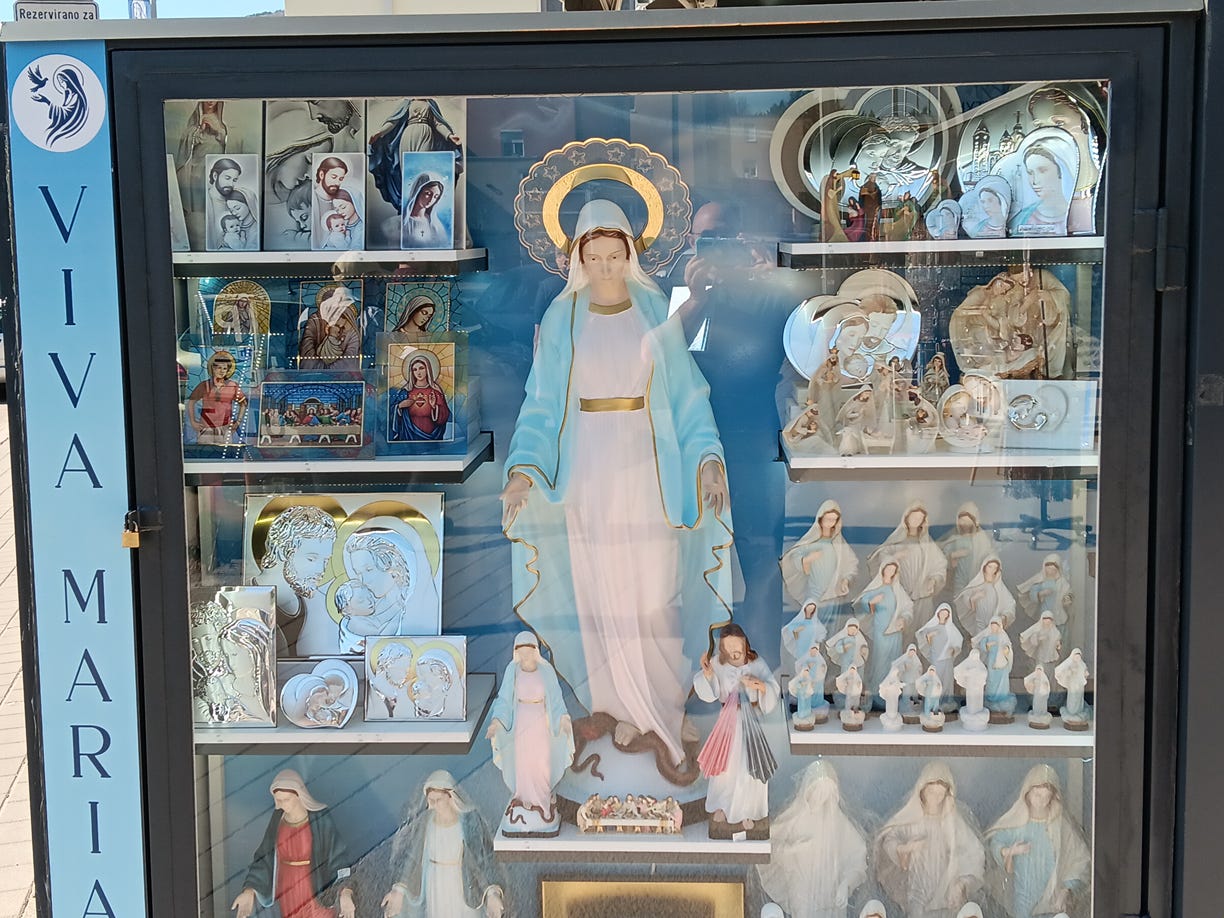
Then I turned another corner, and - lo! - I saw her again!
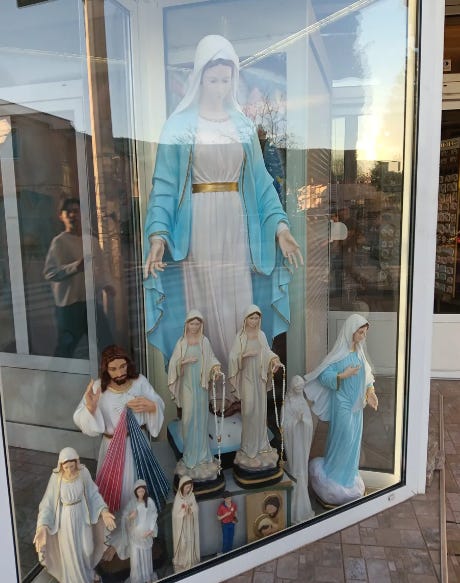
And again!3
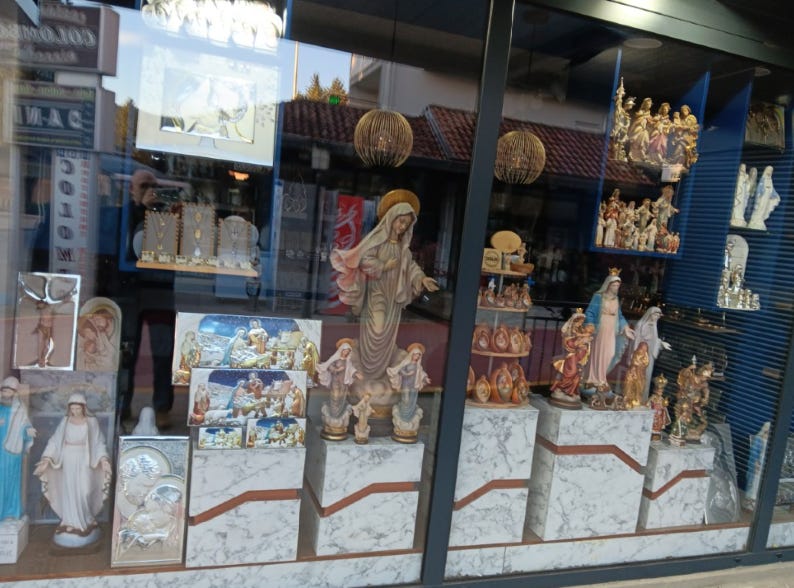
In fact, there were thousands of her! And scores of saints, plethoras of Popes, arrays of angels, crews of Christs, multitudes of mangers, and enough holy water to re-wild the Aral Sea.
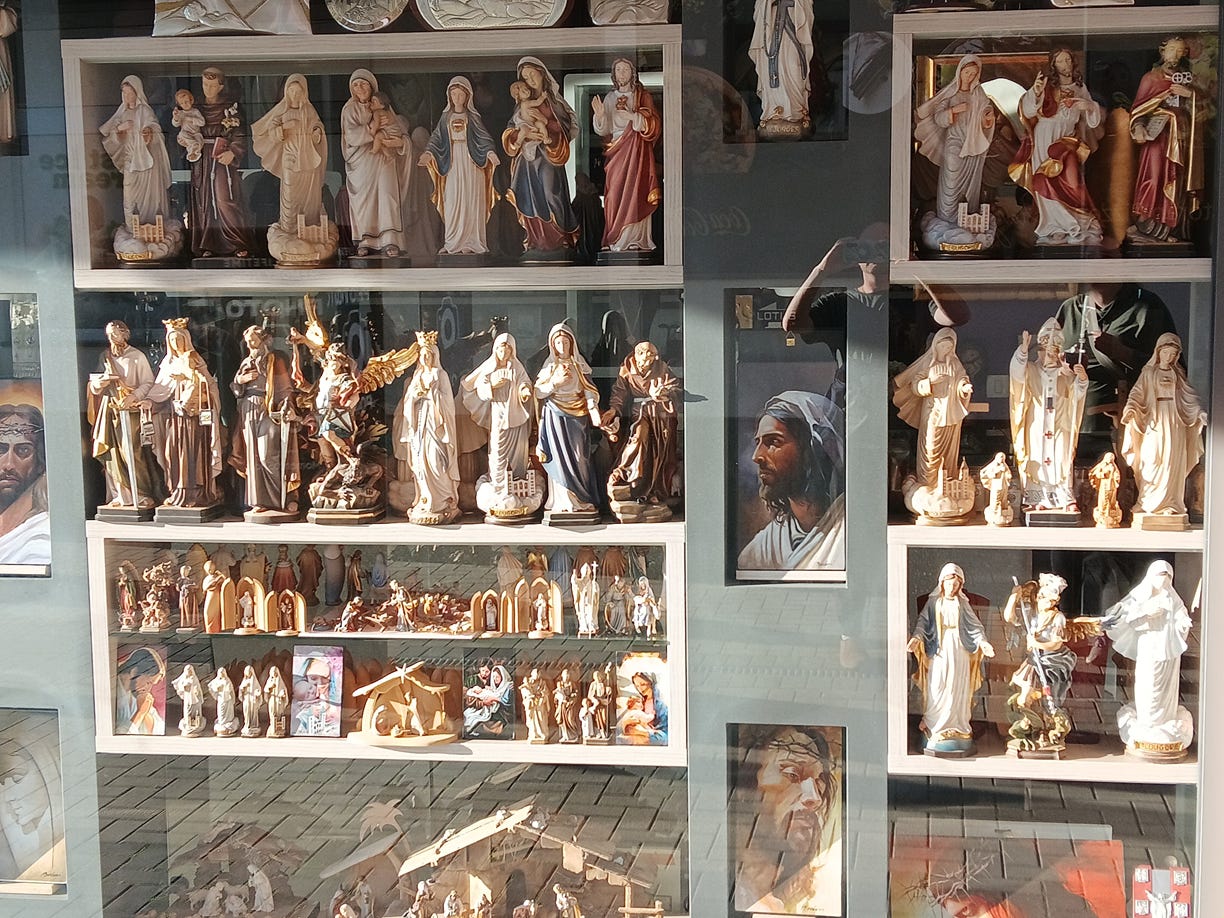
It turns out that Mirjana’s book is slightly dated. Medjugorje is no longer a sleepy village filled with pure-hearted peasants and an aura of sacredness. Now it’s a giant Virgin-Mary-themed Disneyland, 90% souvenir shops by weight. Whatever isn’t souvenir shops is hotels, all called things like Hotel Grace, or Villa Regina…

…or named after angels:

…or Popes:

Is there anywhere suitable for a Californian atheist like me?

Perfect4.
My plan was to interview the residents and pilgrims. I knew that many people who came to Medjugorje saw sun miracles, but how many? The reports were numerous enough that I could believe it was almost everyone. Or it could be selection effects, and it’s only one in a thousand, or one in ten thousand.
And what was the pattern? If the spinning sun was real, we might expect shopkeepers who had been there ten years to have seen it 520x as often as pilgrims who spent a week. But if it was a hallucination, triggered by excessive religious enthusiasm, maybe the pilgrims would see it multiple times during their week, and the shopkeepers not at all. Nobody had previously collected statistics on this, so, fancy journalist’s notebook under my arm, I resolved to be the first. My destination: the great square in front of St. James’ Church, where travelers gathered to listen to the Mass being broadcast via loudspeakers in all the languages of the world.
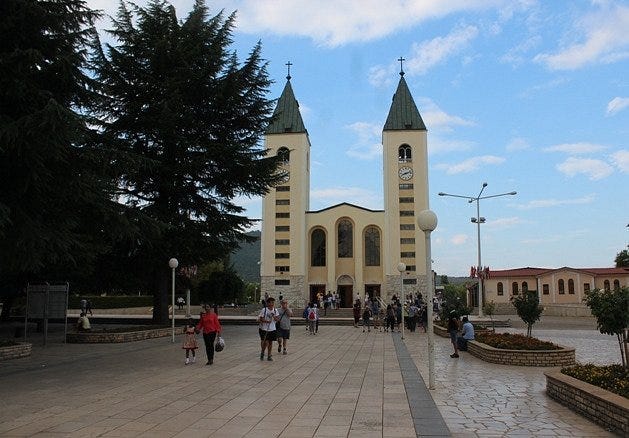
There’s nowhere like a pilgrimage site for people-watching. Yes, there were the expected nuns, priests, and elderly women with the light of faith shining in their eyes. But there were so many other kinds of people. A busload of Asian tourists, snapping pictures with their camera. A man with the most-rabbinical looking beard I have ever seen, wearing flowing black robes and a blue baseball cap. A woman in a dress lower-cut than I would usually associated with churches, covered in enough cosmetics to turn heads at Mar-a-Lago. Mothers desperately trying to redirect herds of five or six children each. A ten-year old in a Ghostbusters t-shirt, which under the circumstances I considered slightly offensive.
Unwilling to interrupt people imbibing the holy atmosphere, I stood at a path leading away from the church, notebook in hand, and accosted passers-by, asking for their experiences. Here’s what I learned:
People hate being accosted by someone with a notebook asking if they have a few minutes to answer some questions.
Bosnians hate it even more than the ordinary cross-cultural background of hating this.
Some of them will say that they don’t speak English, even though in other situations basically everyone in the town speaks English just fine.
Some of them will literally refuse to acknowledge my existence.
Of the various pilgrim ethnicities, the Irish earn a exception, living up to their reputation for friendliness, except dontcha know they were all late for some very important religious event and didn’t have time to talk right now although they would definitely help me later.
I tried several other locations (a bench in a quiet part of town, a little plaza in front of a store) with no better luck. Eventually I resorted to buying little trinkets from souvenir shops to see if the shopkeepers would talk to me (this worked once). I cannot describe how much I hated this. I am introverted and socially awkward. Cold approaches to dozens of people who are annoyed by my existence is a torture worthy of Purgatory. Still, I endured, and after several hours, I had a few reports:
Two Romanian brothers, in Medjugorje for two days, reported that they had seen nothing. But they said that their grandmother had been to Medjugorje nine times, and on the ninth, she saw a vision of the Virgin Mary in a cloud (they specified on further questioning that it was definitely a cloud and not the sun).
One shopkeeper who had lived in Medjugorje for twenty years reported that she used to have her shop at the bottom of the holy hill where the Virgin had first appeared. Once she saw a disabled woman drag herself up on crutches, then come down unassisted, walking as easily and gracefully as anyone else, and her whole party reported she hadn’t been able to walk like that in years, and it was a miracle. She had never seen anything unusual in the sun.
A hotel clerk who had been working there six months hadn’t seen anything unusual, although she had talked to a hotel guest who said they had witnessed some sort of miraculous healing. They had heard vague rumors that there were sun miracles in Medjugorje, but didn’t know anyone who had seen one.
The whole process was so discouraging that I wrote off the entire gather-statistics-about-Medjugorje project off as a loss. That left the second half of my plan. I was going to stare at the sun for a somewhat inadvisable length of time and see what happened.
When You Know That You’ve Been Taken, When You’re Begging For A Crumb
Having returned to my hotel room in defeat, I spent the night finishing My Heart Will Triumph and trying to figure out what to make of it.
The first step was to learn the other side of the story, and the Medjugorje Wikipedia article served admirably. It was clearly written by a hostile unbeliever, and focuses on the visionaries’ material success. The religious-speakers-circuit has been very good to them. Most - all? - of them now own tourism-related properties in Medjugorje. Most - all? - are millionaires (the article, gloriously petty, lists the locations of their various mansions and villas). One of them married a former Miss Massachusetts.
This is awkward, but only updated me slightly. To a first approximation, everyone who was in Medjugorje in 1981 must have gotten rich off tourism - a quick count of the number of hotels per square kilometer makes it clear that this required no special shadiness. Mirjana writes about how she struggled with the decision to become a nun vs. get married and live a normal life, and how the Virgin Mary’s advice helped her pick the latter. All of these people have happy families and lovely children, and there’s no shame in honest wealth. Let he who would never marry Miss Massachusetts if the option were available throw the first stone.
More problematic is the heresy. Decades of daily visitation from the Virgin gave her the opportunity to say a lot of stuff. In particular, she said some beautiful-sounding things about God loving all religions equally, which happen to be extremely contrary to the position of the Catholic Church (they think God loves Catholicism more). Those with more theological knowledge can review the whole list of supposed missteps here.
And: in 1956, a bedridden Italian woman claimed that Jesus and Mary appeared to her regularly and gave her vast amounts of information about their earthly lives. She collected these into an epic called The Poem Of The Man-God, a sort of latter-day gospel narrative dictated directly by Christ. One of the Medjugorje visionaries, Marija Pavlović Lunetti, asked the Virgin Mary whether it was legit, and the Virgin said that it “could be read . . . it makes for good reading”. Bad answer! The Church has said the Poem is super-heretical (and the historical scholars have their own concerns, like references to screwdrivers, vanilla, prickly pear cacti, and other things not known for their presence in first-century Judaea). Accordingly, the Virgin’s apparent endorsement of it as a fun yarn "scandalized Catholic theologians”.
Also counted as a mark against Pavlović Lunetti: one of the priests who helped the children during those first few apparitions in 1981, Father Tomislav Vlašić, later fell off the deep end. He founded a sect called “Church Of Jesus Christ Of The Whole Universe”, with fringe beliefs and (wait for it) sex scandals. Through it, Pavlović Lunetti stood by him, joined his weird commune, and said he was an okay guy. Vlašić claimed the “okay guy” message came directly from the Virgin; when he was later revealed not to be so okay after all, Pavlović Lunetti claimed it did not - it had been her own personal mistake (and the Virgin Mary had simply never mentioned that she was making a horrible mistake?)
Against all of these objections, what positive evidence do we have for the visions?
Mirjana once claimed to have physical proof - a reversed watch, something which it should have been impossible for a teenage girl to obtain without an expert watch-maker in on the conspiracy. But the authorities stole it from her during one of the interrogations. She never got it back.
Later in her book, she mentions a different physical artifact. When she worried about forgetting the secrets (or dying before they came to pass), the Virgin handed her a physical piece of parchment with the secrets written upon it. She was afraid that random houseguests would stumble across it and learn contraband information about the future, but when the feared event happened, the two interlopers only reported random boring text - one, a grocery list, the other a short and boring poem. Mirjana seems not to realize that a parchment which shows different things to different people would itself constitute miraculous proof of God’s existence, and never mentions this again. If anyone should happen to meet her, this is the thing I want to ask about most.
Speaking of the secrets, they, too, are supposed to eventually provide proof of the visions. Mirjana will not reveal them, but she tells us the instructions she is given. Each secret describes a future event. Three days before the event happens, she is to announce it to the world. In case she dies before the last secret is revealed, she is allowed to share them with one priest, who will carry out this task in her stead. Otherwise, she gives us two clues. First, the third secret involves a sign that will take place on the hill near Medjugorje where she first saw the Virgin, and which will serve as undeniable proof of the faith. Second, the secrets are pretty scary, and people will be very unhappy about them, but in the end they will be part of the divine plan, and we should have no fear.
My main thought about these secrets is - Mirjana is currently 61 years old. The average female life expectancy in Bosnia is 81. Although Mirjana mentioned worrying that she might die before the secrets are revealed, she seems to treat this as a remote chance worth warding against (eg the chance that we all might die in a car accident or something), not as a likely outcome. That means the secrets must refer to a time sometime in the next twenty years or so. As clock ticks and the years go by, the chance that Mirjana’s prophecy is true decreases accordingly. On the other hand, my beliefs tell me that we are in for some pretty crazy stuff in the next twenty years, and I can’t fault anyone else whose beliefs imply the same.
Aside from these poor tokens, our only evidence is the case presented by Mirjana herself:
In the early days, I was deeply hurt whenever someone accused me of making everything up. I always wanted to ask them, “Why would I invent such a lie? What would I gain by lying? I would have to be an extremely troubled person to lie about such things, especially during communist times. Before the apparitions, I had a beautiful life. I lived with parents who cherished me, and I went to one of the best schools in Sarajevo. Why would I want to turn my life upside down? Why bring turmoil and agony into an otherwise pleasant situation? Only an unstable person would do that. But I was not the only one; there were six of us, including a ten-year-old boy who much preferred playing soccer over praying.”
By Mirjana’s telling, before June 1981 the six visionaries weren’t especially religious. They barely knew each other; they’d crossed paths before, it was impossible to do otherwise in such a small village, but they were hardly close friends. Then, when the whole village went to the base of hill to investigate the previous day’s reports, those six children all immediately broke out of the crowd, ran up the hill, fell to their knees at the same spot, and would spend the rest of their lives saying that they saw the Virgin Mary.
All six continued to see apparitions throughout their lives. All six faced brutal questioning, threats, and retaliation from the Communists without changing their story in the slightest. All six would speak to fellow Christians, the media, and curious tourists about their past and present visions without sounding the least bit uncomfortable. All six would submit to experiments by various scientists and psychologists interested in their experience5, which would always return results of “idk, they seem to be in some sort of weird trance”.
I’m not sure what to make of this. In case anyone in the exhaustively-categorizing-spiritual-experiences branch of our conspiracy wants to try their hand, I present a suggestive passage in which Mirjana describes her experience of seeing the Virgin:
Towards the end of every month [when the apparitions were happening monthly], I begin to pray and fast more intesely, which helps me feel closer to the Blessed Mother. An enormous excitement builds in my heart. I get little sleep on the night before the apparition. I toss and turn in bed. Anticipation steals my breath and makes me feel like I’m suffocating. But when I pray, I feel as if God gives me strength, as if He whispers to me ‘You can do it’ and only then am I able to wait patiently until morning […]
In the past, I only knew that she’d appear to me at some time on the 2nd. But these days, I know that Our Lady always appears to me a little before 9 AM6. I usually spend the first part of the morning praying in my living room. By then, I can feel the love building in my heart - I can feel the moment drawing near - but it’s not yet time…
By [a little after 8], I’m beginning to experience the feeling of Heaven, and I can sense Our Lady’s presence and hear her faint voice in my heart. That’s when I’m able to encourage myself.
I can do it, I think. See, she does love me. I’m not such a sinner that she won’t come.
But as my consciousness drifts farther into Heaven, I comprehend less of what’s going on around me. For example, I invited an American friend to come with me to the Blue Cross [a literal cross on the hill in Medjugorje] for one of the recent apparitions. When we met in front of my house that morning, I greeted him and asked him how he’d been, but he did not reply…finally, he politely said “Mirjana, I’m sorry, but I don’t speak Italian.” Of course. I knew he spoke English, but my thoughts were so jumbled before the apparition that I even forgot what language I was speaking. Some people even get offended when they tell me something and I do not respond, but it’s difficult to explain that I’m already halfway in another world […]
The volunteers escort me down the street [to the Blue Cross site where Mirjana has her visions in public for pilgrims] and I stop to greet people if I feel compelled to do so. At this point, my heart is bursting with love for everyone I see on my way. Usually when we reach the base of the hill, the crowd of pilgrims is so large that it blocks the entire street…Italian people are known to be blessed with passionate temperaments, and some of them think it’s necessary to touch me, as if I’m some kind of saint or miracle worker. One time, I even caught a woman trying to cut off a lock of my hair as a keepsake.
When I was on my way to one apparition, a disturbed woman in the crowd grabbed my arm so forcefully that it dislocated my shoulder. Intense pain shot through my entire body, and I cried as I held my injured arm with my other hand. When I finally reached the Blue Cross, I was in agony and my body trembled. I prayed in silence, Blessed Mother, please come quickly. I can’t withstand this pain much longer. When Our Lady appeared, the throbbing instantly vanished. In Heaven, there is no pain. There is only love…
As I kneel on the fat rock, facing the Blue Cross, I feel like I’m losing my breath. My heart is awash with a maelstrom of emotions…I would probably hyperventilate or pass out if not for the calming effects of prayer. The feeling builds to a crescendo. I put my hand over my chest as if to prevent my heart from jumping out. I gasp for air. Suddenly it’s as if someone flips a switch - the world disappears, and I’m encompassed in a great, unending blueness. Our Lady is before me in the middle of it all. Every pain and fear disappears. I’m comforted. I’m loved. I’m complete…I’m not aware of anyone or anything around me. I’m not even on the hill anymore. Everything is concealed by the blueness, which itself is difficult to describe. I might compare it to the color of the sky on a cloudless day in springtime, but it’s really nothing like the sky. In fact, it’s more than just a color. It’s like a place and a feeling at the same time. It totally envelops me and Our Lady…
I see her like I see anyone else - as a tangible, physical being, in no way transparent or spectral. Her beauty, however, is clearly not of this world, and when she speaks, it’s like music from Heaven. But her voice is more than a sound…I hear her voice with my ears but also with my heart - with my entire being. One time, an acoustic engineer came from New York with the goal of identifying what Our Lady’s voice was like. He brought recordings of many different types of voices. With headphones on my earts, I listened to all of them, but nothing came close.
Our Lady usually gives me a message halfway into the apparition…sometimes I get concerned that I won’t be able to memorize the message, especially if she says some words I never personally use, and I’ve even asked her “Will I be able to remember all this?” She responds with a gentle smile, as if to say I needn’t worry. When she gives me the message, she doesn’t always speak in the same continuous way that I dictate it later. Instead, she connects certain parts of the message with what has happened and what is supposed to happen in the future. I cannot share specific details about this yet, but, for example, if Our Lady’s message asks us to forgive, then she might explain to me that if we do not forgive, then this or that will happen…
She usually concludes by saying “Pray, pray, pray” and then she rises slowly into the blueness, almost as if being vacuumed away….Our Lady rises just a short distance before she disappears, and the blueness immediately recedes with her. Suddenly back among the pilgrims, I’m assaulted by a cacophony of sound, as if people are shouting in my ears and blasting harsh noises through a megaphone. In reality thought, everyone is quietly praying. Even a whisper sounds like a scream in the moments after I leave the peace of Heaven.
Someone helps me to my feet and I sit on a nearby stone bench. I feel completely broken, lifeless, and I need a moment to readjust. Sometimes I can’t stop crying. I’ve just experienced a brief moment of love in its purest form and lost it just as quickly. To know Heaven and live on Earth is more painful than anyone can imagine….
As soon as I reach my house after coming down, I go to my room. I pray. I cry. I ask God to help me understand why I have to stay on Earth. Through this prayer, I begin to feel God gently nudging me forward…I cannot yet go with Our Lady and she cannot stay here with me. Finally, after two or three days, I have enough strength to face life as a typical person - at least until I taste Paradise again next month.
I’ll wait for the spiritual-experience-categorization experts before I weigh in on this myself, but I did find the level of detail in this description compelling, along with the unexpectedness of some of its twists and turns. Still, one wishes she had kept the watch, or was more willing to show the parchment. For now, this is all we have to go on: one woman’s very compelling book, and several thousand sightings of a spinning, many-colored sun.
Let’s Do Something Crazy, Something Absolutely Wrong
This section is a love letter to my wife.
Family and childcare responsibilities let us take one good vacation per year. When I told her I wanted to spend it on a Bosnian village, her first reaction was “Sure, sounds like it’ll be a good story for your blog.”
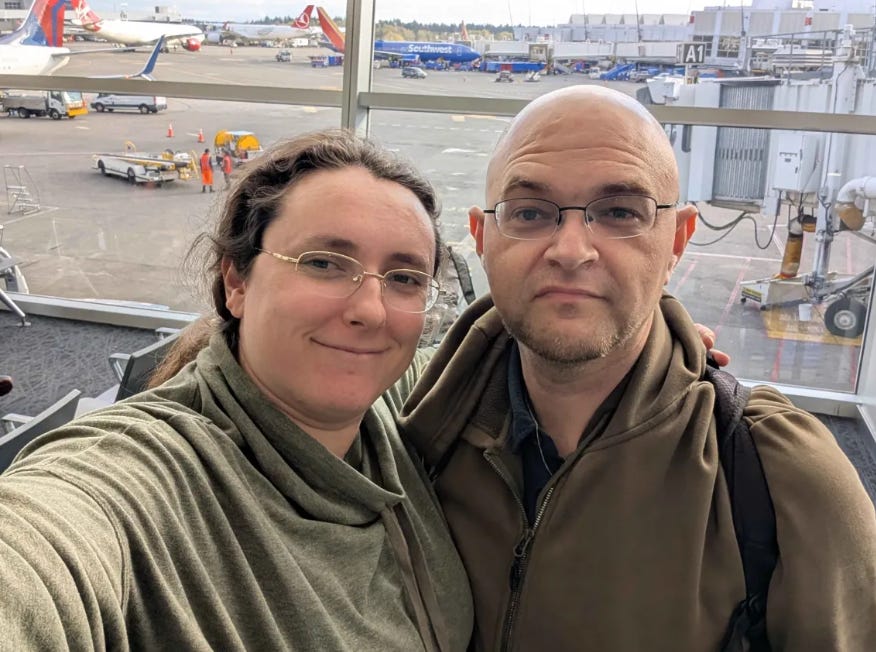
It was only later that she started getting worried. “If you see the miracle, you’re not going to convert to Catholicism, are you?”
“What?” I said. “Of course you’ve got to convert if you see a miracle!”
“No you don’t!” said my wife, just as vocally, and proceeded to list the usual atheist concerns with Catholicism. Many of its stories seem false. The idea of an eternal Hell is morally outrageous. It has various regressive opinions on gender and sexuality.
I agreed these were all strong concerns, which was why I wasn’t currently a Catholic - but come on, if you see a miracle then all that goes out the window. Not, like, if after fasting and purging and otherwise working yourself up into a weird state you manage to spot some slightly trippy hallucinations in the sky. But if, on a totally normal day, you see the sun unambiguously change colors and whirl around like a top, of course you’ve got to convert, right?
My wife raised the very valid point that I already knew that hundreds of people had seen exactly this. I had read their testimonies, even created a spreadsheet comparing all their various observations for use in my posts on the topic. Probably not all of these people were lying. So they must have hallucinated it. But they said it was all perfectly clear and vivid and utterly convincing, not just some vague trippy effect skirting the edges of normality. So if I also hallucinated something that was perfect and clear and vivid and utterly convincing, that would raise the testimony count from ~500 to ~501, which barely matters. Either I should be Catholic already, or else seeing a miracle, however clear, should do nothing for me.
I didn’t like this conclusion. I am, not to toot my own horn, an expert at not hallucinating. I’ve experimented with various forms of woo, alternative medicine, and occultism, and I’ve always seen and felt precisely nothing. One time I was called up to a stage hypnotist’s show, and everyone else was spinning in circles or honking like geese, and I just stood there awkwardly and eventually asked if I could go back to my seat. On hallucinogenic drugs, I can get some pretty crazy delusions, but I never see anything. Who knows what the mental integrity of those previous five hundred witnesses was like? If I saw it with my own stress-tested eyes, surely that had to add something.
My wife approached the topic from the opposite direction. When she was little, her parents made her go to bed long before she was tired. She would lie awake all evening with nothing better to do than experiment with the exact contour of her thoughts. Later, she would learn these experiments were meditation, and that over her childhood she had logged enough hours to make the most serene monk go green with envy. Now, every so often, I’ll read about some crazy qualia self-experimenter on the Internet, and I’ll hit her with something like “Did you know a guy on r/streamentry says that if you take DMT and mescaline at the same time and then lie in a sensory deprivation tank for nine hours, conscious experience will turn into a torus?”. And my wife will answer with something like “Oh yeah, that one’s fun, but you don’t need DMT or mescaline, you can just turn conscious experience into a cylinder and then loop it around so the ends connect.” I never have the slightest idea what she’s talking about when our conversations stray into this zone, but it doesn’t matter - she long ago realized that everyone in California who talks about meditation either joins a cult or starts one, and she responded by ascribing no seriousness at all to any of her experiences and refusing to discuss them except with her husband and a few close friends. I can go months completely forgetting that she’s like this. But then I’ll say something like “Surely you couldn’t hallucinate a miracle!”, and she will list the one hundred different mental states she knows of where miracle-hallucination is natural and common, and tell me which miracles she has hallucinated in each of them.
There followed one of the longest and most stressful arguments of our marriage, in which I futilely insisted that I was as anti-Catholic as the best of them but that you had to convert if you saw a miracle, and she (one of the most practical people I know!) insisted that she had already converted religions once to marry me, and she was not going to do it again, and she was not going to go to Mass every Sunday, and she was definitely not going to wear that headscarf-shawl thing that some Catholic women wear. Eventually, we agreed only that we table the discussion until we went to Medjugorje, saw whatever we saw, and determined whether there was even anything to fight about.
I mention this to confess that I had divided loyalties. I said above that I was hoping for a miracle, but that’s not quite right. My utility function was non-monotonic over different miracle sizes. I wanted either one that was so big it was impossible to doubt, one that was so small I could laugh it off, or none at all. Just don’t, I prayed to God, send a medium-sized miracle.
When You’ve Got To Go On Waiting, For The Miracle To Come
The traditional pilgrimage to Medjugorje has three parts.
First, you climb Cross Mountain, a big mountain with a concrete cross on the top. I did it my first evening in town. It was foolhardy to start so late, but I was antsy and wanted to get started. By the time I reached the summit, the sun had long since set. The stars blazed unusually bright, but no more so than could be attributed to the altitude and relative lack of light pollution. I got slightly lost on my way down, only to be “rescued” by two pilgrims who were so excited at the opportunity to aid a fellow Christian that I didn’t have the heart to tell them I was mostly fine and an unbeliever. They told me this was their second time climbing Cross Mountain. The first time, they’d done it barefoot, as penitence for their sins.
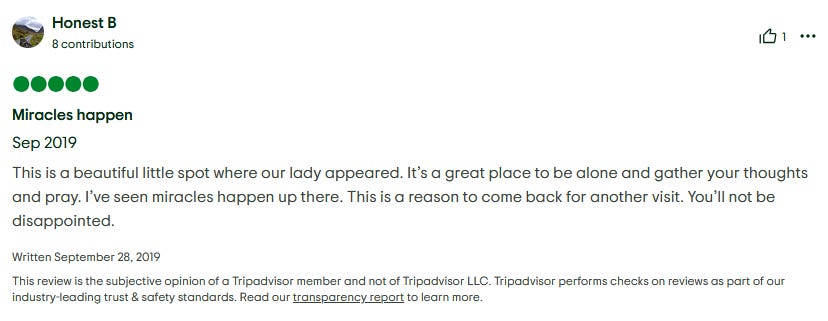
Second, you climb Apparition Hill, the site where the Virgin first appeared almost five decades earlier. This is the nexus for strange occurrences at Medjugorje, and the only tourist attraction I’ve ever been to whose TripAdvisor rating (4.7 stars) is biased by people who saw miracles there:

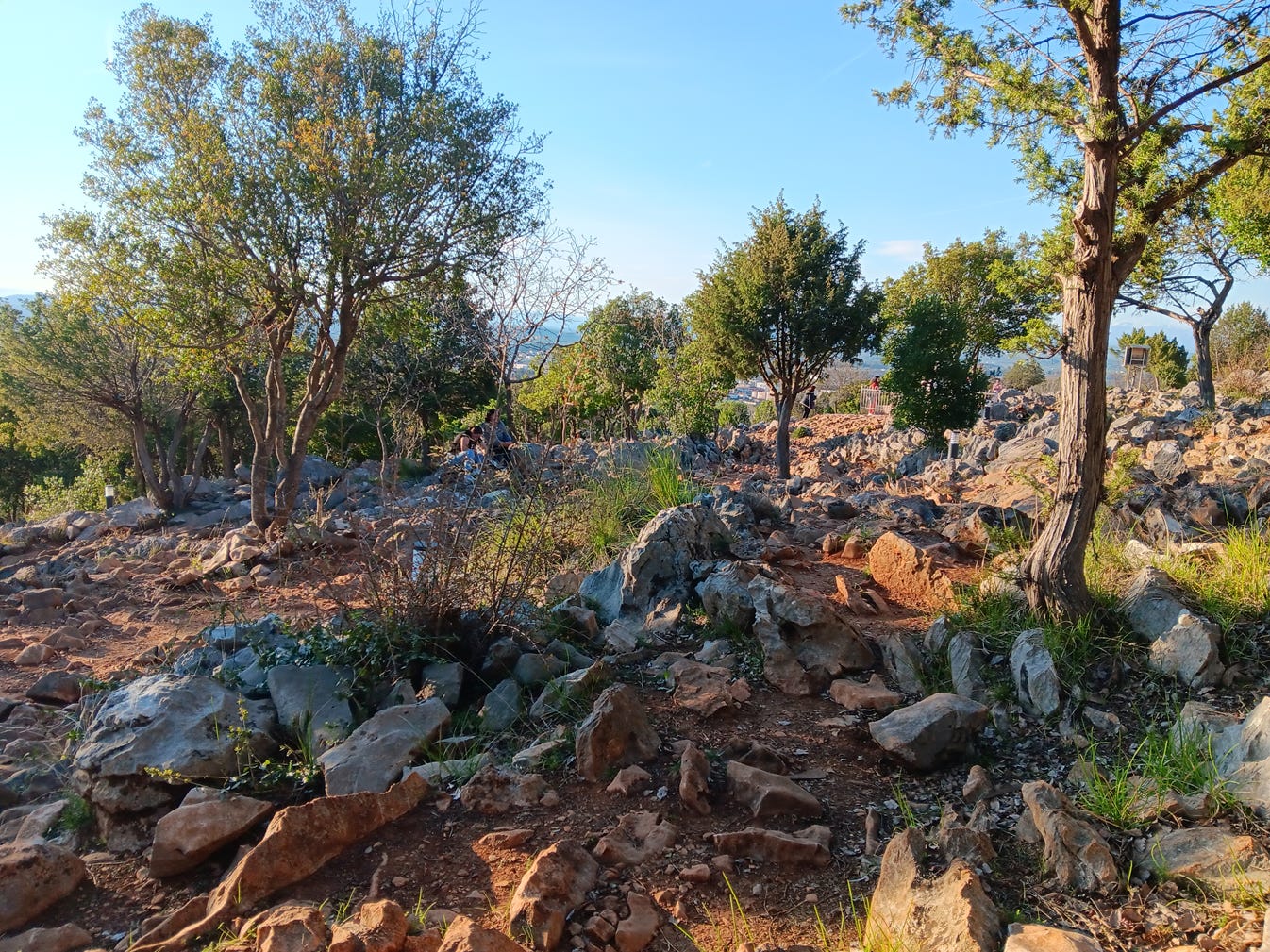
I went up around noon of my second day. The top was pretty and peaceful, and the throngs of pilgrims praying before the statue of the Virgin impressed me with their obvious joy and faith. But the midday sun was as bright and as motionless as ever, and my brief glances won me nothing but a slight headache.
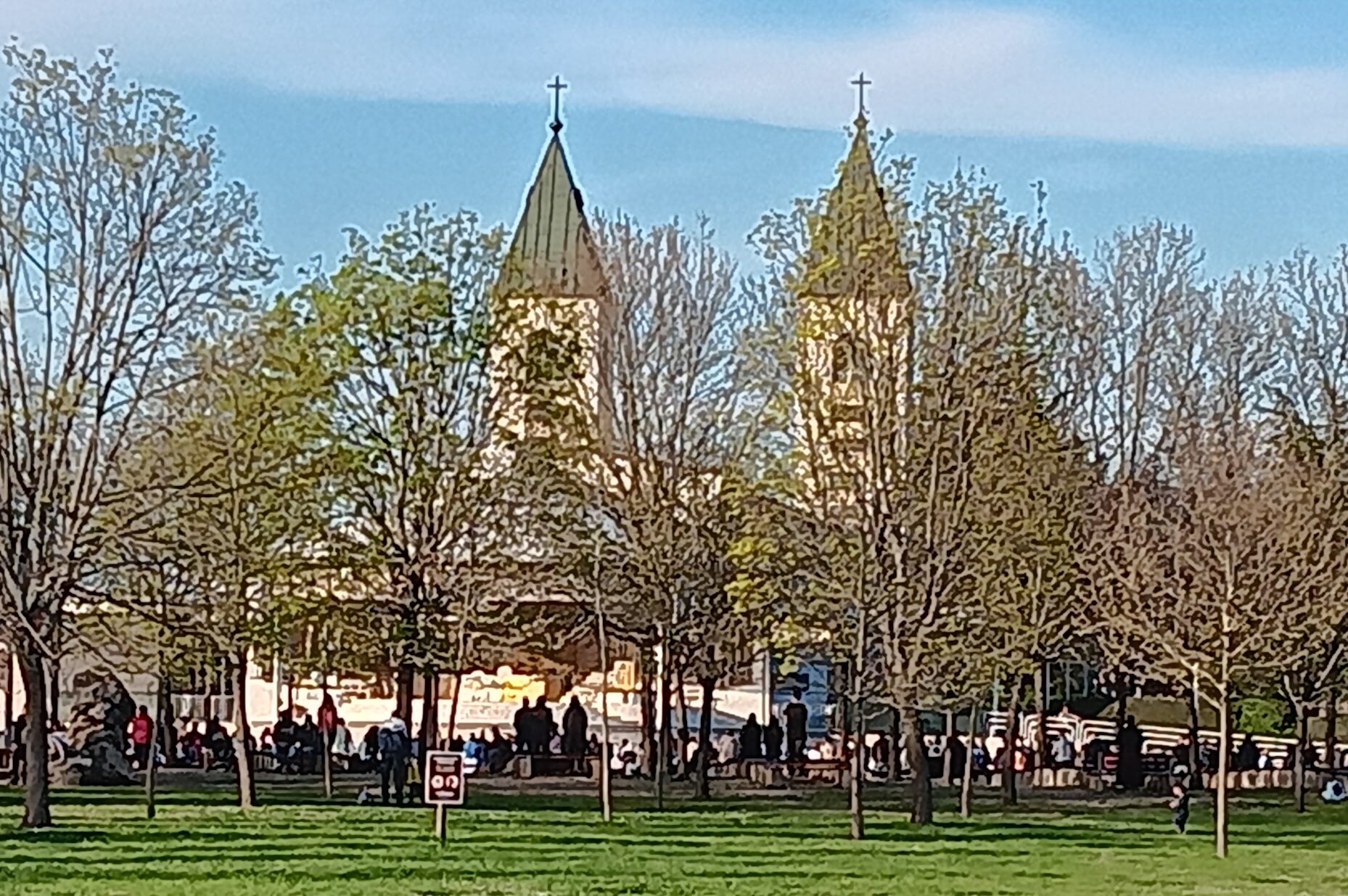
Third, you pray at St. James Church. My wife had finally recovered from the cold she’d gotten on the flight in, so the two of us headed over late afternoon, hoping to make it before the 6:40 mark when miracles are most common. The church itself was full (and besides, had no line of sight to the sun), but loudspeakers blasted the prayers to a lovely park in the back. Nearer the church, a crowd sat and worshipped. Further away, other couples lounged on the grass, half-listening to the prayers and music. A few small children played ball beside an “ABSOLUTELY NO BALL GAMES” sign.
I was glad to have my wife with me, both for the obvious reasons and for one clandestine one. In many of the stories out of Medjugorje, one person in a group had seen the spinning sun first, then pointed it out, and then everyone in the group had seen it. This didn’t really fit the hallucination theory, unless the hallucination was somehow contagious, maybe through mass suggestion. The obvious experiment was for me to shout, at a random moment, “LOOK! THERE IT IS! THE MIRACLE!” and see whether other people agreed or not. I was too much of a coward to do this in a random crowd. But I could do it to my wife.
The problem was, my wife knew me really well, and I didn’t think I could lie to her successfully. Also, I hated lying, even lying for a good cause when I knew I would be forgiven afterwards. Also, we were still in a sort of awkward truce over the question of whether you had to convert if you saw a miracle, and I was scared of opening that wound.
Also, it was 6:30. The miracle most often happened at 6:40. If I did it before then, we would both be in a kind of bad mood and maybe when the miracle was actually supposed to arrive we would be poisoned against it. But if I waited much after 6:40, the sun might be too low on the horizon to be clearly visible. I fretted over this for about ten minutes, then resolved that I would try it at 6:35. I steeled myself up. I rehearsed the exact sequence of events I was going to try. I would grab her by the shoulder. I would point at the sun. I would say “LOOK! THERE IT IS! THE MIRACLE!” I would let her look for ten seconds before admitting my deception. We would laugh about it afterward. Nothing would go wrong.
At 6:33, my wife grabbed me by the shoulder, pointed at the sun, and said “LOOK! THERE IT IS! THE MIRACLE!”
I knew my wife really well, and I didn’t think she could lie to me successfully. And she didn’t look like someone who was lying. She was staring straight at the evening sun, as intensely as I’d ever seen her do anything. “Do you see it?” she asked. “It isn’t bright anymore! It just looks like a disc! It’s stopped being painful to stare at!”
There was no contagion, no suggestion effect. The sun looked totally normal to me. It was too bright to look at directly for more than a few seconds, even though my wife was doing exactly that.
“It’s changing color!” said my wife. “And sort of pulsing, or strobing, or . . . something! Wow! You’re not seeing this?”
I looked harder. I wouldn’t describe myself as seeing any kind of miracle. The sun was partly behind some thin clouds. The clouds made the disc slightly less bright than usual, but were themselves very bright - so much so that the afterimages from the sun bled into the afterimages from the clouds in an odd, almost violent way. I wouldn’t have noticed it was strange on my own, let alone called it a miracle, but maybe now that she’d mentioned it . . .
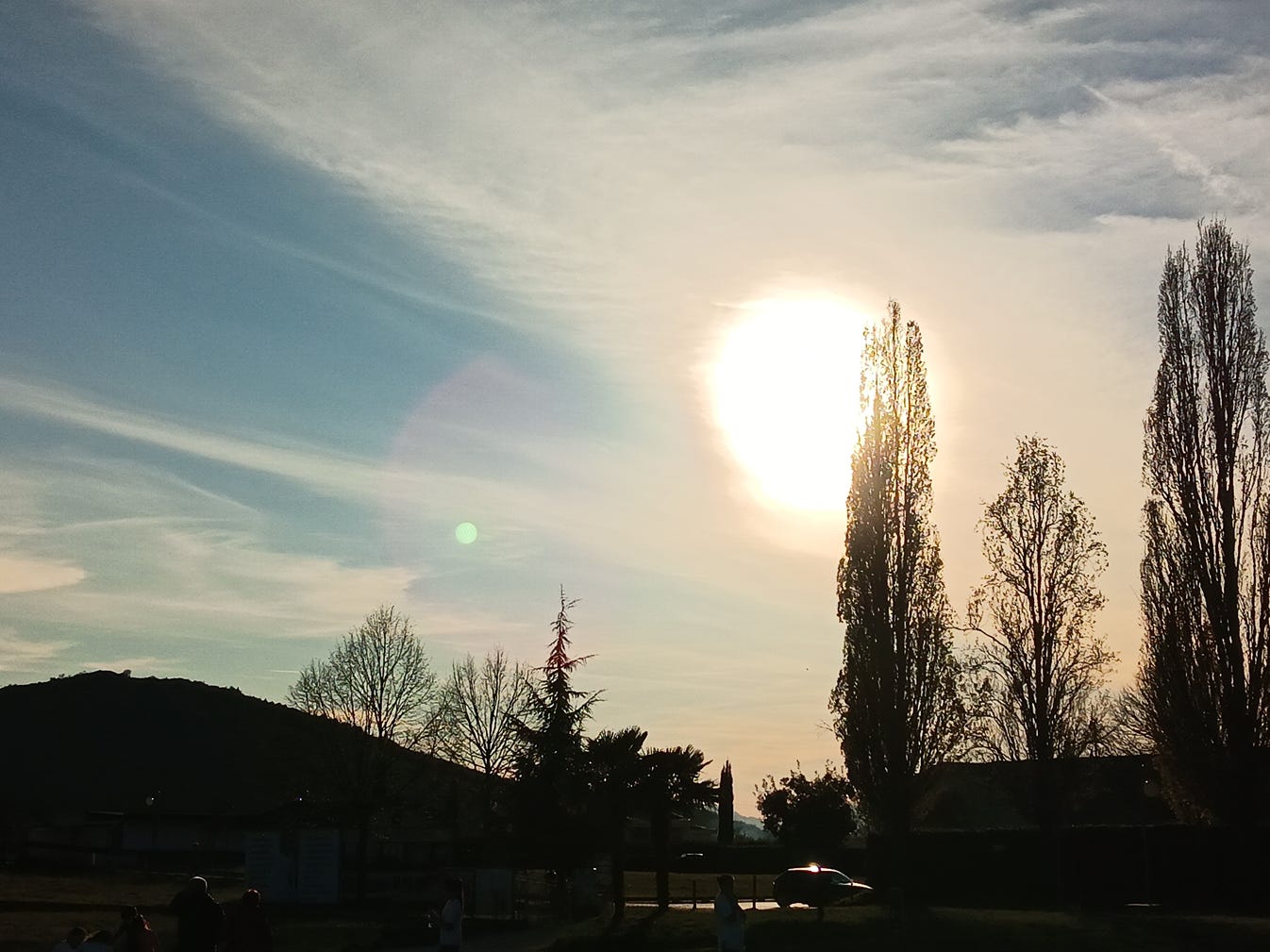
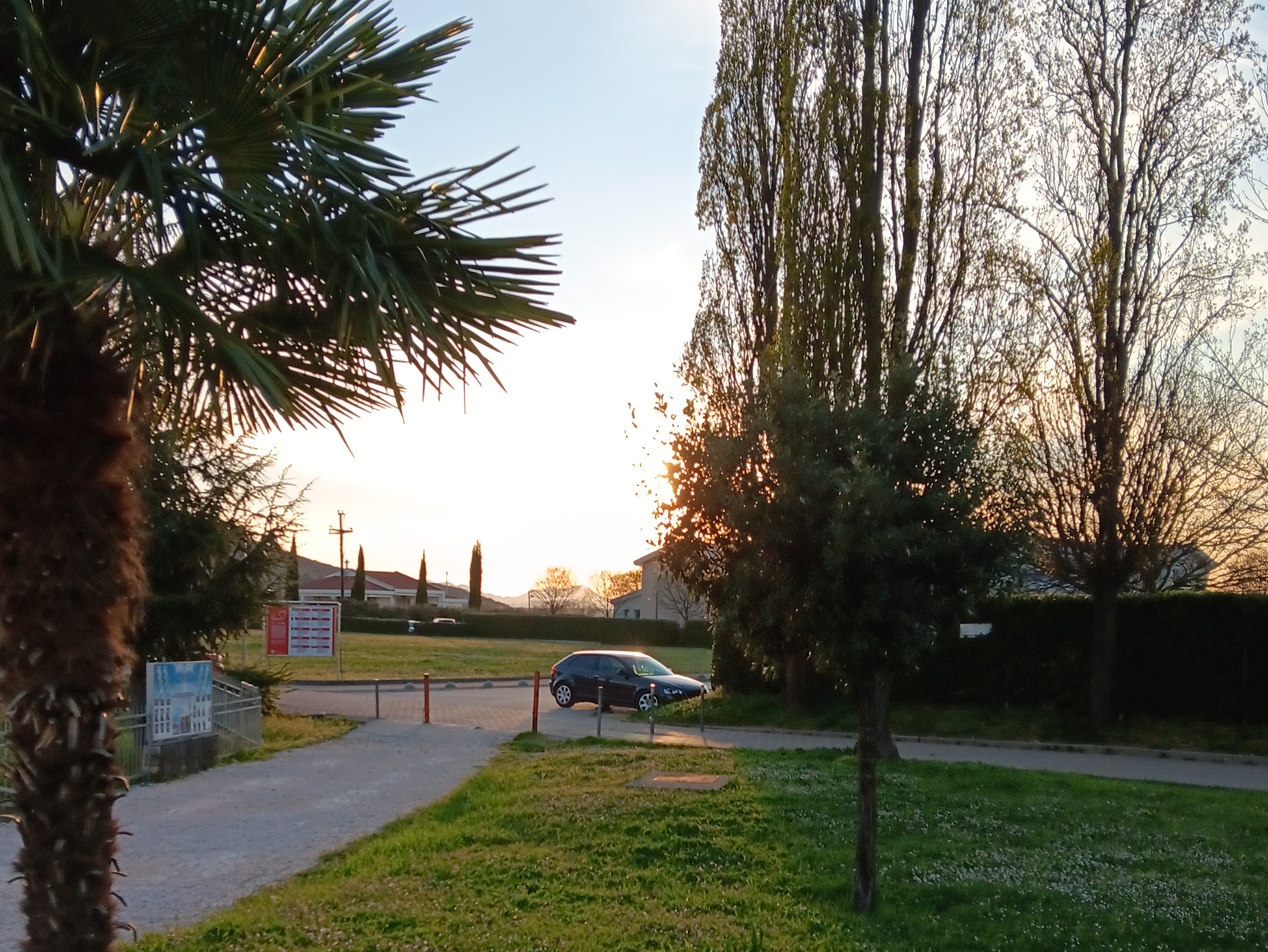
“Oh, there it goes,” she said, after about thirty seconds. “It’s back to normal.” And then “Oh, wow, I’m really crying right now.” She hadn’t thought the sun had been bright, but her tear ducts apparently disagreed. Then “Oh, I have a big white spot in the center of my vision right now, I sure hope this isn’t permanent.” A few months earlier, I’d read through all the ophthalmology journal articles I could find that mentioned sun-staring at Medjugorje and was now something of an expert; given that she’d only stared for thirty seconds around sunset, I assured her that the spot would disappear in a few minutes, which turned out to be the case.
“That was pretty cool!” she told me, once the immediate afterimage-related crisis had passed. Those were her exact words, “pretty cool”. On our way back to the hotel, she passed a church with unusual roof tiles, which she also dubbed “pretty cool”.
Like I said, one of the most practical people I’ve ever met.
The Maestro Says It’s Mozart, But It Sounds Like Bubblegum
We didn’t convert to Catholicism, but we did spend a while comparing notes and trying to figure out what had happened. In retrospect, it was great luck that my wife saw the miracle so much more intensely than I did - it gave us different perspectives that let us sort of triangulate what was going on.
Here’s our working theory for what happens when people see the miracle.
Step 1: Sun within a narrow range of unusual dimness, surrounded by clouds in a narrow range of unusual brightness.
The sun has to be so dim that it’s possible to stare at it without immediately flinching, turning away, or going blind - but also so bright that it’s still able to produce strong afterimages and eventually do damage.
Is it possible for it to be this dim and this bright simultaneously? I think there’s a narrow band around 10,000 nits of brightness where this is possible, especially if the sun is surrounded by very bright clouds. When the sun is surrounded by bright clouds, it appears dimmer than it is, because your eyes estimate brightness through contrast with the surroundings.
(I think the reason my wife’s experience was so much more impressive than mine was that her vision snapped the bright sun against bright clouds to “both sun and clouds are dim” and mine snapped them to “both sun and clouds are bright”, due to some kind of perceptual idiosyncrasy.)
In this band, someone primed to expect a miracle will look at the sun, see that it looks “dim” or “pale”, and notice that it’s possible to gaze at it without feeling pain. This will be surprising enough that they’ll keep staring, precipitating the rest of the miracle.
Looking back over past reports of the miracle, I think there are two ways you can get this:
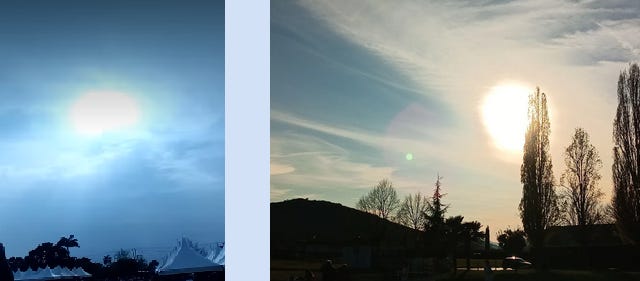
The sun shining through a tiny window of light cirrus clouds, in the middle of a sky of dark rainclouds, in a moisture-filled sky, anytime between midday and sunset. All of the most dramatic examples of large crowds seeing the miracle have happened in these conditions.
The sun shining through light cirrostratus clouds, around sunset. Many of the Medjugorje reports, including ours, happened in these conditions.
Step 2: Afterimage superimposed upon sun
In fact, the sun is still bright enough to produce an unexpectedly strong afterimage, which is superimposed directly over the sun itself. Like all afterimages, these cycle between yellow, blue, and pink as different receptors come on- and offline. But absent normal brightness cues, you don’t naturally interpret them as afterimages. You just see the sun flashing yellow, blue, and pink.
Step 3: Drift and microsaccades cause a fiery, multicolored halo
At first, the afterimage is exactly superimposed upon the sun. But the eyes are constantly making tiny random involuntary movements. One type of movement, microsaccades, is a deliberate attempt to prevent photoreceptor fatigue that usually happens a few times per second. Another type, drift, is caused by the inability of ocular muscles to retain precise focus over multi-hundred-millisecond timescales. These movements happen on a scale of about one degree, compared to the half-degree width of the sun disc. So as you try to stare at the sun, every few hundred milliseconds, your eyes will drift about half a sunlength in some direction or another before you suddenly jerk back to focusing on the center of the sun itself. The end result is a halo of sun-afterimages, half a sunlength wide, surrounding the actual sun.

Afterimages aren’t stable. As the photoreceptors recover at different rates, they pulsate, writhe, and change color before finally disappearing. Since each part of the sun’s “halo” will be an afterimage from a different time (separated by milliseconds to seconds from each other), they will move heterogeneously. A phenomenon called the Troxler Effect, demonstrated in certain radial patterns very similar to sun afterimages, makes some of them fade in and out of vision in surprising ways.

What about spinning? In my original article, I noted an apparent paradox: the sun is a perfect circle, so even if it were spinning, it should be impossible to tell. The pulsing halo of different-colored afterimages potentially overcomes this objection (that is, if the images above were to spin, you would notice) - but doesn’t in itself explain the perception of rotational motion. Here I have nothing better than the general tendency of the visual system to interpret complex radial stimuli as rotating, and their movement as rotational movement…
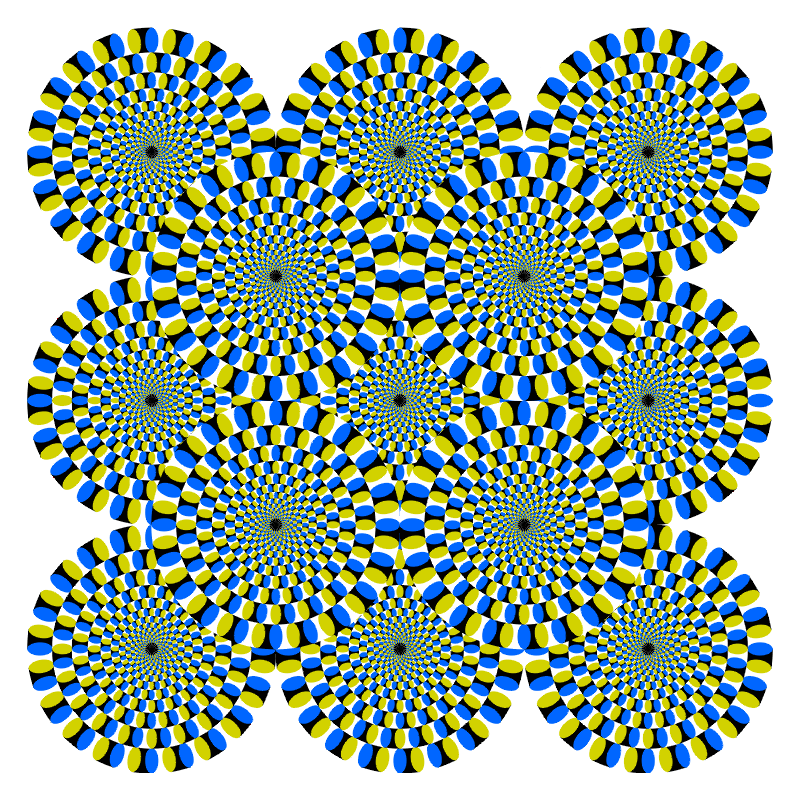
…but I’m unhappy with this non-explanation, and hope that a real perceptual psychologist reading this post can do better7.
Step 4: Ultraviolet damage causes chromatopsia
One of the strangest parts of the Fatima phenomenon was the reports of the whole world suddenly changing to single colors. Jose Garrett wrote:
Everything had the color of an amethyst: the sky, the air, everything and everybody. A little oak nearby was casting a heavy purple shadow on the ground. Fearing impairment of the retina, which was improbable, because then I would not have seen everything in purple, I turned about, closed my eyes, cupping my hands over them, to cut off all light. With my back turned, I opened my eyes and realized that the landscape and the air retained the purple hue […]
Continuing to look at the sun, I noticed the environment had brightened. Soon after, I heard a country bumpkin nearby saying in an astonished voice, “That lady’s yellow.” Indeed, everything had changed, near and far, taking on the color of old, yellow apricots. People looked sickly and jaundiced. I smiled, finding them downright ugly and unattractive. Laughter rang out. My hand was the same shade of yellow.
The newspaper O Dia:
The light turned a beautiful blue, as if it had come through the stained-glass windows of a cathedral, and spread itself over the people who knelt with outstretched hands. The blue faded slowly, and then the light seemed to pass through yellow glass. Yellow stains fell against white handkerchiefs, against the dark skirts of the women. They were repeated on the trees, on the stones and on the [terrain?]
Antonio de Paula:
Taking his eyes off the sun, he saw the people a very bright red color; and he exclaimed: “Oh, gentlemen, how the people are all red!” And the priest replied: “Are they red scarves?” To which he remarked: “How can that be? So they had all agreed to have red scarves on their backs?!” Then the people appeared the color of gold.
Thanks to Pinckers et al in Documenta Ophthalmologica for finally giving me some insight into this phenomenon: this is ultraviolet chromatopsia!
Chromatopsia is defined as a temporary condition in which white stimuli appear coloured. The most frequently occurring types of chromatopsia are yellow-vision (xanthopsia), green-vision (chloropsia), red-vision (erythropsia), blue-vision (cyanopsia) and violet or purple-vision (ianothinopsia).
They write that “erythropsia due to bright (sun-)light is a relatively common finding in aphakia and pseudophakia”. These latter are medical terms for people with absent or damaged eye-lenses. But plausibly very intense exposure to UV light - for example, staring straight at the sun for ten minutes - can cause similar symptoms even when the eye-lens is intact. I was also able to find some reports of this happening to people with early-stage snow blindness (ie on bright days when there’s lots of snow on the ground reflecting UV light), although I don’t know what their eye lens status was.
This paper singles out erythropsia (red-tinged vision) as especially likely to be produced by sunlight-related damage. However, all three witnesses mention multiple colors, and only one (Antonio de Paula) even has red on his list. The authors don’t give a source for their erythropsia claim, but is there any reason to think chromopsias can be multiple and variable?
Elsewhere in sun-related-eye-damage studies, there’s a very closely related phenomenon called retinal bleaching. When someone stares straight at the sun, the damage preferentially hits certain color receptors. This produces an afterimage of the opposite color (eg if it damages the yellow receptors, the afterimage is blue). This is distinct from chromatopsia in that the afterimage is usually a colored spot the approximate size and shape of the light source, “opaque” in the sense that it cannot be seen through.
These retinal bleaching lesions quickly (on the order of seconds to minutes) go through a series of changing hues called the flight of colors, or sometimes Plateau’s Sequence. Due to genetic differences, the exact sequence is different for every individual.
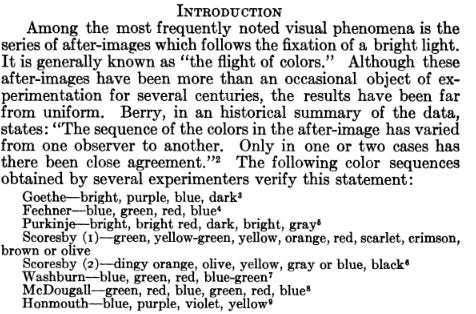
So the Fatima phenomenon is somewhere between ultraviolet chromatopsia and a more traditional afterimage undergoing Plateau’s Sequence. I’m not sure why it would combine these two things, but staring at the sun for ten minutes is sufficiently outside the domain usually studied by ophthalmology that I think we’re permitted to posit exotic new combinations of eye damage types. The Fatima color changes so closely resemble these two well-known diagnoses that I think something in the same family should be our working hypothesis.
This is, I guess, pretty disappointing. Early on, I dismissed afterimages as too obvious and dumb to explain the entire phenomenon that dazzled so many smart people. I’m split between admitting that I was wrong, and objecting that I’ve added so many lovely epicycles to the afterimage theory that should count as a new theory that avoids those concerns. Still, in the end I do think it was basically afterimages and eye damage.
Objections to my theory
I discussed this theory with Fatima true believers, including Ethan Muse, who gave me helpful pushback.
Objection 1: You can’t extrapolate from sunset to midday.
My wife gazed at the sun at evening through light clouds, but the Fatima miracle happened at midday through a clear sky (or rather, the rest of the sky was cloudy, but there was clear line of sight to the sun). This means I can’t rely on clouds-scattering-light based explanations, and also, everyone would have been blinded (or, at best, forced to look away) before they could get any of these phenomena.
Against this, the Fatima miracle occurred just after a heavy rainstorm. I think (without being able to name exactly what was going on) that this created a layer of moisture in the atmosphere which dimmed the sun without seeming like it was obviously blocked by clouds. I’m not an optical physicist and can’t give details, but here’s what the LLMs have to say:
—The setup
The Beer-Lambert law says the fraction of light transmitted through an attenuating layer is T = e^(−τ), where τ is the optical depth. If a star is hidden behind a cloud of optical depth τ it will be dimmed by 1.086τ magnitudes. Physics LibreTexts Each magnitude is a factor of about 2.512 in brightness, so τ = 1 means transmission ≈ 37% (dimmed by ~1.1 mag), τ = 2 means ~14% (~2.2 mag), τ = 3 means ~5% (~3.3 mag).
—What counts as “obviously visible cloud”?
This is the crux. Studies of cloud optical depth retrieval treat τ ≲ 3 as the regime of “thin clouds” where the sun is still visible as a disc through them; “only optically thin clouds with a COD below three can be investigated” ResearchGate using sun-photometer methods that require seeing the sun. Cirrus clouds typically have τ in the range 0.1 to a few. So roughly: τ < 0.5 is barely visible haze, τ ≈ 1 is a noticeable thin veil, τ ≈ 2–3 is a clear gauze where you can still see the disc but it looks dimmed and “milky,” and beyond τ ≈ 3 the disc starts losing its sharp edge. Witnesses at Fatima specifically described the disc as having a clean-cut, sharp edge — which puts us in the τ ≲ 3 regime.
—The midday-vs-evening comparison you asked about
Going from midday to a low evening sun corresponds to a change in air mass from about 1 to about 10–20 (depending on how close to the horizon). The clear-air vertical optical depth at sea level in the visible is roughly τ ≈ 0.2–0.4 in clean air, more with aerosols. So at zenith, transmission is ~70–80%; at AM = 10, the slant optical depth is τ × 10 ≈ 2–4, giving transmission of order 2–14% of the above-atmosphere value.
So evening sun is dimmer than midday sun by very roughly a factor of 5 to 50, depending on aerosol load and how close to setting.
—Could thin post-rain veiling reproduce this?
Yes, comfortably, and with room to spare. To dim midday sun to evening levels you need an additional τ of roughly 1.5–4 on top of the clear-air baseline — exactly the regime of optically thin clouds where the disc remains visible. A thin stratus or altostratus deck with τ ≈ 2 (very ordinary, often not even noticed as a distinct cloud when uniformly spread) cuts brightness to ~14%. A τ of 3 cuts it to ~5% — fainter than typical evening sun.
There’s also a separate issue I glossed over before that’s worth stating: even completely clear atmospheres have an aerosol optical depth (AOD) component on top of Rayleigh scattering. After rain, washout reduces large aerosols but the residual humid layer with suspended fine droplets and re-evaporated moisture can substantially raise the effective τ in the visible without producing what an observer would call “a cloud.” Sun photometer studies regularly distinguish “clear” and “hazy clear” conditions where AOD differs by 0.5–1.5 with no obvious cloud cover.
Several of the Fatima witnesses do say that the sun seemed to be blocked by some kind of very thin, light cloud layer at the time (see section 1.1.2 here). This was likely a high-τ-but-barely-visible post-rain layer; some people noticed it, others didn’t, but it blocked enough sunlight that everyone could stare long enough for the effects to start.
Speculatively, Fatima had “perfect” conditions for the miracle - the exact right kind of cloud layer, the exact right amount of diffusion vs. concentration - and Medjugorje has only “passable” conditions. This explains why so many of the Medjugorje reports - including my wife’s - are comparatively disappointing, lacking the spinning motion or the visual field tinting.
Objection 2: Nobody at Fatima reported afterimages, blindness, or eye pain
None of the Fatima witnesses described eye pain, later eye damage like blindness, or even afterimages.
The first two are explained by the possible cloud layer above. But I acknowledge the lack of an obvious afterimage - the sun disc in negative - is strange. Possibly people stared at the sun so long that it went from afterimage to full retinal bleaching and chromatopsia, and by the time the world had regained its normal colors their eyes were mostly healed. My wife’s eyes were fine after about five minutes.
Objection 3: There were distant witnesses
I actually think this makes sense on my theory! We know that many of the distant witnesses had heard there was going to be a sun miracle at Fatima, and were looking up at the same time. The same rainstorm was covering the whole region, and it wouldn’t have been too surprising for the conditions to be right in other places too.
There are even a few cases of distant witnesses in Lisbon or further afield. These don’t make sense for a real phenomenon, since one would expect that everyone in Lisbon (a huge city) would have seen it, rather than just one or two people. But it does make sense if everyone who stared at the sun very hard saw it, and that was everyone in Fatima, some people in surrounding villages who were very aware of the situation, and a tiny number of people in Lisbon who just so happened to think about the story they’d heard about some far-off town that might be having a sun miracle.
Objection 4: There was too much other weird stuff
Fatima witnesses reported a wide variety of other extraordinary phenomena, including the sun zooming towards Earth, the Virgin Mary appearing in the sun, other religious iconography appearing in the sun, shooting stars, color changes even among people who never looked at the sun, and the sudden drying of wet clothes.
The sun “zooming towards Earth” might have just been sudden changes in the size or brightness of the diffuse cloud region. As for the others, I can only appeal to the literature on eyewitness unreliability. Witnesses to crimes often confabulate details, especially details that fit the stereotype of “things that happen at crimes”. For example, they might report having seen broken glass at a minor car accident where no glass got broken, or remember a criminal leaping a turnstile to get to the crime scene when he entered normally.
Is it weird or even hypocritical to bring up eyewitness unreliability this late in the game, after having generally tried to accept the frame where thousands of people really saw the sun spin and change color? I don’t think so. Eyewitnesses rarely confabulate entire crimes when in fact it was a perfectly normal day when nothing happened! When someone is in a stressful, shocking situation outside their normal range, they get confused enough that they confabulate extra details, or lean on their stereotypes of the situation rather than the reality. Seeing a miracle is so unusual that it might place someone in the same sort of altered state as seeing a crime, where their attempts to regenerate their memory from its traces bumps up against inexperience with the entire genre of situation.
Something like this has to be true - the sheer variety of miracles reported by different Fatima witnesses, which other witnesses don’t mention or outright contradict - doesn’t match any particular single miracle that could have objectively occurred. I think it’s fair to concentrate on the parts that almost everyone saw - the spinning, multicolored sun - and dismiss the rest as the consequences of the mental shock of having seen any miracle at all.
Objection 5: Do we need too much fine-tuning?
One of the most compelling aspects of the Fatima miracle has always been that it was predicted in advance. This rules out most meteorological and astronomical phenomena; what’s the chance that this particular rare event would happen at the exact time predicted by child-seers beforehand?
My theory requires only a certain pattern of diffuse clouds. How unlikely is that? We saw it at Medjugorje once during three days of relatively frequent checks, although we may have gotten lucky - other people spend much longer and don’t see at at all. Plausibly, we get at least mediocre miracle conditions sometime on the order of once every few days to weeks. The details might depend on how rainy the weather is, or vary by area (eg Medjugorje might have them especially often, since it’s pre-selected for being a place where the miracle is often seen).
So why doesn’t everyone see the miracle once every few weeks? People rarely stare at the sun! Suppose that when conditions are exactly perfect, it takes about two seconds of staring before the sun looks like a pale disc, and five to ten seconds to get the full multicolored spinning halo. Then:
In normal life, very few people stare at the sun for two seconds. Even if they did stare at it at the exact right time, they would only see that it kind of looked like a pale disc - which it often does anyway for unrelated reasons - and not necessarily continue to stare.
In normal human life, almost nobody stares at the sun for five to ten seconds. The only exception are people in the sun-gazing movement, who do sometimes report experiences similar to the miracle.
At Fatima, there are records of the pilgrims arriving with an expectation that there might be a sun-related miracle. At least somebody would have been checking the sky when the right conditions started, and would have shouted “Look! The miracle!” People would have stared at the sun for two seconds, and seen it as a pale disc, which would have been intriguing enough that they would have marked the beginning of the miracle from that point and continued to stare. Then after five to ten seconds, they would have seen the full multicolored spinning halo. Then, when people asked them about it later, they would have said the miracle began “immediately” and hadn’t required any special amount of staring at the sun.
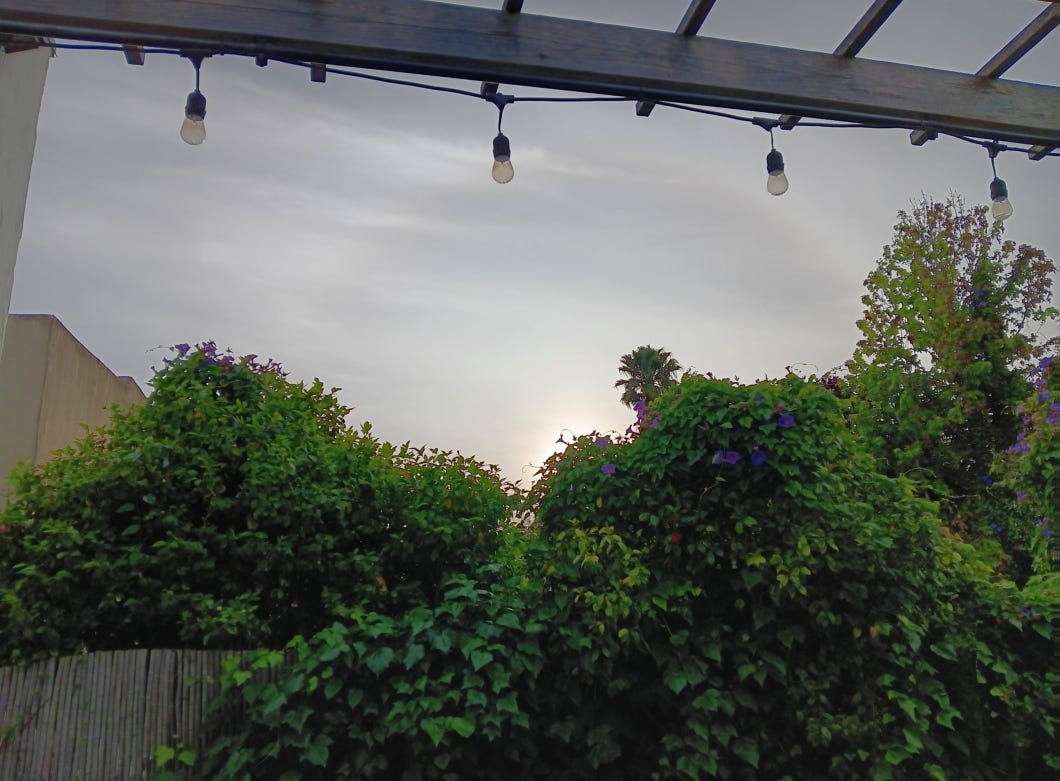
As further evidence, after we got home from Bosnia, I was on the lookout for conditions like those under which we’d seen the miracle. A week or two later, just before an unseasonal rainstorm, we got them. The afterimages were doing the weird things again! I called to my wife to come outside, where she confirmed a repeat of the whole miracle. Other Medjugorje returnees have noticed the same thing. So I think if you’re looking pretty hard for sun miracles, you would get these conditions once every few weeks.
(I can’t provide any more data than that, because after that rainstorm we shifted into California’s long dry season when there are rarely any interesting clouds for months on end).
In his book The Lump Of Coal, Lemony Snicket wrote:
Miracles are like pimples ... once you start looking for them you find more than you ever dreamed you’d see.
This has been my experience too, and I consider it a satisfying conclusion to my engagement with the Sun Miracle of Fatima.
I’m blurring together a few different messages given on different days for simplicity.
This makes sense; Pope John Paul II was especially devoted to Mary and wanted to visit Medjugorje, but was never able to make it; a friend sent his shoes there so it would be “as if” he had walked on its soil
Most photos in this post are mine, but when I failed to capture something successfully I’ve used photos I got on the Internet. You can tell which is which because mine are worse.
This hotel was actually named after Father Slavko Barbaric, a local priest.
My favorite story along these lines: an American audio engineer came to Medjugorje, hoping to recreate the voice of the Virgin Mary. He spent several days questioning the visionaries - “Did she sound more like this sample here, or more like this next sample here?” before concluding that she sounded nothing like any earthly voice and giving up.
Elsewhere I say that she always appears at 6:40. The contradiction is because Mirjana’s apparitions were (at the time of writing) once per month. Two other visionaries have daily apparitions, these are the ones associated with most of the sun miracles I’ve read about, and these are at 6:40.
About 10 - 20% of witnesses at Fatima didn’t mention spinning, and Medjugorje witnesses tend to more often describe the sun as “pulsing” or “strobing”. Either this is a difference in conditions between the two sites, or else an early description of the spinning sun at Fatima caused more people to describe the seething solar aura in that way. Also of note is that many Fatima witnesses described it as “like a firework wheel” - probably the best metaphor available to rural 1910s Portugese people for a seething sparkling circle - and this comparison may have additionally made them more likely to interpret the movements as coming from spinning, since that’s how a firework wheel works.