

I.
In the gods’ great scramble for human followers, Nodens would seem to have lost decisively.
We know him only from vague inscriptions at two archaeological sites near the Welsh-English border. One might have been his temple. He seems to have been a Romano-British-Celtic god of . . . hunting? rivers? . . . worshipped around the Severn estuary between 100 and 400 AD. His cult may have been dispersed by Christianity, or could have faded away before that, a victim of ordinary religious churn. Roman paganism was Schumpeterian; innovate or be destroyed. Nodens didn’t innovate.
Yet the more one looks, the less convinced one becomes that this is the whole story. Nodens was a river god; if you dam up a river in one spot, it will flow down other channels. Sometimes it will vanish underground, bursting out of some unexpected cavern miles away. Nodens was a hunter, and hunters know when to stay camouflaged.
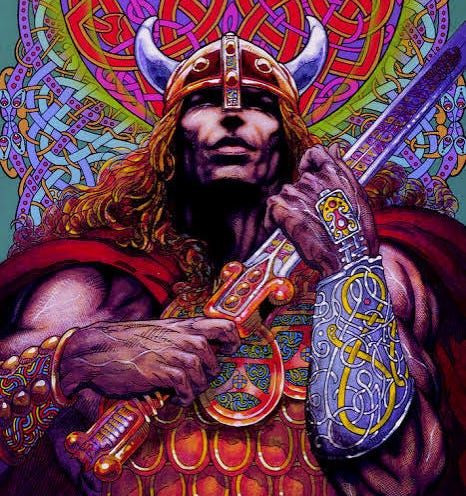
In 1929, an archaeologist digging at the Temple of Nodens had some questions about the etymology of the god’s name, and asked Oxford to send a linguist. Oxford dispatched a young philology professor with an encyclopedic knowledge of European mythology, who spotted a connection that had evaded previous scholars: Nodens appeared to be the same figure as the Irish god-hero Nuada of the Silver Arm. Nuada was king of the Tuatha de Danaan, a race of immortals who sailed from the north on ships that were clouds and made war against the then-inhabitants of Ireland, the Fir Bolg. He fought bravely, wielding his all-powerful Sword of Light, but in the climax of the battle, the Fir Bolg champion cut off his right arm. This caused some temporary trouble (the laws of the time prevented a one-armed man from being king), but his people were skilled at magic and metalworking, so they made him a new arm of silver, hence his epithet. He ruled for some number of centuries, a golden age of crafting and wonder-working, until the Tuatha de Danaan were invaded in turn (this was a theme; our source for these stories is a medieval manuscript called The Book Of Invasions). The new invaders banished Nuada’s people to the hills and forests, where they became the sidhe aka fae aka fairies.
From there, the web of connections grew. It seemed like the Romano-British Nodens and the Irish Nuada were the same figure as the Welsh Nudd, whose name later morphed to Lludd, and who was sometimes called Lludd Llaw Eraint, Lludd of the Silver Hand. Lludd was also a mythical king; during his reign, the kingdom encountered three plagues: dwarves, dragons, and a giant. The Tale of Lludd and Llefelys tells how he and his brother came up with various clever schemes to defeat the plagues and save the kingdom. Lludd’s son Gwyd became king of the fairies, which makes no sense, since Lludd was just a normal guy. Probably this is the tangled web again; Nodens/Nudd/Lludd started as a deity, and later Christian sources euhemerized him in different ways. Some of them made him a king, others a fairy, others king of the fairies, and then some of them got the wires crossed and made him a normal guy whose son was king of the fairies for no reason.
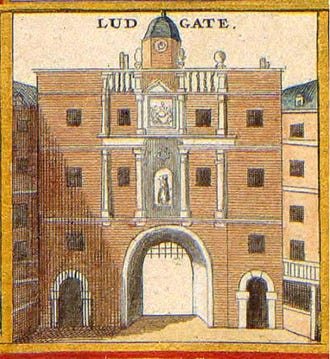
Speaking of tangled euhemerizations, in English legend Nodens/Nudd/Lludd is known as King Lud, after Geoffrey of Monmouth’s attempt to reconceptualize ancient Celtic deities as primeval kings of Britain. Geoffrey did this with approximately one zillion Celtic heroes, and Lud might have ended up a footnote among such unlikely characters as Gurguit Barbtruc and Rud Hud Hudibras, except for the random coincidence that his name happened to sound a bit like “London”. This was enough for Geoffrey, who made him the mythical founder of Britain’s capital. The Londoners accepted the link and raised a statue to him over the city gate.
It’s not surprising that a Romano-British deity worked his way into every great mythology in the British Isles. These are all Celtic or Celtic-influenced cultures, everyone knows they all descend from the same Indo-European stock anyway, probably there’s some Hindu god who looks a bit like Nodens if you squint. But this was just the start. Nodens worked his way into mythologies that shouldn’t even have been possible.
The popular view of Lovecraft says he portrays an indifferent cosmos, one where alien gods treat humans with the casual cruelty of a bulldozer running over ants. As usual, the popular view is mostly right. But a few of his stories break this mold and hint that the indifferent gods are opposed by an alternate collection of slightly-less-indifferent gods, and the leader of this benevolent pantheon is Nodens. No sound changes, no strained resemblances, just obviously the same guy. How did this minor Celtic river-god earn a place alongside Cthulhu and Nyarlathotep? Welsh horror writer Arthur Machen grew up in the shadow of Nodens’ ruined temple, and found something about it so eerie that he gave Nodens a cameo in his book “The Great God Pan”. Lovecraft was a big Machen fan, and lifted Nodens as a tribute to his predecessor.
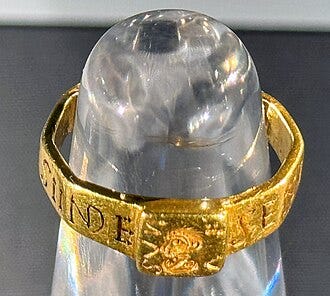
How serious was I when I said Nodens was in every great British mythology? Here we return to the Oxford philology professor who first linked Nodens to Nuada, a young man named J. R. R. Tolkien. During his research, he would have come across a tablet, one of a handful of inscriptions mentioning Nodens at all, in which a petitioner asked the god to curse the thief who had stolen his special ring. Did this influence Tolkien’s later work? There’s no hard evidence, but there is one clue suggesting that an older and more famous Tolkien still remembered this period of his life: in the Silmarillion, the godlike elven smith who forges the Rings of Power is named Celebrimbor, which is Sindarin for “Silver Hand”.
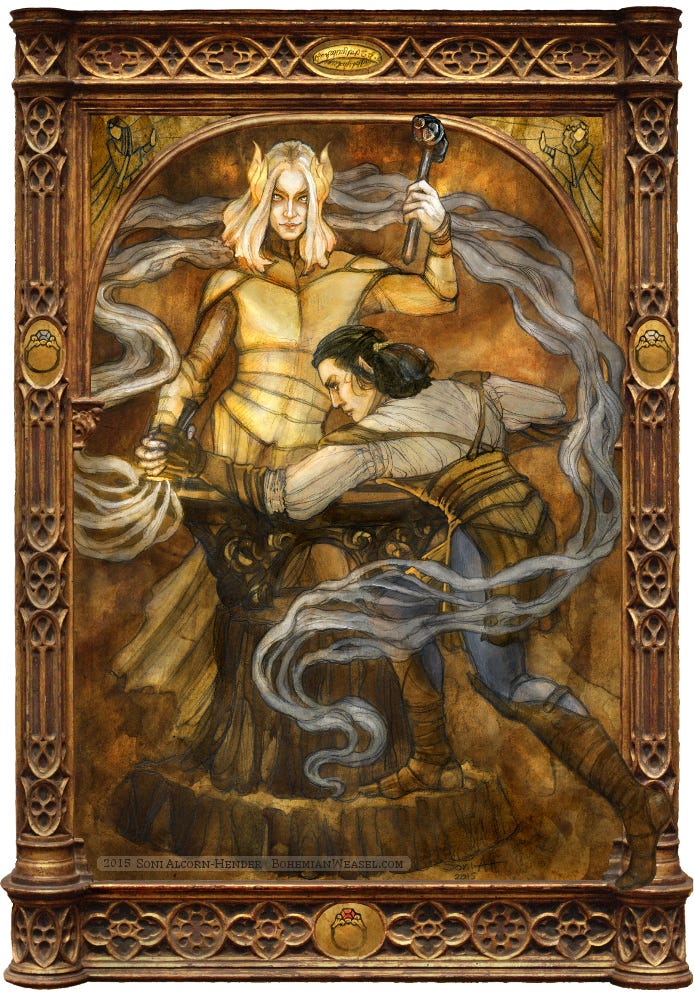
Celtic myths are notoriously weird; we never learn Nuada’s motivation for invading Ireland, and the stories of King Lludd pass over why there was a race of Arabian dwarves with super-hearing who could only be killed by powdered insect dust. Tolkien is a modern; try as he might to capture the ancients’ rhythm, his stories cannot help but make more sense. Celebrimbor, in particular, is a type well known to us: the techno-utopian visionary genius. When a mysterious stranger named Annatar fills in the last gap in his understanding of magic theory, he forges the Rings to bring prosperity and glory to Middle Earth. Unbeknownst to him, Annatar is a mask of the Dark Lord Sauron, who corrupts the Rings and uses them for his own purposes. Celebrimbor spends the rest of his life trying to undo the damage he wrought. He smuggles out three extra rings, free from Sauron’s corruption, and gives them to the paladins of Middle-Earth (by the Third Age, they are in the hands of Elrond, Gandalf, and Galadriel). Then he and his followers move against Sauron openly, which ends with Celebrimbor’s country annihilated and he himself tortured to death1.
From here, we can only begin to trace Nodens’ continued movement through the literary canon, a dozen or a hundred silver-armed characters with names sounding like Nud or Lud, various types of smith or hunter, who have introduced some dangerous techno-magical force into the world and are struggling to undo their mistake. In Star Wars, we get Luke Skywalker, a womp-rat hunter who, like Nuada, wields a Sword of Light, and, like Nuada, lost his right arm in battle and replaced it with a metal prosthetic. Luke didn’t personally unleash any danger upon the world, but his father helped create the evil Galactic Empire, and it is Luke’s quest to destroy it. Marvel Comics features Norrin Radd, a scientist who turned his body into silver while guiding the evil Galactus to new victims; he later regretted his actions and spent the rest of his life working to contain the menace he created (his weapon is the Twilight Sword). The Harry Potter series includes Peter Pettigrew, a magician with a silver hand who summons Voldemort back into the world, then hesitates to follow his evil orders, only to be strangled by his own cursed prosthetic. William Blake’s prophetic books speak of Los, a mythical founder of London (okay, fine, the “spiritual four-fold London”) and hammer-wielding smith in the model of Celebrimbor, who is the last holdout against the encroachments of Urizen, god of science and technology.
Far from vanishing in the fourth century, Nodens has snuck into every myth of the modern world. But why? He must be playing a long game, but what is it?
Blake, Lovecraft, and Tolkien - not to mention the original Celtic myths - all share a common theme: a deep ambivalence about technology which finally settles into determined opposition. "We live,” Nodens whispered to his chosen prophet, “on a placid island of ignorance in the midst of black seas of infinity, and it was not meant that we should voyage far. The sciences, each straining in its own direction, have hitherto harmed us little; but some day the piecing together of dissociated knowledge will open up such terrifying vistas of reality, and of our frightful position therein, that we shall either go mad from the revelation or flee from the deadly light into the peace and safety of a new dark age.“
The Tuatha de Danaan have always puzzled me. At the beginning of their story, they brim with power and knowledge, a race of smiths and wonder-workers. There is even a tinge of transhumanism; they have made themselves immortal, apparently through sheer skill, and when Nuada loses his hand, his craftsmen replace it with a working silver prosthetic. His Sword of Light is some kind of laser weapon; his cloud-ships bear a passing resemblance to zeppelins. But fast-forward a few centuries, and they have become the sidhe aka fae aka fairies, nature spirits mournfully representing the lost world of the virgin wilderness. Like Celebrimbor, they are frustrated techno-utopians, grown older and wiser after their powers were turned against them; whatever ambition they have left is directed at undoing the damage they have wrought.
Tolkien’s ultimate aim, studying the temple inscriptions, was to figure out the etymology of the theonym “Nodens”. After many digressions - cursed rings, silver hands, the founding of London - he speculated that it came from the root *noudont, meaning “Catcher”, a reference to Nodens’ supposed role as a hunting god. But nothing in Irish or Welsh or English mythology mentions Nodens/Nuada/Lludd/Lud hunting a single animal, or caring about the pastime in the slightest. So I propose a different meaning. To the King of the Fairies, human history is a projectile, shot straight into the void, gathering speed as it goes, until very soon it will be irrecoverable. All of his interventions into human history have been his attempts to catch it.
II.
I was thinking about all this when trying to figure out why a mob of thousands of people terrorized north Britain in the 1810s while shouting “King Ludd! King Ludd!” And why it took an army bigger than the one Wellington was leading against Napoleon to put them down. And why people regularly accuse me of being associated with them.
Everyone knows that the Luddites were inspired by a man named Ned Ludd. That they called him their “king”, their “general”, or their “captain”. That he was the Robin Hood to their Merry Men, the Osama to their al-Qaeda. But historians are quite certain that nobody by this name ever existed. He seems to have precipitated all at once out of the collective unconscious, an upwelling of mythic energy from everywhere and nowhere.
His story, as far as we can reconstruct it, is this. Once upon a time, in Nottingham, or Anstey, or maybe Leicester, there was a young man named Ned Ludd. One day, because some other young men were bullying him, or because his master beat him, or because his father told him to redo his work, he got angry and broke two knitting frames with a hammer. What became of him after this, we don’t know, except that he turned into the 19th century Leicester version of a meme. If a machine broke, people would say “Must have been Ned Ludd!” If someone expressed concern about technology, the answer would be “Take it up with Ned Ludd!” Badger badger badger badger Ned Ludd. Ned Ludd is over 9000. All your base is belong to Ned Ludd.
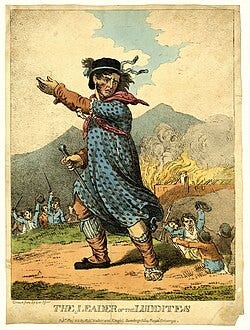
So when a decentralized anti-technology movement spontaneously coalesced out of the economic conditions of 19th century Nottingham2 , its members called themselves Luddites. When they settled on a common tactic - sending lists of demands to factory-owners - the lists were always signed “Ned Ludd”. When they marched into battle, their marching song was The Triumph Of General Ludd:
Those engines of mischief were sentenced to die
By unanimous vote of the trade
And Ludd who can all opposition defy
Was the grand executioner made […]
Let the haughty no longer the humble oppress
Then shall Ludd sheath his conquering sword
His grievances instantly meet with redress
Then peace shall be quickly restored
The Australian Aborigines, who have thought about their gods for longer than most, believe that they operate in the Dreaming, a sort of mythic other-dimension which is everywhere and nowhere, located in the distant past but also happening right now, in your mind but also fully real. Some god in the Dreaming gets hungry and catches a wallaby, and then every instance of wallaby-hunting forever more is somehow downstream of that in some unspecified way. Like Plato’s world of forms, except full of wide deserts and delicious animals. And, apparently, textile machinery. The only way I can interpret the Luddite Riots is that in the late 18th or early 19th century, some deity using the pseudonym “Ned Ludd” entered the Dreaming, found two knitting frames there, smashed them into pieces, and now every time someone opposes any technology in any respect, we can only think about it through the category of Ned Ludd and his hammer.
Who could do such a thing? My thesis is that Ned Ludd was Nodens / Lludd. The King Ludd of the Luddites and the King Lud who founded London were one and the same. The hammer which broke those two infernal machines is the same as the hammer of Celebrimbor which forged the Rings in Eregion and the hammer of Los that creates “every space larger than a red globule of a man’s blood”, and all three are incarnations of the Sword of Light brought from mighty Finias in 1897 BC.
We are all slaves to the Dreaming. We invent great works, panic, and desperately try to wrest them back under our control; for this, we get called Luddites. There’s no shame in this, any more than there is shame in being called a Christian. When a god dips his finger into the stream of the world, the consequences are too large for anyone to see. We build movements in the frothy wake, and some are good and others evil. Which is which depends entirely on our own virtue; the gods are too strange and distant to judge. Lovecraft claimed that Nodens was the only god who was less than wholly alien, but reality doesn’t grade on a curve.
Speaking of streams and frothy wakes, we recently learned something about fluid dynamics: it tends towards a singularity in finite time. Given its Millennial nature and the first four letters of its name, I can’t help but interpret Navier-Stokes prophetically. But we should be careful here. The Clay Institute lists four different Navier-Stokes subproblems. OpenAI only proved the third and fourth, sometimes called “forced Navier-Stokes”, which say that fluid dynamics produces singularities in finite time if an outside force puts its finger on the scale to make it happen.
Demigods and heroes make flashy miracles that stampede across the natural course of history, but true gods only intervene in ways that buttress humanity’s free will. The message Nodens has been desperately trying to send, through two millennia of bards and prophets, is that humanity can take its finger off the scale any time it wants.
I’ve never really understood what allegorical point Tolkien was making with the Three. Without them, it would be easy to interpret him as warning against the pursuit of powerful technology, which must inevitably be corrupted. But the Three Rings forged outside Sauron’s direct influence performed exactly according to spec, sustaining some of the few remaining sparks of beauty in the world (Lothlorien, Rivendell) and eventually saving Middle-Earth. So what’s the lesson? Pursuing powerful technology is good and helpful, as long as you don’t give the literal Devil a backdoor into your system? Big if true.
Ham = town; you have no idea how much restraint it’s taking me not to interpret Nottingham as “Nodens’ Town”.