

I.
Should safety-conscious employees at AI companies quit in protest, or stay and fight? The latest argument didn’t resolve the dispute, but it did get me in contact with organizers working on both sides.
Those planning to stay and fight are increasingly interested in labor unions. There’s already a group called the Coalition Of Concerned AI Staff, but it operates across companies and includes former employees, which is less effective for labor-organizing purposes than a traditional union linking the employees of a single company.
You may remember stories of bitter unionization battles at places like Starbucks, but AI workers are likely to route around that. The toughest labor disputes happen in fields where the employer could easily fire all the unionized workers and replace them from a bottomless pool of faceless scabs: although this is illegal, everyone needs to be maximally lawyered-up to prevent it. But there are so few skilled AI researchers that these laws are hardly necessary; if a dozen top AI researchers threaten to walk, it doesn’t matter whether Section P Sub-Section Q forces the AI company to negotiate - the AI company will want to negotiate. This cuts through the red tape that intimidates workers in less blessed fields1; AI researchers could likely get away with only the package of rights provided by informal “concerted activity”, defined as two or more workers doing anything vaguely labor-activism-shaped. Just put up a sign somewhere saying “OpenAI Safety Union” and get at least two employees to stand behind it, and it counts.
(even the word “union” is unnecessary; if employees felt like it was too adversarial, they could call it a “research council” or something)
Once a union existed, the law would ban the company from firing people simply for being part of it, or talking to other members, or planning demands or actions together. It also couldn’t fire workers for striking over workplace conditions2.
Does the “workplace conditions” requirement rule out most forms of safety activism? Not necessarily: many safety issues double as workplace issues, including whistleblower protections, auditing requirements, and safety team staffing. Most of all, fears of recursive self-improvement are naturally workplace-related: whatever else RSI does to the world, it will also automate AI researcher positions. This would be a popular starting issue that might attract even non-alignment-pilled colleagues.
But even if some safety issue has no workplace relevance at all, unions can still strike over it; they only lose their protection against being fired. And good AI researchers are worth tens of millions of dollars each and nearly irreplaceable, so AI companies are already averse to firing dozens of them at once. And any attempt to fire striking AI researchers would likely make national news and be a PR disaster. So the legal protection against being fired isn’t doing most of the work anyway, and AI unions could strike over issues without direct workplace relevance if they wanted3.
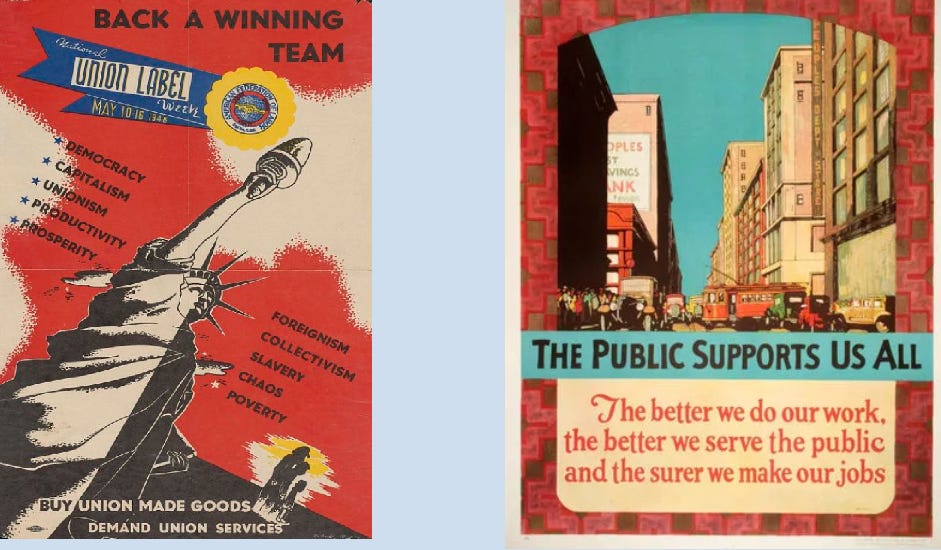
What if employees think their company already does a good job prioritizing safety? Then they should unionize in order to give their already-virtuous company more options. Negotiations between unions get less antitrust scrutiny than negotiations between companies, so workers can forge deals to slow research or prioritize safety even when executives’ hands are tied.
For example, suppose that OpenAI leadership orders its researchers to switch to a less-monitorable looped transformer design. A safety-conscious employee union might ask further questions, or mutually refuse to pursue this. If Sam Altman said that they had to build a looped transformer, or else Anthropic would build it first and beat them, the organizers could call up their friends at the Anthropic Employee Union and ask whether they would go on strike if Anthropic built a looped transformer. If the Anthropic Employee Union said yes, then the two unions could present a united front, and their companies wouldn’t have to worry about the other company racing ahead.45
Although on its own this has limited value - Meta or DeepSeek could still build the looped transformer - these union deals could also provide a standard that the industry could rally around, or a clear starting point for government intervention. In an extreme case, two unions could negotiate the beginnings of a pause deal, force it on their parent companies, and the government could take note and make it part of a future international deal.
What else could unions work for?
Upholding normal protections around discipline and firing. In October, OpenAI fired three safety researchers after accusing them of leaking information on the company’s experiments with potentially-dangerous looped transformers; these accusations now seem to be false, with the most likely scenario being that OpenAI was angry about the leak and fired some people in the vicinity of the problem to make a point. If OpenAI employees had a union, the company might have to be more careful about firing employees under false pretenses.
Holding companies to the commitments they made during September’s excitement around Pacing The Frontier, for example, demanding that they hire independent evaluators with employee-level access by such-and-such a time.
Demanding transparency, eg about compute allocation as described here, or about the information necessary to measure the speed of recursive self-improvement.
Acting as an independent voice holding companies to their commitments. This is another one that works even if (especially if?) employees already trust their company leadership. Currently, companies struggle to make credible promises because there’s nobody inside who can enforce them. A union that threatened to investigate or raise a fuss if a promise were broken could help executives be taken seriously.
If you’re interested, contact the people taking point on this, who I can vouch for as smart and trustworthy, at AIemployeeorganizing@gmail.com
II.
For people taking the other route - whistleblowing or quitting - my contacts recommend talking to Psst, a nonprofit that provides legal advice for concerned tech workers.
Whistleblowing is a fraught process. Your company has more experience catching and neutralizing whistleblowers than you have being one, and if you’re working on your own, then you will probably fail to cover your tracks (did you know companies look to see how many times different employees checked leaked documents, on the grounds that someone who’s agonizing about whether to whistleblow about them probably reads them more often than most?) Another classic mistake is to complain about something internally, then whistleblow after your complaints are not taken seriously; it’s not hard for companies to connect the dots and realize that the complainer and the whistleblower are probably the same person. Psst has more experience with this than you or your company, and can walk you through the process.
Even if you’re thinking of quitting, Psst may be able to help. You may have more options than you thought, like threatening to quit unless you get the thing you want. And if you do decide to quit, you may want to do it in the most effective way possible - make a splash on your way out, like Jacob Coxon did. This requires some basic media literacy, and Psst will connect you with the people who can give it to you.
Contact Psst by messaging @PsstLegal.01 on Signal on a personal device without any employer spyware. The person on the other end will be a lawyer, and your conversation with them will be confidential.
Whatever AI employees do, they should do it soon. RSI could start making them obsolete as soon as next year, so they may never have this amount of leverage again.
To become an official majority union, a union must win the support of a majority of workers in a secret ballot. This gives them a few extra rights like forcing companies to bargain with them (the companies don’t have to agree to any bargain, but can get in trouble for bargaining in bad faith if they’re pointlessly recalcitrant), but also restricts the union’s ability to legally advocate for non-workplace-related causes. A union can also get some of these rights by having an employer voluntarily recognize them. We don’t expect that AI company unions will go down either of these paths.
Companies do have the option of replacing striking workers during a strike, then firing them after the strike because their jobs are already filled. But frontier AI researchers are hard to replace en masse, so they may not need to worry about this.
If AI destroyed the world, wouldn’t that negatively impact working conditions at AI companies? Legal theory only considers a generally destructive event detrimental to working conditions if it would damage the conditions more than it damaged everything else, so this argument probably wouldn’t hold.
This particular example may straddle the border of legality; the situation might change depending on how much it seemed like a nod-and-wink deal between Sam and Dario, and whether it was a purely political demand (as in this case) vs. had a plausible connection to working conditions. I would still be excited about borderline-legal examples, because court cases might last longer than my timeline to AGI anyway, the publicity would be pure positive, and any sanctions if it turned out illegal would likely be weak.
Legally recognized unions get more antitrust exemptions and bargaining rights, and potentially could bring both Anthropic and OpenAI to the table and hammer something out, but they are under closer scrutiny to ensure that they focus on workplace conditions rather than issues of general interest.