

I.
“Telescopic altruism” is a supposed tendency for some people to ignore those close to them in favor of those further away. Like its cousin “virtue signaling”, it usually gets used to own the libs. Some lib cares about people in Gaza - why? Shouldn’t she be thinking about her friends and neighbors instead? The only possible explanation is that she’s an evil person who hates everyone around her, but manages to feel superior to decent people by pretending to “care” about foreigners who she’ll never meet.
This collapses upon five seconds’ thought. Okay, so the lib is angry about the Israeli military killing 50,000 people in Gaza. Do you think she would be angry if the Israeli military killed 50,000 of her neighbors? Probably yes? Then what’s the problem?
“But vegetarians care about animals more than humans!” Okay, yeah, they sure do get mad about a billion pigs kept for their entire lives in cages too small to turn around in, then murdered and eaten. Do you think they’d care if a billion of their closest friends were kept for their entire lives in cages too small to turn around in, then murdered and eaten? I dunno, seems bad.
Maybe there is some possible comparison where some altruist cares about some set of foreigners more than a comparable set of countrymen? The war in Gaza killed 50,000 people, but the opioid crisis kills a bit over 50,000 Americans per year - is everyone who cares about Gaza exactly equally concerned about the opioid crisis? No, but there’s a better explanation - people care about dramatic deaths in big explosions more than boring health crises, regardless of where they happen. Everyone, lib and con alike, cared more about 9-11 than about a hundred opioid crises, even though the former only killed 4% as many people as the latter. And even the people who care about the opioid crisis usually can’t bring themselves to care about anything on the List Of Top US Causes Of Death, which are all extra-boring things like diabetes. Once you match like to like, nope, it’s pretty hard to find a “telescopic altruism” example that stands out from the general background of people having weird priorities.
Nearly everyone cares about people close to them more than people far away. If there’s a lib who would attend a Gaza protest instead of getting their deathly-ill kid emergency medical care, I haven’t met them - and the “telescopic altruism” crowd certainly hasn’t provided evidence of their existence. Instead, the people who care about their neighbors 1,000,000x times more than Gazans point to the people who ‘only’ care about their neighbors 1,000x times more than Gazans and say “Look! Those guys care about Gazans more than their neighbors! Get ‘em!” in order to avoid any debate about whether a million or a thousand or whatever is the right multiplier.
II.
At this point, usually the telescopic altruism people bring up That One Study.
They have not, in general, read That One Study. But they have seen a graphic from it.
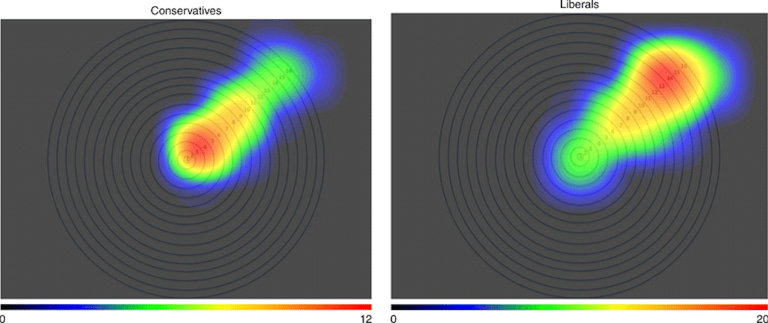
The inner circles of this graphic represent people close to the respondent - for example, circle 1 is immediate family, circle 4 is friends, circle 7 is countrymen. After that, they get further and weirder: 9 is everyone in the world, 11 is all higher life, 12 includes “paramecia and amoebae”, 15 includes rocks.
The “telescopic altruism” people read the study as saying that conservatives properly care about their family first and so on, whereas the liberals care more about rocks and amoebae than their own families. Big if true.
It isn’t. The heatmap was just a poorly-designed attempt to represent the limit of concern. If the liberal map is “hottest” at animals, that means liberals say animals are worthy of at least some care. If a conservative’s map is “hottest” at friends, that means the conservative only cares about their friends (and doesn’t care at all about countrymen, foreigners, or animals).
When the paper actually looks at who cares more about their friends and family, liberals win very slightly on friends and conservatives very slightly on family, but not in a way that matters - it’s mostly just a grab bag of tiny irrelevant effects.
Conservatives can take heart in a different study in the paper, which gives people a limited supply of 100 “moral units” to distribute. If you distribute any moral units at all to foreigners, then you necessarily have fewer for your own countrymen. But this proves too much. If you distribute moral units to your cousin, you have fewer for your own child - does this make you a “telescopic altruist” who hates everyone close to him? Is this even wronging your child in any way? The average decent person is able to be decent to both their child and their cousin; anyone who freaks out about someone who is nice to their cousin, because “how can they take that niceness away from their own child?” doesn’t understand niceness. If you design an experiment where every moral unit you give someone must be taken from someone else, then people who care about their cousin will necessarily be robbing their child - but this is an artifact of the study design, not a condemnation of cousin-likers.
III.
Dave Barry has a saying - "A person who is nice to you, but rude to the waiter, is not a nice person."
This is the opposite of the “telescopic altruism” hypothesis. A telescopic altruism believer would insist that being nice to a waiter is a red flag - “he’s just signaling niceness to people of other social classes because he’s incapable of loving people of his own class - I bet he’s a jerk to his family!”
You could call Barry’s alternative position correlated altruism. People who are nice to a far-off group are more likely to be nice to a nearby group, because all forms of compassion come from the same place.
When I look out in the world, I see more evidence for the correlated altruism hypothesis than the telescopic one.
Telescopic liberal altruists are always asking demanding that the government send food to people starving in Ethiopia. But would they support government programs to help Americans starving near their own home? Yes - most Democrats support programs like free school lunches (used as a way to ensure poor kids get at least one good meal a day), and most Republicans oppose them. This is probably just downstream around general beliefs in government intervention, but at least these beliefs are consistent.
Telescopic liberal altruists are always asking you to donate bednets and medications to fight pandemics in Africa. But would they care about a pandemic that affected ordinary Americans? Yes - the COVID pandemic was only five years ago, and most Democrats supported stronger anti-pandemic measures than most Republicans.
Maybe this is still too telescopic - helping poor sick Americans was just another part of their plot to avoid helping their families and friends? I don’t really know what metric you would use to determine who is a better friend or family member, but here are some vaguely related statistics:
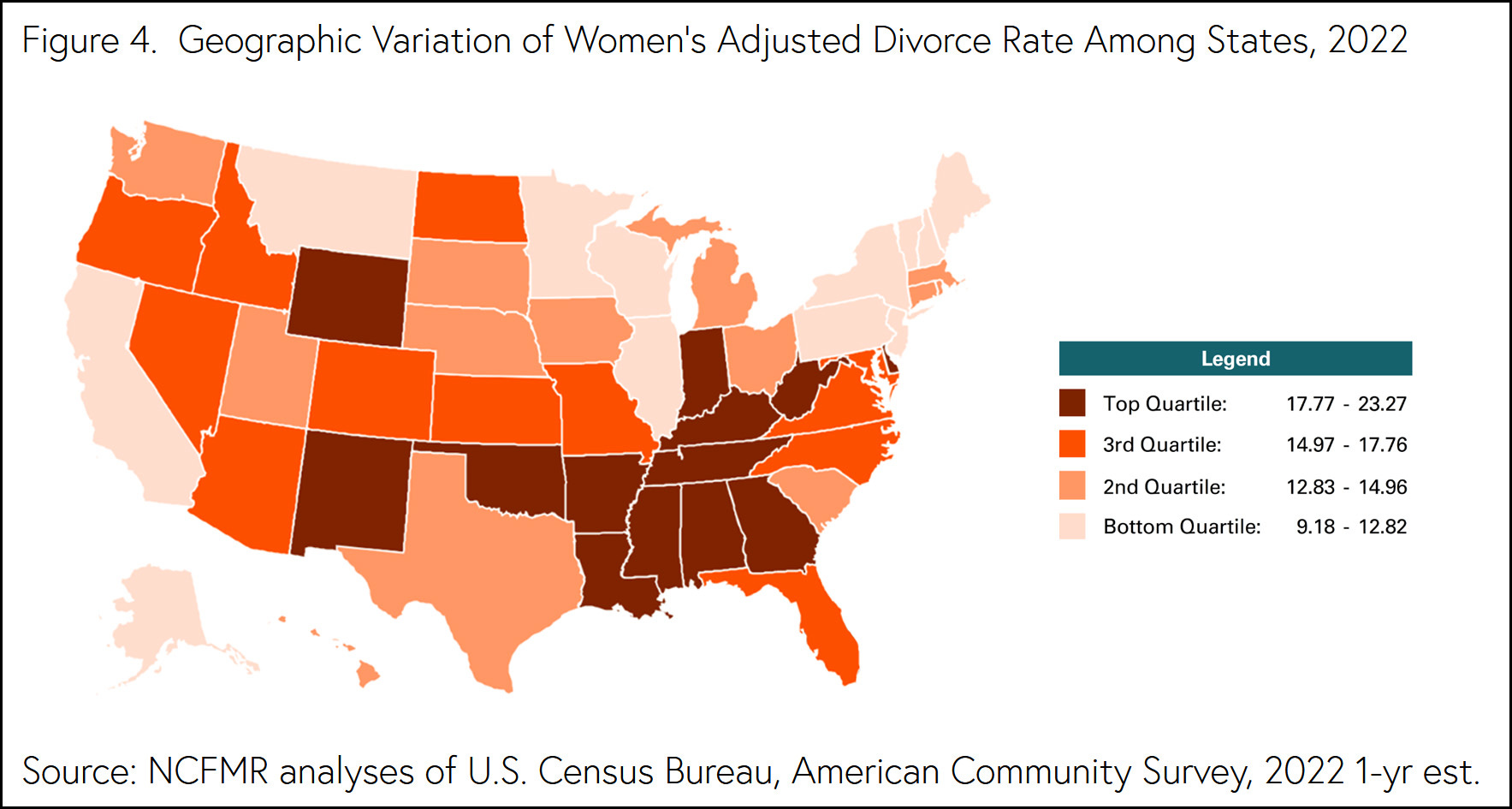
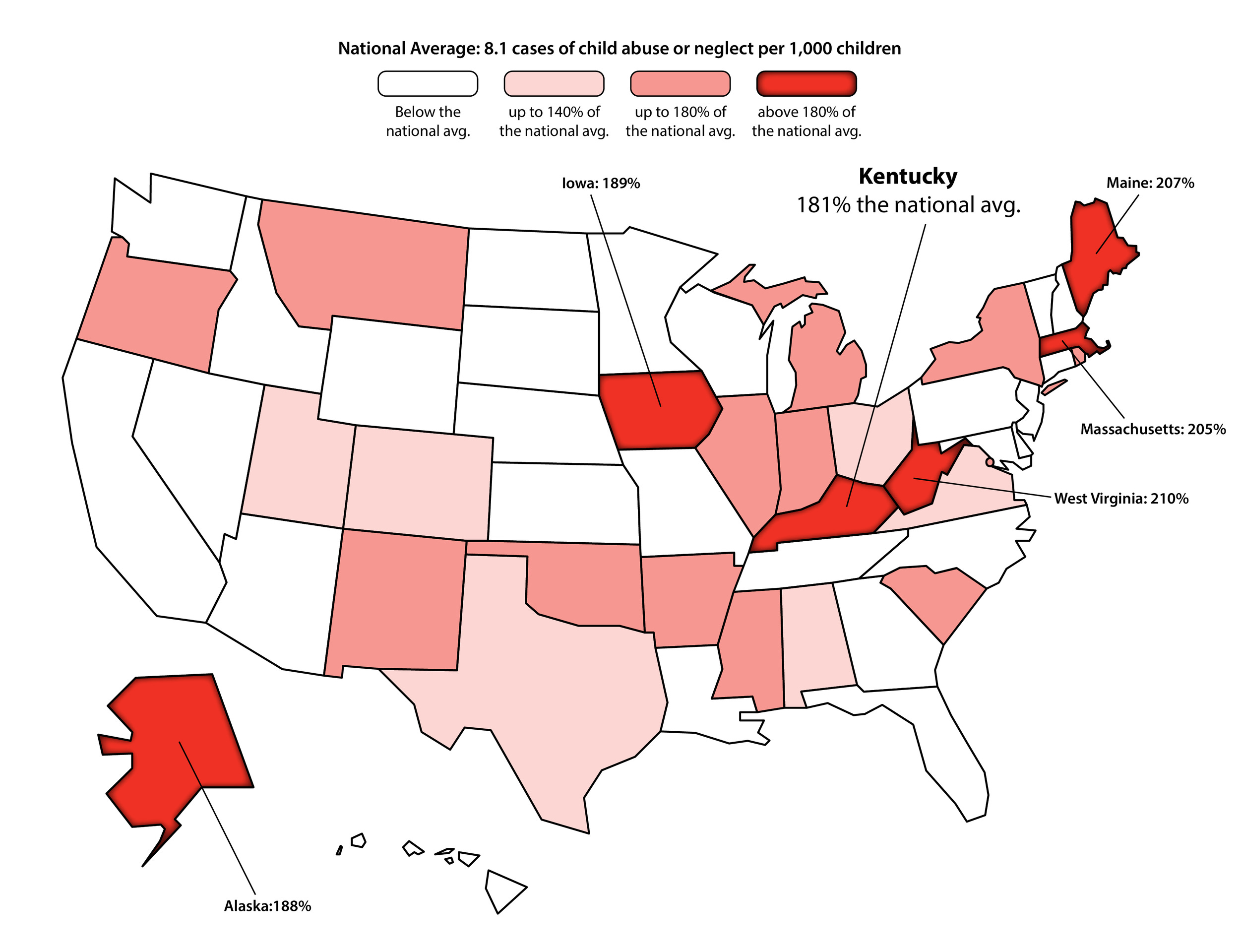
I don’t really think liberals are better spouses/parents in the way a naive reading of these maps might suggest - but there’s certainly no sign that they’re worse (except in Massachusetts - I blame the Kennedys!)
I will grant this to the telescopic altruism believers - I know many people who spend endless time and energy telling everyone else exactly how to behave, while their own lives and communities are total messes. I think greater familiarity with this pattern will find that they’re not total messes because these people fail to care about their own communities. They’re total messes because these people care way too much about their own communities, and are so messed up and bad at everything that every action they take in their own community makes it actively worse. This isn’t better. But it is, at least, different.